
A small button update, rolled out without warning, is wrecking sales for merchants across the UK and beyond. We spoke to Jacob, one of the first to sound the alarm, about what happened and what it means for Shopify’s relationship with its merchants.
On the morning of May 27, merchants across Shopify’s platform woke up to something alarming: their conversion rates had cratered overnight with no warning. Just a new checkout screen their customers had never seen before, asking them to choose between two unfamiliar buttons before completing a purchase.
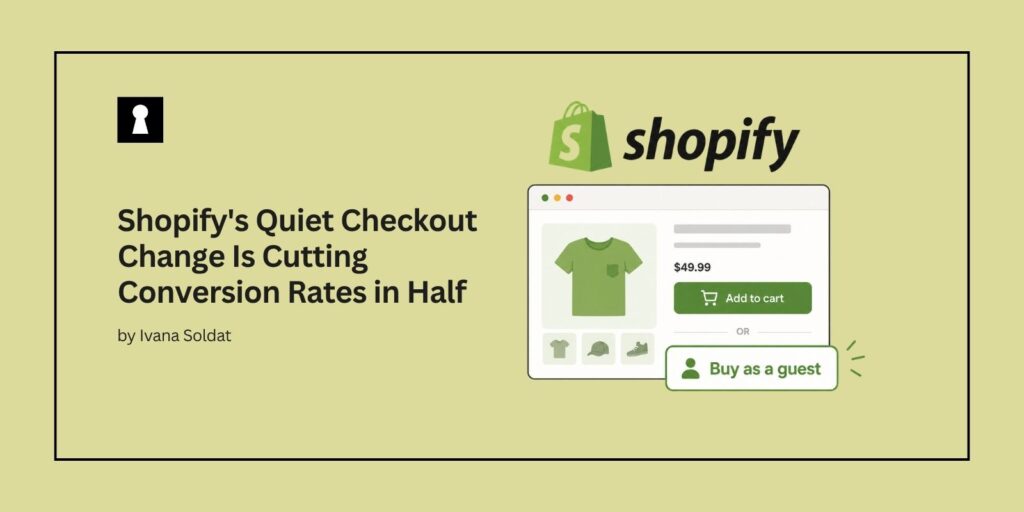
The culprit was a quiet design update to Shopify’s checkout flow. Where shoppers previously saw a single, clean path to payment, they now faced a choice: a large green “Pay as guest” button, or a smaller option to “Pay and save my info,” which creates a Shop account. The friction it introduced was immediate and brutal for many stores.
50% CVR drop reported
by some merchants
2× Checkout dropoff
rate in affected stores
0 Days advance notice
given to merchants
Jacob, an ecommerce merchant whose X post on the issue quickly went viral among the Shopify community, was among the first to investigate. We reached out to him for his take on what happened, why it hit so hard, and what it signals about where Shopify’s priorities really lie.
Meet the Merchant
Jacob · Shopify merchant · UK-based store
X: @jforjacob
First, Tell Us What Happened
When did you first notice something was wrong?
“I first noticed the change yesterday, but that was only because I had seen declining CVRs in the previous days, so I investigated what was going on. I saw that it was specifically drop off at checkout that was the issue, and the UK being mostly affected, which prompted me to look at my checkout using a UK VPN. That’s when I saw it.”
That methodical approach, spotting the signal in the data before seeing the problem directly, is telling. The change was gradual enough that many merchants didn’t catch it immediately. By the time Jacob did, his UK store had already taken a significant hit.
How bad did it actually get?
“My CVR in the UK halved.”
Why the Design Creates Real Friction
A 50% conversion rate drop sounds dramatic, but the psychology behind it is straightforward. Presenting shoppers with a decision they weren’t expecting, at the most critical moment in their journey, is a classic source of checkout abandonment.
Research from the Baymard Institute has consistently shown that forced account creation causes roughly 1 in 5 shoppers to abandon their carts. Shopify’s new design stops just short of forcing it, but the choice itself is the problem.
Do you think the design creates genuine confusion for customers?
“Yes, it definitely creates customer confusion. Instead of just a simple ‘pay now’ button they have to stop and figure out the difference between checkout as guest or to have their details saved. I have a largely older demographic of customers, 65 and above, so they are more easily confused, which is why I think I was one of the worst affected.”
“It was forced on merchants for the sole purpose of getting more customers’ details on their Shop app, at the expense of their merchants.”
The demographic point matters. Shopify’s checkout change may perform differently across store types, and a design optimised for a younger, tech-comfortable audience can be genuinely disruptive for merchants serving customers who expect simplicity above all else.
Can Merchants Fix It Themselves?
The short answer, as Jacob found out, is no. Shopify’s checkout is notoriously locked down for merchants on standard plans, with meaningful customisation reserved for those on Shopify Plus. That limitation bit hard here.
Did you try to undo or work around the change?
“We tried everything to change it, from looking at all settings within Shopify, changing the default theme content, re-coding the checkout, but it was not possible to change it back yourself.”
Other merchants in the thread began sharing workarounds: switching to custom themes, migrating to third-party checkout tools like Adyen or CheckoutChamp, or considering a move away from Shopify Payments entirely. These are not small decisions. Shopify charges additional transaction fees for merchants using third-party payment gateways, so the “fix” comes with a financial cost of its own.
The Silence from Shopify
Perhaps more aggravating than the change itself is how it was handled. Shopify did not announce the update through its standard merchant communications, did not post it to its changelog, and did not offer merchants the ability to opt out. As of the time of writing, the company has not issued a public statement on the rollout.
What frustrates you most about how this was rolled out?
“The thing that frustrates me the most is that Shopify did not communicate this in any way to their merchants or give them the option to opt out. It was forced on merchants for the sole purpose of getting more customer details on their Shop app, at the expense of their merchants.”
The Shop app is Shopify’s consumer-facing product, a shopping and order-tracking app that competes with the likes of Amazon’s app for wallet share and repeat purchase behaviour. Growing its user base requires collecting shopper accounts, and the new checkout design is an efficient mechanism for doing exactly that. The question is who bears the cost.
What This Means for Merchant Trust
Does this change how you think about Shopify long-term?
“Yes, I think it affects long-term trust, as this shows that Shopify are prioritising their own Shop ecosystem over the health of their merchants’ stores.”
If you could say one thing directly to Shopify, what would it be?
“They need to have better communication with their merchants and not just roll out changes, especially at checkout, without first telling people or giving them the option to opt out. We understand there is compliance criteria at checkout and that’s why they limit customisation there, but this was nothing to do with Shopify’s checkout staying compliant. It was a purely selfish move from Shopify.”
Several other merchants echoed the same frustration across X, with some already moving toward third-party processors and checkout tools. The conversation also connected to a broader tension: Shopify’s increasing push to expand its own ecosystem products, from Shop Pay to the Shop app, sometimes puts it in direct competition with the interests of the very merchants it hosts.
Our Take
Platforms Don’t Get to Be Landlords and Developers at the Same Time
What happened here is not really about a button. It’s about the fundamental tension that exists when a platform simultaneously hosts businesses and competes with them for customer data and loyalty.
Shopify has every commercial reason to grow the Shop ecosystem. More accounts mean more data, more repeat purchase opportunities, and a stronger argument for advertisers and investors. But the way this was executed, silently, irreversibly, and at the direct expense of merchant conversions, is a reminder that merchants are ultimately tenants on someone else’s platform.
The least Shopify could do is communicate changes like this in advance and give merchants a genuine opt-out. That’s not a big ask. It’s basic respect for the people whose businesses fund the platform. The silence since the backlash began is not a great sign.