
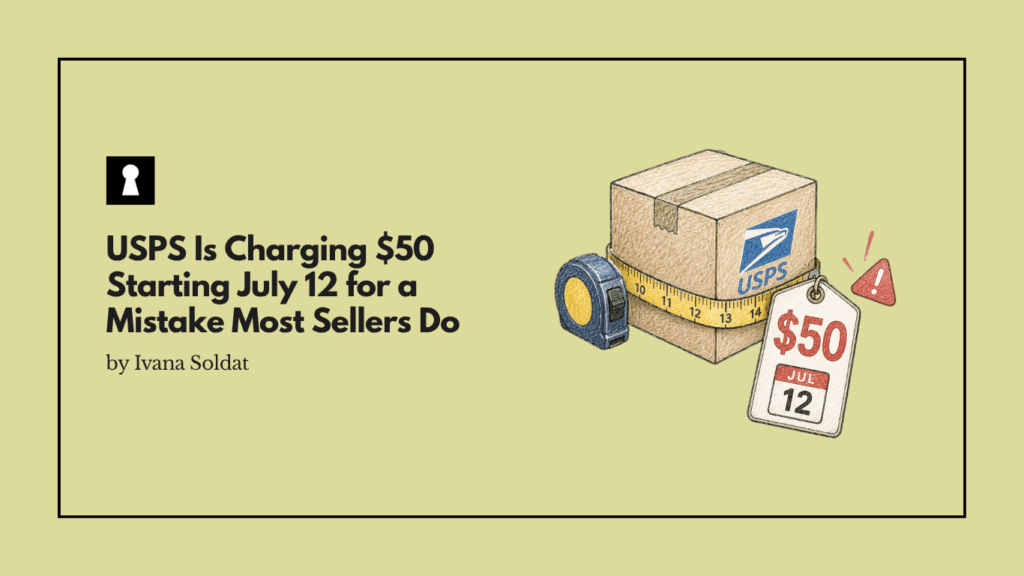
Most sellers who ship nail polish do not think of themselves as shipping hazardous materials. They think of themselves as shipping nail polish. The distinction matters starting July 12, when USPS begins enforcing a $50 noncompliance fee for packages containing hazardous materials that have not been properly declared and labeled.
The list of what the Department of Transportation classifies as hazardous for shipping purposes is longer than most sellers expect. Essential oils. Nail polish and nail polish remover. Perfumes and colognes. Hand sanitizer. Inks, stains, and varnishes. Hairspray. And any electronics containing a lithium battery, which in 2026 means phones, tablets, laptops, wireless earbuds, portable chargers, e-readers, and a significant portion of the toys and gadgets category.
None of these products are exotic. All of them are common in ecommerce. Many of the sellers shipping them have been doing so without incident for years, under a system where noncompliance was flagged inconsistently and rarely resulted in a meaningful penalty. That changes next week.
The Two New Fees
Starting July 12, USPS will apply two separate charges to packages containing hazardous materials.
The first is a $7.50 hazmat handling fee, applied to any package that has been properly declared and labeled as containing a hazmat item. This is the cost of compliance: declare your hazardous goods correctly, follow the labeling requirements, and pay $7.50 per package for USPS to handle it accordingly.
The second is a $50 noncompliance fee, applied to any package containing a hazmat item that has not been properly declared or labeled. This is the cost of not knowing, or not checking, or assuming that what you have always done will continue to work. On a package of nail polish worth $18, a $50 noncompliance fee does not just eliminate the margin on that order. It creates a net loss per shipment that compounds quickly across any seller doing meaningful volume in affected categories.
Pitney Bowes called it “the $50 mistake you don’t want to make.” That framing is accurate but slightly generous. The more precise description: the $50 mistake a significant number of sellers are going to make in the first few weeks of July because they had no idea their product was on the list.
The Hidden Rate Increase That Is Not Being Called a Rate Increase
The hazmat fee is the most visible change hitting on July 12, but it is not the only one. USPS is also lowering the dimensional weight divisor from 166 to 139 across all domestic competitive products.
Dimensional weight is how carriers charge for packages that are large but light. The formula is length times width times height, divided by the divisor. Whichever is greater, the actual weight or the dimensional weight, determines what you pay. Lowering the divisor from 166 to 139 means the dimensional weight calculation produces a higher number for the same sized package, which means more packages cross the threshold where dimensional weight exceeds actual weight, which means more sellers pay more for the same box.
To put that in concrete terms: a package measuring 12 inches by 10 inches by 8 inches has a volume of 960 cubic inches. Under the old divisor of 166, the dimensional weight is 5.78 pounds. Under the new divisor of 139, the dimensional weight is 6.91 pounds. A seller shipping a light product in that box who was previously paying for a 4-pound package is now paying for a 6.91-pound package. Nothing about their product or packaging changed. The math changed, and the math is what determines the bill.
USPS is also eliminating ounce-based rate differentiation for published commercial Ground Advantage prices, replacing finely graduated pricing with a broader tier structure. Sellers who engineered their packaging specifically to hit favorable ounce thresholds will need to revisit whether that optimization still makes sense.
October Is Coming
One more date worth putting in the calendar: USPS has another rate increase scheduled for October, arriving just ahead of the holiday shopping season. For sellers planning holiday shipping costs now, the July 12 changes are not the full picture.
The Sellers Most Exposed
The combination of changes hitting July 12 hits hardest for specific seller profiles. Small independent sellers on Etsy, eBay, or Shopify who ship beauty, wellness, or lifestyle products using USPS Ground Advantage as their primary carrier are the most exposed to the noncompliance fee, because they are the least likely to have a compliance process in place and the most likely to be shipping products on the list without realizing it.
High-volume sellers in electronics accessories, especially anything involving lithium batteries, face both the hazmat compliance requirement and the dim-weight divisor change, which could meaningfully shift per-unit shipping cost depending on current packaging.
And any seller who has not looked at their USPS rate card since earlier this year is working from numbers that no longer apply.
Our Take
USPS Changed the Math, the Labels, and the Fee Structure. Most Sellers Are Still Using Last Month’s Numbers.
The $50 noncompliance fee is the kind of change that generates a wave of unhappy seller posts in mid-to-late July when the first invoices arrive, followed by a wave of “I had no idea nail polish was a hazmat” realizations. USPS is not wrong to enforce hazmat labeling requirements.
These rules exist for real safety reasons, and the carrier has a genuine interest in knowing what is in its network. But the combination of a fee this size, applied to products this common, with this little advance notice reaching the sellers most affected, is a setup for a lot of expensive surprises.
If you sell anything from the list above and ship via USPS, the time to check your compliance status and update your labeling workflow is before July 12, not after.