
There is a pattern in how large economies regulate their biggest tech companies that is worth understanding before reading China’s latest ecommerce law amendments. The pattern goes like this: domestic regulators apply pressure to platform companies when those companies get too big, too extractive, or too politically inconvenient.
At the same time, those same regulators resist foreign governments doing the same thing, because a Chinese company being fined by the EU or a Chinese platform being tariffed by Washington is a different category of problem than a Chinese company being fined by Beijing. One is discipline. The other is an attack.
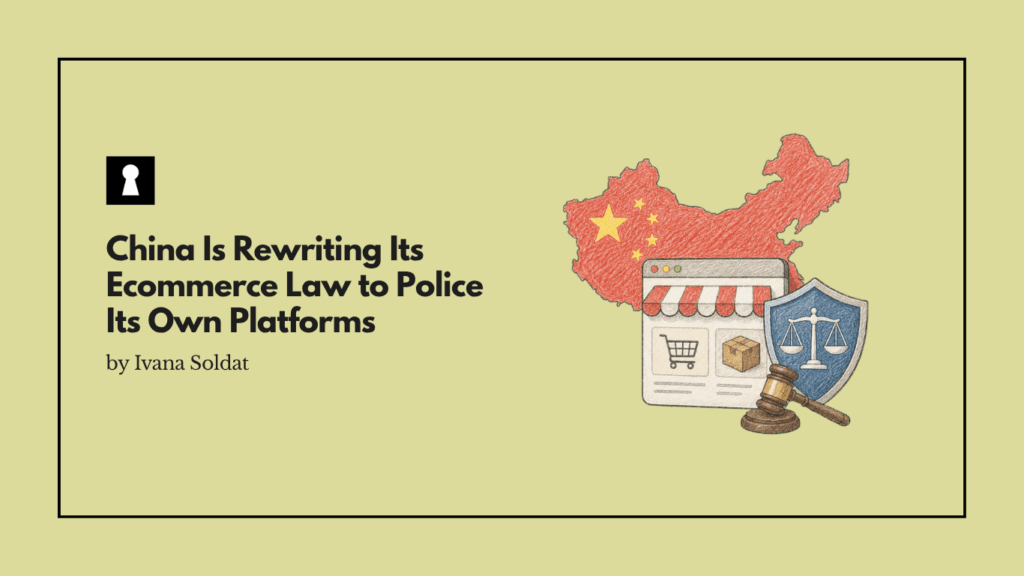
China’s draft amendments to its ecommerce law, released on Saturday and open for public consultation until August 4, are a fairly clean expression of that pattern. Twenty new provisions. Jointly issued by the State Administration for Market Regulation and the Ministry of Commerce. Broader domestic oversight on one side. Legal countermeasures against foreign regulatory action on the other.
What Is Actually Changing Domestically
The original ecommerce law took effect in January 2019 and focused primarily on platform operators and the merchants selling through them. The draft amendments extend regulatory oversight to what Beijing now calls the “platform economy,” a deliberately broad category that now includes AI-powered shopping agents, logistics providers, payment processors, and the data infrastructure connecting them. In practical terms, this means the law’s reach grows from covering Taobao and JD.com to potentially covering the entire digital supply chain those platforms sit on top of.
The amendments also add new regulatory enforcement tools. Currently, regulators can issue fixed fines or suspend business operations. The draft calls for “routine oversight” mechanisms and better coordination between government departments, including consistent enforcement across online and offline operations. This matters because China’s current enforcement tends to be episodic and high-profile rather than systematic.
The 3.6 billion yuan ($528 million / €463 million) fine issued in April against Alibaba, JD.com, PDD Holdings, Meituan, and ByteDance’s Douyin for failing to block unqualified food delivery merchants was an example of the episodic model. The new amendments would give regulators a formal legal basis for the kind of ongoing platform monitoring the EU has been running under its Digital Services Act for two years.
The domestic context is Beijing’s 15th Five-Year Plan, which specifically calls for stronger oversight of platform companies’ data, algorithms, traffic rules, and operating practices. The amendments are also part of China’s “anti-involution” campaign, the government’s term for the self-destructive price wars between Alibaba, JD.com, Pinduoduo, and Meituan that have been eroding margins without producing the kind of innovation Beijing considers strategically useful. Earlier this year, a dozen internet companies were summoned by regulators over aggressive pricing competition. The new law would give those informal summons a formal legal foundation.
The Countermeasures Clause
The more novel and geopolitically interesting part of the amendments is a set of provisions covering international cooperation and what the draft explicitly calls “countermeasures” to protect the “lawful rights and interests” of Chinese enterprises operating abroad.
The targets of those countermeasures are not named in the draft, but they are not hard to identify. The EU fined Temu €200 million under the Digital Services Act for selling unsafe products to European consumers. On July 1, the EU abolished the €150 de minimis exemption that had allowed Temu, Shein, and AliExpress to ship low-value goods duty-free into Europe.
In the United States, the Trump administration ended the $800 de minimis exemption for Chinese imports in May 2025, imposing a 54% tariff or a $100 flat fee per package on goods that previously entered duty-free. Temu has reportedly lost more than half of its daily US users since that policy took effect.
China has been building toward a formal legal response to this pressure for some time. A revised Foreign Trade Law took effect in March with expanded provisions for trade countermeasures and national security. The ecommerce law amendments extend that logic specifically to the digital commerce context, formalizing Beijing’s ability to take retaliatory or protective action when Chinese platforms face what the government considers discriminatory regulatory treatment abroad.
The draft also includes language about “compatibility” between Chinese and international ecommerce standards, diplomatic language for something more ambitious: Beijing wants Chinese regulatory frameworks to shape global norms rather than simply comply with them.
The Tension the Draft Does Not Resolve
The central contradiction in the amendments is one Beijing has not fully worked out and may not be able to. Domestically, the law seeks to rein in platforms that have grown too powerful and resistant to state oversight. Internationally, it seeks to protect those same platforms from foreign governments applying similar logic. China wants the right to discipline its own platforms. It does not want the US or EU to have equivalent rights.
This is not a new tension in Chinese regulatory philosophy, but it is sharpening as Chinese platforms become genuinely global businesses operating across multiple jurisdictions simultaneously. Temu and Shein are not just Chinese companies anymore. They have hundreds of millions of customers in the US, Europe, and Southeast Asia, which means the regulatory decisions of those markets now affect Chinese platforms in ways that matter at the highest levels of government.
The public consultation period runs until August 4. The final version of the amendments could look substantially different, and there is no guaranteed implementation timeline after consultation closes.
Our Take
China Wants to Regulate Its Platforms. It Just Does Not Want Anyone Else To.
The draft ecommerce law amendments are a useful document for understanding how Beijing thinks about the current moment in global digital commerce. The domestic provisions signal that China’s platform crackdown, which appeared to ease after its aggressive 2021 phase, is being institutionalized rather than abandoned.
The international countermeasures signal that China views the EU’s DSA fines and the US de minimis changes not as legitimate consumer protection or trade policy, but as discriminatory action against Chinese companies that warrants a formal legal response. The interesting question for anyone watching global ecommerce regulation is whether the countermeasures clause will produce actual retaliation or whether it is primarily a signaling mechanism.
Given that China’s largest ecommerce platforms still depend heavily on Western markets for their growth projections, the answer probably involves more legal architecture and less actual escalation, at least until Beijing decides those markets are no longer worth protecting access to.