
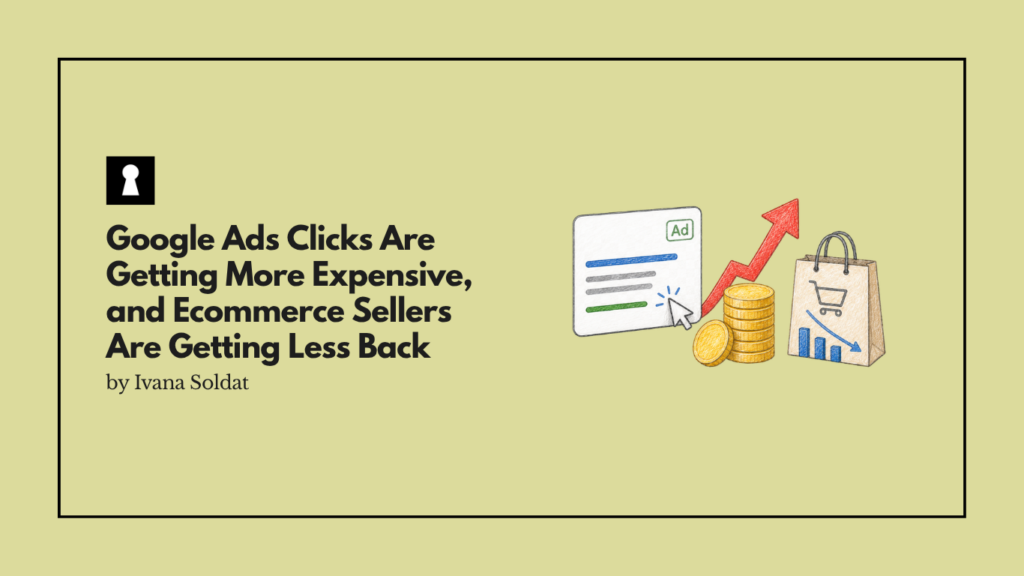
Google Ads is getting more expensive for ecommerce brands, and the extra cost is not coming with better results.
According to a new ecommerce Google Ads benchmark from Channable, cost-per-click across Google Ads increased by 15% between June 2025 and June 2026. The increase was measured across Google Shopping and Performance Max campaigns, based on 1.38 billion euros in verified ad spend from more than 10,000 European ecommerce advertisers.
The same benchmark found that return on ad spend fell sharply over the same period. Average ROAS declined by 43% on Standard Shopping campaigns and by 46% on Performance Max campaigns.
For ecommerce sellers, the message is clear. Buying traffic on Google is becoming more expensive, and many brands are getting less revenue back for every euro they spend.
That does not mean Google Ads has stopped working. It does mean the old approach of increasing budget, feeding the algorithm, and hoping the numbers improve is becoming harder to defend.
CPC Increased 15% in One Year
The benchmark found that Google Ads cost-per-click increased by 15% year over year across Shopping and Performance Max campaigns.
In absolute terms, Ecommerce News Europe reported that the increase equaled around 0.06 euros across all campaign types. That may sound small on a single click, but it becomes much more meaningful once applied across thousands or millions of clicks.
For ecommerce brands operating on tight margins, a higher CPC can quickly change campaign economics. A product that was profitable at last year’s click price may become much less attractive if conversion rates stay flat or decline.
That is the issue sellers are facing now. The problem is not only that clicks are more expensive. It is that the cost increase is happening while returns are weakening.
ROAS Fell Across Shopping and Performance Max
The more worrying part of the benchmark is the decline in return on ad spend.
According to the report, average ROAS fell by 43% on Standard Shopping campaigns and by 46% on Performance Max campaigns. Performance Max also saw lower conversion rates, with the benchmark pointing to a decrease of 0.11 percentage points.
This creates a difficult situation for ecommerce advertisers. Brands are paying more for traffic while seeing weaker returns from that traffic.
For sellers, this can show up in several ways: higher customer acquisition costs, lower campaign profitability, tighter margins, reduced scaling potential, and more pressure to discount products during peak sales periods.
It also makes campaign performance harder to read. A brand may see traffic volume holding up, but profitability can still deteriorate if click costs rise and conversion efficiency declines.
This is why ecommerce advertisers should not only look at spend and revenue. They need to look at contribution margin, product-level profitability, repeat purchase behavior, and whether paid acquisition is still making financial sense after fulfilment, returns, discounts, payment fees, and ad costs are included.
For wider coverage of paid channels and acquisition strategy, see our guide to ecommerce marketing channels.
Q4 is Becoming Even More Expensive
The benchmark also showed that advertising costs increased during the busiest shopping period of the year.
Across combined Google Ads channels, CPC was 9.1% higher in the fourth quarter of 2025 than in the first quarter. Total advertising spend was 47.9% higher in Q4 than in Q1.
That is not surprising, but it is still important. Q4 is when brands compete for Black Friday, Cyber Week, Christmas shopping, and end-of-year demand. More competition means more pressure on auctions, higher costs, and less room for weak campaign structures.
For ecommerce sellers, this means Q4 cannot be planned using average yearly performance. A campaign that looks acceptable in spring may become unprofitable during the holiday period if CPC rises and discounting increases at the same time.
This is especially risky for brands that enter peak season without clean product feeds, accurate margin data, clear budget controls, or a realistic view of how much they can afford to pay for a customer.
The Problem is Not Only Google
It is easy to look at rising CPCs and blame Google.
That would be too simple.
Google Ads is expensive because ecommerce competition is expensive. More brands are fighting for the same search intent, the same shopping placements, and the same consumers. At the same time, many brands are relying on the same platforms, the same campaign types, and the same automation tools.
Performance Max has made this more complicated. It gives advertisers access to broad inventory across Google’s ecosystem, but it can also make performance harder to understand. Brands may see blended results, limited visibility, and less control over where spend is going.
That does not make Performance Max useless. It does mean brands need better inputs.
If product data is messy, margins are unclear, feeds are poorly structured, and budgets are not separated by business priority, automation can scale the mess rather than fix it.
Google Ads is not a magic machine. It is a system that works better when the underlying ecommerce operation is clean.
Product Feeds are Becoming More Important
One of the clearest takeaways from the benchmark is that product data now matters more.
In ecommerce advertising, the product feed is not just an administrative file. It determines how products are understood, matched, surfaced, and promoted across campaigns.
If titles are weak, product attributes are incomplete, categories are inaccurate, images are inconsistent, or availability data is wrong, campaign performance can suffer before a customer even sees the product page.
This is especially important for Shopping and Performance Max campaigns, where Google relies heavily on product information to decide when and where ads should appear.
For sellers, feed optimization should not be treated as a one-time setup task. It should be part of the advertising process. Product titles, descriptions, pricing, stock status, images, GTINs, categories, and custom labels all affect how campaigns perform.
Custom labels can be particularly useful because they allow brands to group products by margin, seasonality, bestseller status, discount level, inventory position, or promotional priority. That helps advertisers avoid treating every product as if it deserves the same budget.
For ecommerce brands trying to improve organic and paid visibility together, our guide to ecommerce SEO mistakes also covers why product pages and structured content matter beyond ads.
Sellers Need to Stop Judging Campaigns By Revenue Alone
Rising CPC makes one thing more important: revenue is not enough.
A campaign can drive revenue and still lose money. That becomes more common when click costs increase, conversion rates fall, and brands rely on discounts to maintain volume.
Ecommerce sellers should be looking at profit by product, not only ROAS at account level. A blended ROAS number can hide serious problems. Some products may be profitable. Others may be absorbing budget while contributing little after costs.
This matters even more for brands with wide catalogs. If Performance Max is allowed to spend freely across products without margin-based controls, it may push products that convert well but do not make enough money to justify the spend.
That is why campaign structure matters. Brands need to separate products by margin, priority, inventory, seasonality, and business goal. A high-margin product with repeat-purchase potential should not be treated the same as a low-margin product that only sells when heavily discounted.
The more expensive clicks become, the less room there is for lazy campaign structure.
The Holiday Season Will Expose Weak Advertisers
The pressure is likely to become more visible during peak season.
When CPC rises during Q4, brands with weak campaign foundations are forced into a difficult position. They either spend more to maintain traffic, or they pull back and risk losing visibility during the most important sales period of the year.
Neither option is ideal if the economics are already weak.
This is why sellers should review their paid acquisition setup before Q4, not during it. By the time Black Friday arrives, auction pressure is already high and there is less room to fix broken feeds, unclear budgets, or poor product segmentation.
The brands that are better prepared will know which products they want to push, how much they can afford to spend, what margin they need to protect, and when it makes sense to reduce spend rather than chase revenue.
For ongoing coverage of ecommerce platform, marketplace, and advertising changes, see our Ecommerce News section.
What Ecommerce Sellers Should Do Now
The first step is to review Google Ads performance at product level.
Sellers should identify which products are profitable after ad spend, fulfilment, returns, discounts, payment fees, and product costs are included. They should also identify which products are consuming budget without producing meaningful profit.
The second step is to clean up product feeds. That means improving product titles, filling in missing attributes, checking categories, updating availability, improving image quality, and using custom labels to control bidding and budgeting more intelligently.
The third step is to separate campaign goals. Not every campaign should be judged the same way. Some campaigns may be focused on profitable sales, others on new customer acquisition, inventory clearance, or seasonal growth. Mixing all of those goals into one account-level ROAS target can make performance harder to understand.
The fourth step is to prepare for Q4 earlier. Higher seasonal CPCs are not a surprise. Sellers should build budgets around expected auction pressure rather than assuming that costs will remain stable.
Finally, brands should be honest about whether paid acquisition is covering for deeper problems. If conversion rates are falling, the problem may not only be advertising. It may be pricing, product-market fit, landing pages, shipping costs, returns, product availability, or competition.
Paid media often reveals these issues before the rest of the business wants to admit they exist.
Our Take
Expensive Clicks are Forcing Ecommerce Brands to Grow Up
The rise in Google Ads cost-per-click is not just a media buying problem. It is a business model problem.
For years, many ecommerce brands treated paid traffic as the easiest way to grow. If sales slowed, they increased spend. If they needed volume, they pushed campaigns harder. If the numbers looked good at the top level, nobody asked too many questions about product-level profitability.
That approach is becoming more dangerous.
When CPC rises and ROAS falls, weak economics become harder to hide. Brands can no longer rely on cheap clicks to cover poor margins, messy product feeds, weak retention, generic creative, or badly structured campaigns.
The uncomfortable truth is that a lot of ecommerce brands were only “good at marketing” when traffic was cheaper. Now that clicks cost more, the brands with stronger product data, clearer margins, better retention, and more disciplined campaign structures will have an advantage.
The controversial point is that rising CPC may actually be good for the market in the long run. It forces sellers to stop treating paid ads like a growth shortcut and start treating them like a financial decision.
That will hurt brands that built their growth on loose spending and blended ROAS screenshots.
But for operators who know their numbers, it creates a clearer divide between real performance and expensive noise.