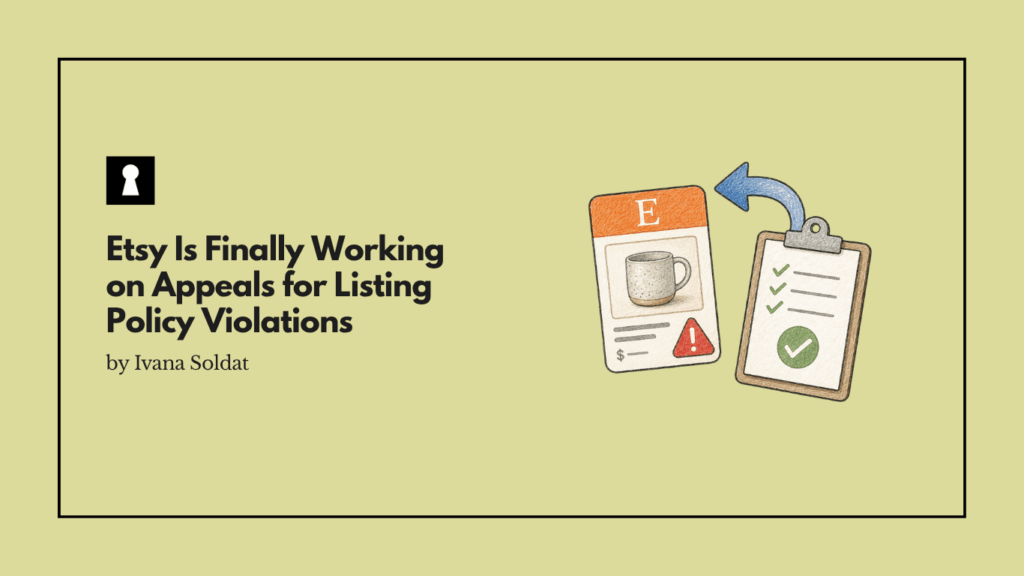
Etsy says it plans to give sellers more ways to appeal listing-level policy violations, a change that could matter for sellers who have had products removed or restricted without a clear path to challenge the decision.
The update was included in Etsy’s Transparency Report. Etsy said it introduced a listing-level appeals process in 2025, initially focused on violations of its Creativity Standards, and plans to expand the system across more policy areas in 2026.
The company said its goal is to have broad appeals coverage by the end of the year.
For Etsy sellers, this is not a small technical change. Listing removals can affect revenue, search visibility, seller trust and shop stability, especially when enforcement decisions are automated or difficult to understand. A clearer appeals process gives sellers at least one more route to challenge decisions that may be incorrect, unclear or too broadly applied.
The question is whether Etsy’s expanded appeal system will be strong enough to solve one of the marketplace’s most persistent seller complaints: enforcement that feels fast when removing listings, but slow and opaque when sellers ask for help.
What Etsy is Changing
Etsy already allows account-level appeals, but listing-level appeals have been more limited.
According to Etsy’s transparency report, the company introduced listing-level appeals in 2025, beginning with violations of its Creativity Standards. Those standards were introduced to clarify what belongs on Etsy, including whether an item is made by, designed by, handpicked by or sourced by the seller.
In 2026, Etsy says it plans to expand listing-level appeals beyond that initial area and provide broader coverage across its policy ecosystem.
That matters because not every enforcement issue is an account-level problem. A seller may have one listing removed while the rest of the shop remains active. In those cases, forcing sellers into vague support channels or leaving them with limited explanation creates frustration and uncertainty.
A proper listing-level appeal process should allow sellers to dispute a specific decision, provide evidence, and receive a clearer answer about why a product was removed or restricted.
Why this Matters for Etsy Sellers
For sellers, a listing is not just a page. It is inventory, search ranking, reviews, ad spend, photography, product development and sometimes months of accumulated sales history.
When a listing is removed, the damage can be immediate. Sales stop. Ads may be interrupted. Search momentum can disappear. Customers who saved the item or planned to buy it may no longer be able to find it.
That is especially important on Etsy, where many shops depend on a small number of strong-performing listings. A single removal can affect a meaningful share of a seller’s revenue.
This is why appeals matter. Sellers need a way to challenge enforcement decisions without feeling like they are shouting into a support form.
Marketplace rules are necessary, but so is due process. If Etsy removes a listing, sellers should be able to understand the reason, correct the issue where possible, or challenge the decision if they believe it was wrong.
For broader marketplace updates affecting sellers, see our Ecommerce News section.
Etsy is Also Expanding Enforcement
The appeal update is only one side of the story.
Etsy is also continuing to invest in enforcement. In its transparency report, the company said it is improving detection systems, expanding use of large language model-based tools, and working to remove content that does not belong on the marketplace more quickly.
That includes stronger enforcement around spam, scams, counterfeit goods, unsafe products and items that violate Etsy’s marketplace rules.
From Etsy’s perspective, this is part of protecting what makes the platform distinct. Etsy wants to remain a marketplace for creative, handmade, vintage, designed and carefully sourced goods, not a general marketplace flooded with mass-produced products pretending to be handmade.
That goal makes sense. Etsy’s brand depends on trust. Buyers go to Etsy because they expect something different from Amazon, Temu, Shein or AliExpress.
The problem is that enforcement at scale often creates mistakes.
When platforms use automated systems to police millions of listings, false positives are almost guaranteed. A product can be flagged incorrectly. A listing image can be misunderstood. A seller’s wording can trigger enforcement. A handmade item can be treated like a prohibited or non-compliant product.
That is why stronger enforcement and stronger appeals need to move together. If Etsy is going to rely more heavily on automated detection, it also needs to give sellers a better way to challenge the system when it gets things wrong.
The Creativity Standards Problem
Etsy’s Creativity Standards are central to this issue.
The standards were introduced to clarify the role sellers must play in the products they sell. Etsy groups qualifying items into categories such as made by, designed by, handpicked by and sourced by.
In theory, this helps buyers understand what they are purchasing and helps Etsy protect its identity as a marketplace for creative goods.
In practice, the rules can be complicated.
Etsy sellers operate across many product types, from handmade jewelry and digital downloads to vintage goods, craft supplies, print-on-demand products, personalized items and designed products manufactured by production partners.
That creates gray areas. A seller may design a product but use a production partner. Another may curate vintage items. Another may sell craft supplies. Another may use AI-generated imagery in a way that raises questions about representation and originality.
Etsy has to decide what belongs on the platform, but sellers need to understand how those decisions are being made.
A listing-level appeal process can help, but only if it gives sellers specific explanations rather than generic policy language.
Sellers Need Clearer Enforcement Notices
One of the most important parts of Etsy’s 2026 plan is not just appeals. It is clearer enforcement communication.
Etsy says it wants to expand targeted enforcement notifications across more policy areas so sellers can better understand enforcement decisions and avoid future violations.
That is important because many seller complaints around marketplace enforcement come down to communication. Sellers often say they are told a listing violated policy, but not given enough information to understand what exactly went wrong.
That creates a cycle where sellers either guess at the problem, remove too much from their listing, or avoid selling certain products entirely because they do not know what will trigger another violation.
Clearer notices would help sellers understand whether the issue was the product itself, the title, the description, the category, the images, intellectual property, prohibited materials, medical claims, handmade representation, or something else.
Without that level of clarity, an appeal process can become less useful. Sellers cannot make a strong appeal if they do not understand what they are appealing.
Why Automated Enforcement Needs Human Review
Etsy’s report says the company has expanded the use of large language model-based detection technology to improve speed and accuracy.
That is not surprising. Marketplaces are under pressure to police enormous catalogs, and manual review alone is not realistic at Etsy’s scale.
But AI-assisted enforcement creates its own problem. Automated systems can help detect patterns, but they can also misread context. This is especially risky on a marketplace like Etsy, where the difference between compliant and non-compliant products can depend on nuance.
A handmade-inspired item is not the same as a handmade item. A designed product made with a production partner is not the same as a mass-produced resale item. A vintage listing may need different treatment from a new manufactured product. A product image may be illustrative, misleading, AI-generated or simply stylized.
These distinctions matter.
If Etsy wants sellers to trust enforcement, appeals need to include meaningful human review, not just another automated answer wrapped in nicer language.
For sellers trying to build stronger shops across marketplace and direct ecommerce channels, our Ecommerce Platforms coverage looks at the systems and platform rules shaping online selling.
The Timing is Important
Etsy’s appeal expansion comes at a time when marketplace sellers are increasingly concerned about enforcement, account health and platform dependency.
Across ecommerce, sellers are dealing with more automated decisions, stricter platform rules, stronger product compliance requirements and more pressure around authenticity, safety and intellectual property.
This is not only an Etsy issue. Sellers on Amazon, eBay, TikTok Shop and other marketplaces have similar concerns about unclear enforcement decisions and limited routes to appeal them.
The difference is that Etsy’s marketplace identity makes the issue more sensitive. Sellers are not only trying to comply with ordinary retail rules. They are also trying to fit into Etsy’s definition of creativity.
That definition can be commercially important. It decides what gets listed, what gets removed, and which sellers are allowed to keep building businesses on the platform.
What Sellers Should Do Now
Sellers should not wait for the expanded appeals system before reviewing their listings.
The first step is to check whether listings clearly show the seller’s role in the product. If an item is handmade, designed, vintage, sourced or made with a production partner, the listing should make that clear and avoid language that could be interpreted as misleading.
Sellers should also review product images, especially where AI imagery, mockups or heavily edited visuals are used. Etsy has said it is focused on misleading use of AI imagery, so sellers should be careful that images accurately represent what buyers will receive.
The second step is documentation. Sellers should keep records that support their listings, including production notes, supplier details, design files, sourcing records, vintage authentication where relevant, and communication with production partners.
The third step is to treat policy compliance as part of shop operations rather than something to deal with only after a violation. Strong listings are not only optimized for search and conversion. They are also built to survive marketplace review.
For sellers focused on improving product listings, search visibility and marketplace positioning, our Ecommerce Marketing section covers the wider link between product pages, search and conversion.
Etsy’s Appeal Expansion is Overdue
Etsy’s plan to expand listing-level appeals is a positive move, but it also highlights how exposed sellers have been when listing enforcement goes wrong.
A seller should not need to lose revenue, search history and buyer visibility because a platform decision cannot be challenged properly.
At the same time, Etsy is right to enforce its marketplace standards. If the platform becomes filled with generic resale products, counterfeit goods, unsafe products or misleading AI-generated listings, it loses the identity that made buyers trust it in the first place.
The hard part is balancing both sides.
Etsy needs to remove listings that do not belong on the marketplace. But it also needs to protect legitimate sellers from being caught in enforcement systems that are too vague, too automated or too difficult to challenge.
That balance will determine whether expanded appeals become a meaningful seller protection or just another support feature that sounds better in a transparency report than it feels in practice.
Our Take
Etsy Sellers Should Not Have to Prove They are Innocent After the Damage is Done
Etsy’s decision to expand listing-level appeals is a necessary step, but it should not be treated as a generous new benefit for sellers. It is basic marketplace infrastructure.
If a platform has the power to remove a seller’s listing, interrupt their revenue and damage their search momentum, it should also provide a clear and fair way to challenge that decision.
That is especially true when enforcement is increasingly supported by automated systems. Faster detection may help Etsy remove bad listings more efficiently, but speed is not the same as fairness. A wrong decision made quickly is still a wrong decision.
The controversial point is that marketplaces have become too comfortable with enforcement systems that place the burden on sellers after the damage has already happened.
Appeals should not be the only safety net. Etsy also needs clearer notices, better explanations, more precise enforcement and meaningful human review when sellers challenge a decision.
Protecting the marketplace matters. But so does protecting the sellers who actually make the marketplace worth visiting.