

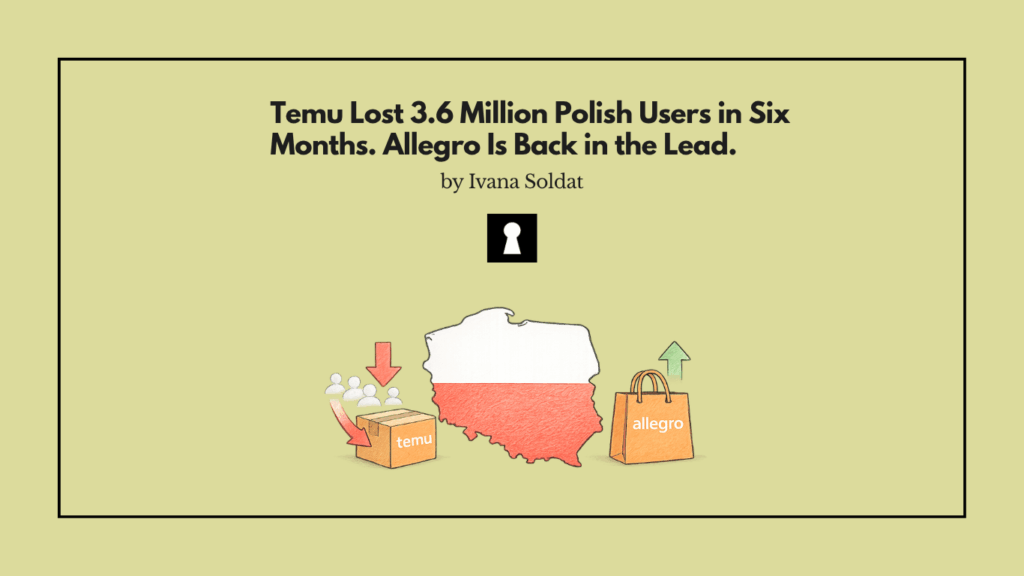
The Polish ecommerce market has been one of the most closely watched battlegrounds in European digital commerce for the past eighteen months. When Temu overtook Allegro in monthly unique users for the first time in March 2025, it was treated as a milestone in the European expansion of Chinese platforms. When it built a lead to 20.34 million users versus Allegro’s 18.9 million by January 2026, the question was not whether Temu had won but how complete the victory would become.
The answer, according to June 2026 Mediapanel data confirmed by independent measurement, is that the victory was not complete. It was temporary.
In June 2026, Temu was used by 16.68 million Polish internet users, approximately 700,000 fewer than in May and the lowest figure in around one and a half years. Allegro, meanwhile, recorded 18.36 million users in June, reclaiming the lead it had lost in early 2025. The trend had clearly reversed from just a few months earlier when Temu was still setting consecutive popularity records in Poland.
The user count decline of 3.66 million Polish users between January and June 2026 is significant in absolute terms and more significant in directional terms. Temu is not plateauing in Poland. It is retreating.
The Two Pillars That Are Both Cracking
Polish ecommerce analysts watching this shift converge on two structural weaknesses manifesting simultaneously.
The first is the novelty effect. Temu’s initial success in Poland, as in most markets, was driven by aggressive advertising spend, highly gamified shopping mechanics, and prices that were genuinely difficult for domestic competitors to match. Experts in the Polish market point out that the novelty effect is ending, the price advantage over Allegro is shrinking, and marketing is no longer driving impulse purchases as effectively as before.
An important data point on the price gap: as recently as January 2026, the average Temu user in Poland was spending approximately 60% of what the average Allegro user was spending per transaction, up from 30% a year earlier. That convergence shows Temu users becoming more committed shoppers rather than purely impulse buyers, but it also shows that the price gap that made Temu uniquely compelling is narrowing. A platform that was dramatically cheaper than the alternative has a specific value proposition. A platform that is somewhat cheaper has to compete on other dimensions where Allegro has years of accumulated advantage.
The second structural weakness is logistics. The EU parcel duty of 3 euros per customs tariff code, introduced on July 1, is beginning to reach consumer awareness as the first orders placed after the change are fulfilled. A customer who discovers that a package containing four products has been charged 12 euros in duties, or that their products have increased in price by several dozen percent, will return to domestic platforms.
The Trap of Moving to EU Warehouses
Temu’s operational response to the July 1 duty is instructive and, according to Polish market analysts, potentially self-defeating. The most interesting thing Temu is doing in response is moving logistics to EU warehouses to avoid the charges. But when it does that, it loses its original ultra-low price advantage and starts playing Allegro’s game on Allegro’s home ground, as analyst Jakub Rajski put it.
This is the strategic bind that several EcomWatch pieces this week have been circling from different angles. The EU parcel duty works not by stopping Chinese platforms directly, but by forcing them into a choice between two bad options: keep shipping from China and absorb the duty cost, which erodes the price advantage; or build European logistics infrastructure, which eliminates the duty but also eliminates the cost structure that made the price advantage possible in the first place.
Temu is choosing the second option in Poland. In doing so it is becoming a different kind of competitor than the one that overtook Allegro in 2025. It is no longer competing on ultralow prices from a Chinese supply chain. It is competing on price and range from European warehouses against a competitor that has spent two decades building exactly that kind of operation.
Poland Is the Preview for the Rest of Europe
The Polish data is worth watching carefully because Poland went through the Temu adoption cycle faster and more dramatically than most Western European markets. It was among the first EU countries where Temu overtook a domestic incumbent. It is now among the first to show meaningful reversal.
The sequence: aggressive advertising builds rapid user acquisition, novelty and price drive initial conversion, users habituate and the novelty effect fades, price advantage narrows as EU regulatory and logistics costs rise, domestic incumbent counterattacks with marketing and infrastructure investment, users who switched for the price discover the gap is smaller than they thought and the convenience and trust advantages of the domestic platform still matter.
If that sequence plays out in Germany, France, Italy, and the Netherlands on a similar timeline, the German ecommerce H1 data showing Asian platforms still growing at 20% versus the overall market’s 4.3% may represent a peak rather than a continuing trend.
Our Take
Allegro Won a Battle. The War Has New Terms.
The Temu decline in Poland is the most concrete evidence yet that the EU regulatory and logistics changes are doing something to Chinese platform growth, even if not in the way the regulations were designed to work. The parcel duty did not make Temu unaffordable. It made Temu’s cost advantage smaller and its logistics response more expensive.
Combined with a novelty effect that was always going to fade and a domestic competitor that fought back harder than expected, the result is a market that looks materially different in June 2026 than it did in January.
The uncomfortable question for anyone celebrating Allegro’s return to the top is whether Temu’s EU warehouse strategy eventually makes it a more durable competitor rather than a cheaper one, and whether Allegro’s current lead is the beginning of a recovery or a brief window before a better-positioned Chinese rival comes back.