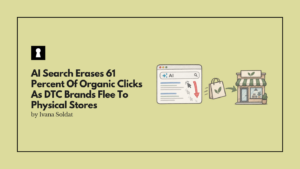

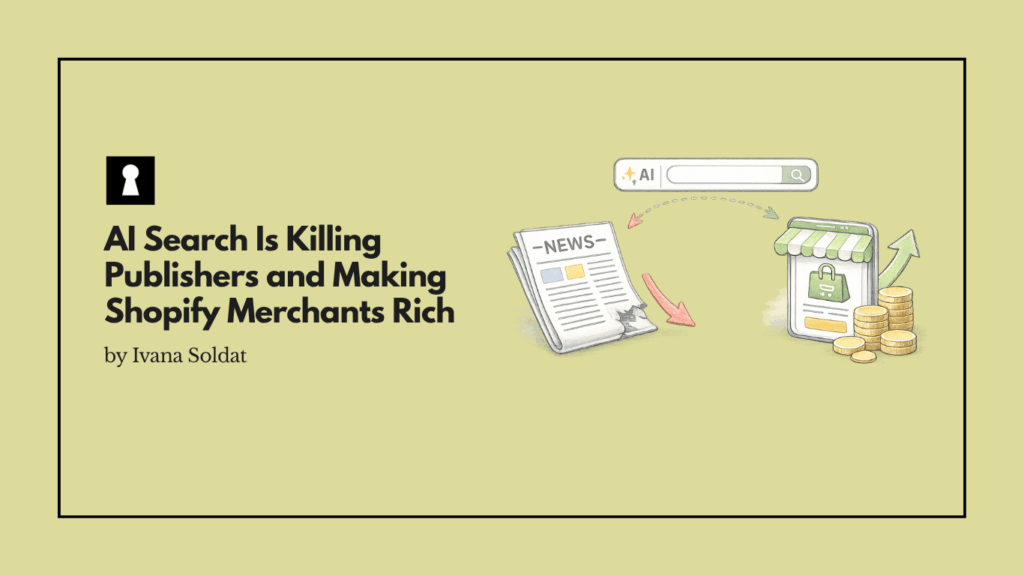
Two stories about AI search are running simultaneously right now and they point in opposite directions. For publishers, AI search is catastrophic: Google’s AI Overviews and ChatGPT answer questions that used to require clicking a link, traffic drops by 50% or more, advertising revenue follows. For Shopify merchants, AI search is a windfall with more traffic, better-converting traffic, orders from categories that traditional search was never surfacing.
Shopify President Harley Finkelstein explained it on the Q2 earnings call:
“While search engines rank by popularity against a handful of keywords, AI agents make multiple calls into Shopify’s catalog, working with richer structured data to match products with the buyer’s specific intent, rather than just keywords.”
He gave an example that is cleaner than any analyst framing:
“When a buyer asks an AI assistant for the best car seat that fits three across a sedan, traditional search focuses on the keyword ‘car seat.’ An agent, however, understands the actual need, the dimensions, the vehicle type, and the fact that they need three. It searches across all of those constraints at once to find the product that actually works, not just the one that ranks highest.”
This is the structural difference. A publisher produces information. When AI can synthesize that information directly, the click to the publisher becomes unnecessary. A merchant sells a product. When AI can find the right product for a specific need, the click to the merchant becomes more necessary and more intentional than it was before.
The Numbers That Explain the Earnings Beat
Shopify reported Q2 2026 revenue of $3.6 billion, up 36% from a year earlier, outstripping Wall Street’s forecast of $3.4 billion. Gross operating profit rose 31% to $1.71 billion, also ahead of analysts’ expectations of $1.63 billion.
AI-driven traffic and orders to Shopify stores tripled year over year in Q2. The detail underneath that number is more interesting than the headline.
“Buyers’ shopping journeys are being compressed as half of all AI-referred sessions are landing directly on a product description page. That is 2.5 times more than what we see with traditional search,” Finkelstein said.
Traditional search sends a shopper to a homepage or a category page. They browse, maybe add to cart, maybe abandon. AI search sends a shopper directly to the product that answered their specific question. The funnel collapses. The conversion rate goes up. The merchant does not need to work as hard to close the sale because the work of matching the buyer to the product has already been done by the AI.
75% of AI-attributed purchases in Q2 happened outside Shopify’s top 100 categories. This is the long-tail story that nobody in ecommerce has been telling clearly enough. Traditional keyword search surfaces popular products in popular categories.
An AI that understands intent and constraint can surface niche products that exactly match a specific need, products that would never win a keyword auction but are precisely right for the person asking. The merchant selling specialized hiking poles for people with knee injuries does not rank for “hiking poles.”
But when a buyer describes their exact situation to an AI assistant, the AI might find that merchant’s product and send a highly motivated buyer directly to the product page.
Traditional Search Is No Longer Alone
Finkelstein told analysts:
“Search remains one of our largest sources of buyer traffic to our merchants, and it’s still growing. Traditional search sessions are up 1.3x over the past two years, holding roughly a third of all storefront sessions.”
AI search tripled. Traditional search grew 30%. Both are growing. The pie is expanding, not shifting entirely from one column to another. For ecommerce merchants, this is a genuinely better situation than the narrative of AI killing search would imply. They are getting more traffic from more sources, with AI traffic converting at a higher rate because it is more intentional.
This is meaningfully different from what publishers are experiencing. Publisher traffic from search has declined precisely because AI answers questions without requiring a click. For merchants, the AI answers a question by recommending a product, and the click is the transaction.
The Shopify Infrastructure Bet
Shopify said it has built connectors to Claude, ChatGPT, Perplexity, Manus, Replit, and Vercel, as well as vibe-coding platforms like Lovable. The company also suggested Shopify stands to benefit from AI playing a larger role in transactions thanks to its trusted checkout experience.
This infrastructure positioning is not accidental. If AI agents are making purchase decisions on behalf of users, the agent needs to be able to complete the transaction. A Shopify checkout already integrated with the AI agents driving discovery is positioned to capture that transaction. A merchant whose product data is not structured in ways that AI can interpret, whose checkout is not connected to the agents driving discovery, is invisible to a growing share of buying decisions.
The Wix report we covered earlier this month showed that LLMs drive under 1% of publisher traffic. Shopify is showing that for ecommerce specifically, the same LLMs are driving tripled orders. The difference is product data infrastructure and structured catalog information that AI can query.
Our Take
The Publishers Are Losing, and The Merchants Are Winning
Shopify’s Q2 AI search data is the clearest commercial evidence yet that the AI search disruption is not uniformly negative and not uniformly positive. It is category-specific. For content that answers questions, AI replaces the click. For products that fulfill needs, AI enables the click and makes it more intentional. Publishers with ad-supported content models are experiencing the downside of that distinction at scale.
Shopify merchants with structured product catalogs and trusted checkout experiences are experiencing the upside. The merchants who need to pay the most attention to this are the ones who have not yet thought about whether their product data is structured in a way that AI agents can query, interpret, and recommend from.
The Finkelstein car seat example is a technical specification for what Shopify-integrated merchants need their product listings to look like if they want to be findable by the agents that are tripling orders in their category.