
The Shopify Q2 earnings data we covered earlier this month showed AI-driven traffic and orders to Shopify stores tripling year-over-year, with Shopify’s president crediting richer structured product data as the mechanism. The Digital Commerce 360 and ReFiBuy AI Commerce Rankings data published today shows what that looks like at a retailer level, and the results are counterintuitive in ways that every ecommerce brand should understand before finalizing its Q4 strategy.
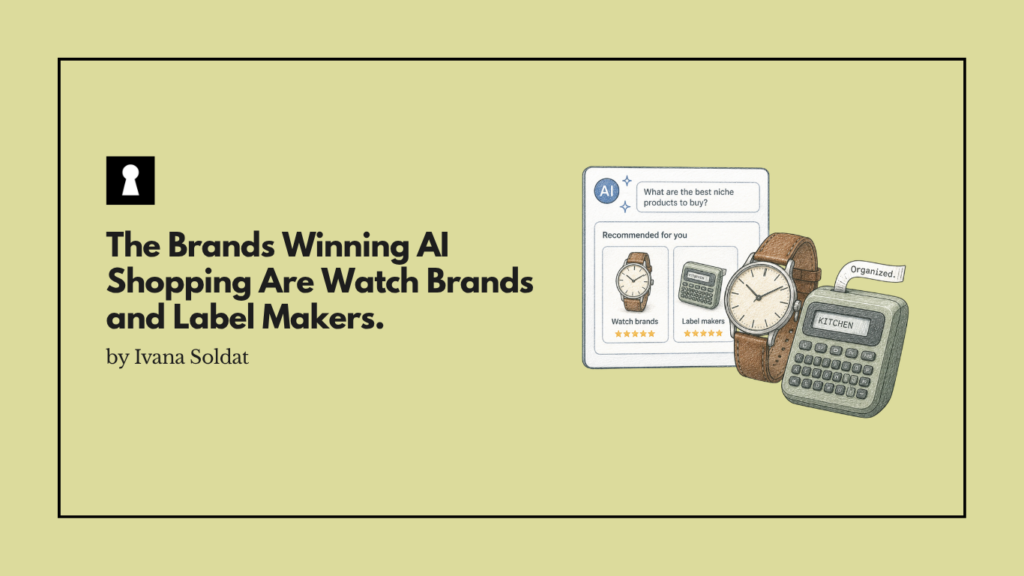
In the top five spots of the AI Commerce Rankings from Q2 2026, the retailers ranked 722nd, 814th, 264th, 826th, and 133rd, respectively, in the Top 1000 by traditional web sales. Nixon, the watch brand, overtook previously number-one-ranked Online Labels.
CustomInk, the custom apparel platform, held a top five position. ReFiBuy’s analysts found that all five of these leaders rank outside the top 100 in traditional web sales, which they see as a sign that larger brands may be getting edged out when it comes to their products’ accessibility to AI shopping agents.
Let that sit for a moment. The number one brand for AI commerce in Q2 2026 ranked 722nd by traditional web sales. The brands at the top of the AI discovery stack are not the brands at the top of the traditional ecommerce stack, and the gap between those two rankings is the story.
Why Smaller Brands Are Winning AI Discovery
The AI shopping dynamic that ReFiBuy’s rankings are measuring is not about brand awareness or advertising budget. It is about product data quality. When a consumer asks an AI shopping agent to find a specific watch with specific features, the agent queries accessible product catalogs and returns results based on how well each product’s data matches the stated need.
A brand whose product listings are structured with clean attributes is more likely to surface in that query than a brand whose product pages are written for human readers with keyword-stuffed descriptions and minimal structured data. The AI agent cannot browse a product page the way a human does. It reads the data that has been made machine-readable.
This creates an advantage for smaller, more category-focused brands that have invested in product data quality, and a disadvantage for large retailers whose catalog breadth and historical SEO investment does not automatically translate into AI readability.
Adobe data from March 2026 showed AI-driven traffic to retailers’ websites converting 42% more often than non-AI traffic, a reversal from a year earlier, when AI-referred visitors converted at nearly half the rate of non-AI traffic. The consumers who arrive via AI recommendation have already been qualified by the AI’s understanding of their specific need.
The Category Fluctuation Pattern
ReFiBuy’s analysts found seasonal fluctuations by merchandise category in the Q2 rankings changes. The presence of Online Labels and CustomInk in the top five shows that personalised and custom products are discovering opportunities in AI channels.
Custom and personalised products are a particularly interesting category for AI commerce because the search intent is inherently specific. Someone looking for a custom label for a specific jar size is making a query that describes exactly what they want. An AI agent can match that specific description to a product more accurately than a keyword search can.
“Q2 showed how much the market can shift in a single quarter and why retailers can’t treat Agentic Commerce Optimization as a one-time project,” said Scot Wingo, CEO and co-founder of ReFiBuy. “Retailers preparing their catalogs now will enter Q4 with a real head start as holiday shoppers increasingly turn to AI agents to research, find and buy products.”
The Adobe AI Readiness Gap, Revisited
We covered in yesterday’s Labor Day piece that Adobe data from July 2026 found homepage visibility for US retail sites at an average of 61%, meaning nearly 40% of homepage content is not fully readable by AI shopping agents.
The DC360 AI Commerce Rankings data gives that number a commercial dimension: the brands losing out in AI discovery are not losing to Amazon and Walmart. They are losing to a watch brand ranked 722nd in traditional web sales and a label company ranked 814th.
That reframes the AI readiness gap from an abstract technical challenge to a specific competitive threat. The question is not “will AI shopping agents matter eventually.” It is “which competitor with better product data is capturing the AI-referred conversion that should be coming to me.”
Our Take
The Brands Winning AI Commerce Did Not Win It With Ad Spend
The ReFiBuy AI Commerce Rankings are the most concrete data point yet that AI shopping is creating a genuinely new competitive landscape in ecommerce, one that does not map to the traditional rankings by web sales or brand awareness.
The brands at the top of the AI commerce stack got there through product data quality, catalog structure, and machine-readable product information. That is not a function of size or budget. It is a function of deliberate data investment.
For any brand heading into Q4 planning, the ranking methodology, which tracks AI-driven discovery and conversion rather than total web sales, is worth understanding, because it describes where the incremental growth opportunity is going to come from in a market where AI-referred traffic is now converting 42% better than traditional search traffic.
The brands that arrive at November with clean, structured, AI-readable catalogs are going to have a materially different Q4 than the ones that do not.