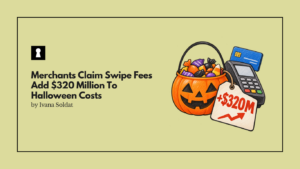

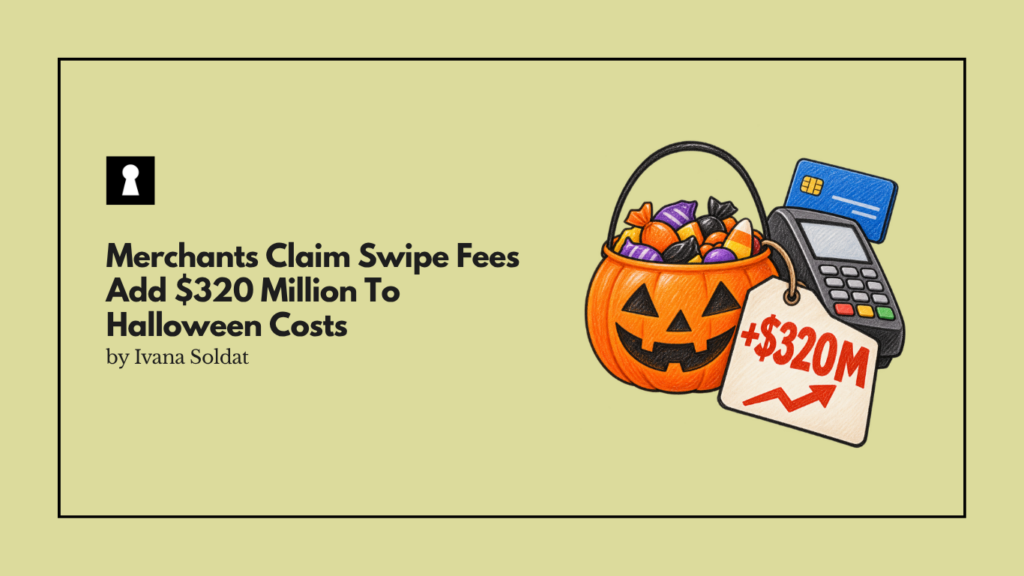
According to the MPC, swipe fees will account for an estimated $318.6 million of the $13.5 billion consumers are projected to spend on Halloween this year, based on National Retail Federation projections.
By applying an average credit card transaction fee of 2.36 percent, the coalition calculates that roughly $2.72 of the average $115.14 spent per consumer goes directly to payment processors.
The group breaks this down further, estimating that fees will consume $103.8 million of costume spending, $101.5 million of decoration purchases, $96.8 million of candy sales, and $18.9 million of greeting card purchases.
The Duopoly’s Growing Toll
The Halloween estimate is being used as a microcosm for a much larger structural issue in retail economics. The MPC argues that Visa and Mastercard credit card swipe fees have more than quadrupled since 2010, reaching $118.8 billion last year. When including debit networks, total credit and debit card swipe fees hit a record $198.25 billion.
Merchants contend that these fees are now their largest operating expense after labor. Because these costs are baked into base merchandise prices, the coalition argues that cash-paying customers are effectively subsidizing the credit card rewards of other shoppers.
The Legislative Fix: Credit Card Competition Act
To combat this, the MPC is aggressively lobbying for the passage of the Credit Card Competition Act. Doug Kantor, an MPC executive committee member and general counsel of the National Association of Convenience Stores, stated that “Congress has the chance to drive a stake through the heart of these out-of-control fees” by passing the legislation.
The proposed Act would mandate that banks with at least $100 billion in assets enable credit card transactions to be processed over at least one unaffiliated network, such as Star, NYCE, or Shazam.
This would break the current processing restrictions that tie issuing banks exclusively to Visa or Mastercard routing. The coalition projects that introducing this routing competition would save merchants and their customers $17 billion annually.
The Reality Of “Pass-Through” Savings
While the narrative that lower swipe fees will directly lower consumer prices is politically compelling, the economic reality is historically more complex. When interchange fees are capped or reduced, such as with the Durbin Amendment for debit cards, large retailers often retain the margin improvement rather than passing the savings on to consumers in the form of lower shelf prices.
Furthermore, payment networks argue that these fees fund critical infrastructure, including advanced fraud detection, zero-liability protections, and the lucrative reward points that consumers actively demand and expect.
Our Take
Lower Swipe Fees Won’t Mean Cheaper Halloween Costumes
The Merchants Payments Coalition’s Halloween fee estimate is a clever, highly publicized framing device designed to make abstract B2B payment processing costs feel like a direct, tangible theft from the average consumer’s pocket.
While the duopoly power of Visa and Mastercard undoubtedly warrants regulatory scrutiny and increased routing competition, founders and retailers should be skeptical of the promise that legislative fee caps will magically result in cheaper goods.
The primary beneficiaries of the Credit Card Competition Act will be corporate profit margins, not the $2.72 saved on a Halloween costume.