
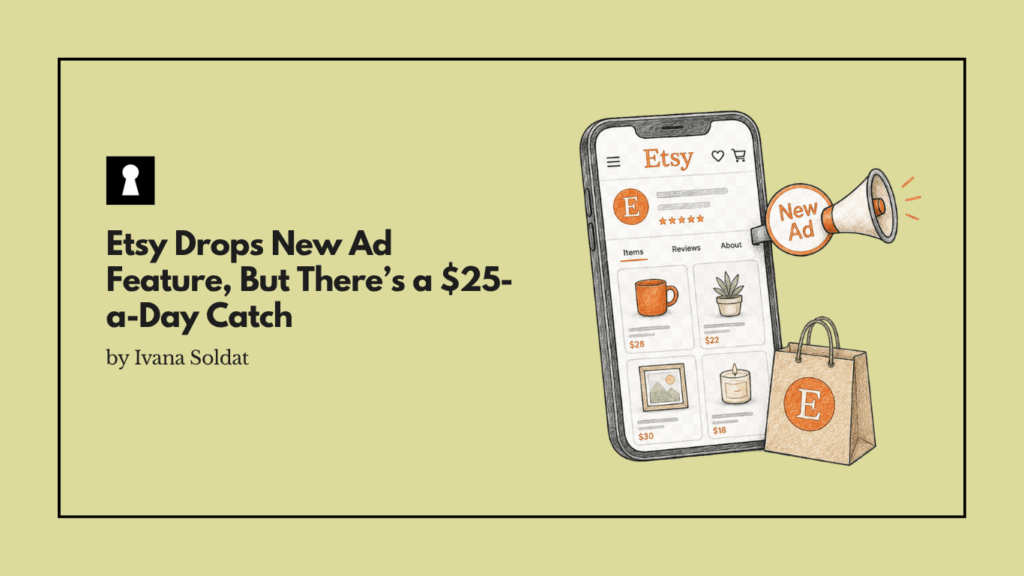
Etsy has rolled out a new advertising tool called Listing Strategies, giving sellers more control over how their ad budget gets spent on individual listings. It sounds like a win for the little guy. Until you read the small print.
The feature is only available to sellers running Etsy Ads with a daily budget of $25 or more. So if you’re a cottage candle maker spending $10 a day, this one is not for you.
What Listing Strategies Actually Does
The new tool lets sellers assign a specific goal to each individual listing they advertise, rather than applying a blanket approach across an entire campaign. Think of it as giving each product its own personality at the ad auction.
Etsy describes it as taking the existing campaign strategy feature and drilling it down to listing level, with “same simplicity, more control where you want it.” More control is always nice, assuming you can afford to be in the room where it happens.
Sellers can pick from three strategies for each listing.
- Greater Visibility pushes for maximum reach, suited for bestsellers or seasonal launches.
- Lower Click Cost keeps spending lean for items with tight margins or limited stock.
- Efficient Spending is the default, described by Etsy as a “balanced approach” for most listings.
The $25 Threshold Is Not Accidental
Etsy is not being shy about the paywall here. The company literally tells sellers in its own announcement: “Not at $25 a day yet? Increasing your daily budget to $25 or more unlocks listing strategies.” That sentence is doing a lot of work.
Etsy also recommends giving each strategy at least 30 days before drawing conclusions, which, at $25 a day, adds up to $750 minimum just to test whether your tweak did anything. For a handmade jewellery seller shipping out of a spare bedroom, that is a significant chunk of margin.
Etsy Has Been Here Before
This move does not exist in a vacuum. Etsy has a well-documented track record of making ad participation more financially demanding over time, with sellers increasingly feeling the squeeze.
The platform’s Offsite Ads programme already forces sellers who exceed $10,000 in annual sales into mandatory participation, with no opt-out option ever, even if sales later drop back below that threshold. Sellers in that bracket pay a 12 to 15 percent fee on any sale linked to an offsite ad click, on top of all existing transaction fees. Back in 2022, over 14,000 Etsy sellers went on strike over fee hikes, with a petition gathering more than 48,000 signatures from buyers and sellers urging Etsy to “work with sellers, not against us.”
Fast forward to 2026, and Etsy’s own financial filings show advertising revenue as a key growth driver. The company’s Q1 2026 shareholder letter highlighted that the take rate expansion was “led by Etsy Ads, where we continued to benefit from machine learning-driven improvements to relevance and seller budget pacing.”
Translation: sellers spending more on ads is very much part of the business model.
What This Means for the Ecommerce Owners
Etsy is not alone in nudging sellers toward higher ad spend to unlock better tools. Across the ecommerce world, platforms from Amazon to Shopify have built increasingly sophisticated ad ecosystems where visibility is, to varying degrees, pay to play.
What makes Etsy’s case a little more pointed is the brand identity it has built around independent makers and authentic craft. There is an inherent tension between the handmade ethos and a system that rewards the sellers who can afford to spend $750 testing a single ad tweak.
Listing Strategies is genuinely a useful feature if you have the budget for it. More granular control over ad spend is something sellers have asked for, and Etsy has delivered something functional. But framing it as a gift to sellers while placing it behind a daily spend requirement that excludes most small shops is a choice worth naming.
Our Take
The Handmade Marketplace Is Starting to Feel Pretty Corporate
The feature itself is not the problem. Giving sellers the ability to prioritise visibility on a new product launch versus a low-margin clearance item in the same campaign? That makes sense and we are glad it exists.
The issue is the growing sense that Etsy’s platform is becoming friendlier to sellers who operate at scale and less hospitable to the small independents who made the marketplace worth visiting in the first place. Every time a useful tool gets gated behind a spending floor, the gap between Etsy’s marketing narrative and the experience on the ground widens a little more.
If Etsy wants sellers to trust it as a partner rather than a landlord, it might want to rethink who gets access to the tools designed to help them succeed.