
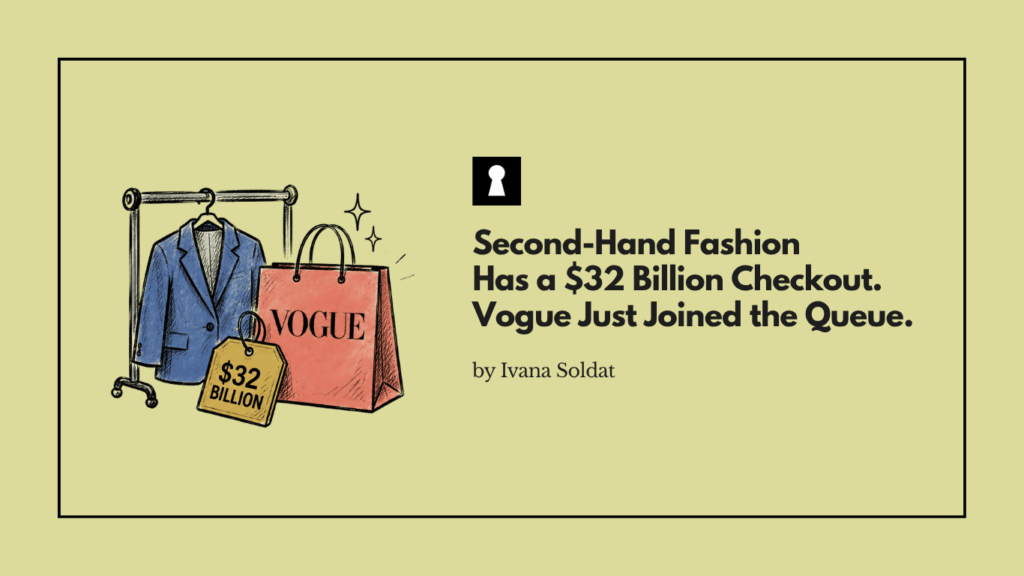
When fashion’s most powerful magazine sets up a vintage market at Australian Fashion Week, it is not ahead of the curve. It is catching up to one that eBay, Depop, and millions of casual sellers have been riding for years.
Vogue showed up at Australian Fashion Week this month with racks of archival designer garments, a Sydney cruise terminal, and a bold new editorial position: second-hand fashion is officially on trend. Near the Opera House, shoppers sifted through pre-loved luxury, curator-picked oddities, and pieces that had spent years circulating through TikTok moodboards before landing on a physical rail.
For seasoned observers of ecommerce, the scene was familiar. The platforms built to move this exact inventory have been watching consumer behaviour shift for years. Vogue’s arrival is less a trendsetter moment and more a very glamorous confirmation.
The Numbers That Were Already Pointing This Way
eBay partnered with Vogue on the event, and the collaboration was not accidental. The platform’s own data had long signalled that pre-loved fashion had graduated from a niche pastime to mainstream retail behaviour. Coach Tabby bags were up more than 200 per cent year-on-year in sold listings. Alemais dresses were changing hands for close to $700. Carhartt, Louis Vuitton and Zimmermann were the platform’s top fashion search terms.
Zannie Abbott, eBay’s head of marketing and communications in Australia, put it plainly: shoppers were already seeking “value, sustainability and individuality all coming together.” The Vogue market was, as she framed it, a visible manifestation of changes that had been building across the industry for several years.
The Platform That Quietly Ditched Its Own Fees
While the cameras were pointing at the Vogue market floor, eBay was also making a structural bet on recommerce. Earlier this month the platform removed transaction fees for casual Australian sellers on annual sales up to $25,000. The previous fee had sat at up to 13.4 per cent of the final transaction value, a figure that one in three Australians said had actively stopped them from listing items at all.
Fifty-five per cent of those surveyed said they would be more likely to sell with fees removed. eBay’s own research estimated Australian households are collectively sitting on around $32 billion in potential resale value, with the average home holding about 15 sellable items. Removing the fee barrier was not charity. It was competitive positioning.
“We’re not just making selling easier. We’re unlocking billions in untapped value.”
Facebook Marketplace has grown steadily on the back of its zero-fee model, and eBay has watched that happen. The move to eliminate casual seller fees was the platform’s clearest signal yet that it is willing to restructure its revenue model to stay relevant in the recommerce space it helped create decades ago.
eBay Bought Itself a Younger Audience
The fee change did not arrive in isolation. In February this year, eBay announced it would acquire Depop, the London-founded, Gen Z-beloved fashion resale app, from Etsy for approximately $1.2 billion in cash. The deal is currently pending regulatory approval and is expected to close this quarter.
Depop had around 7 million active buyers at the close of last year, with nearly 90 per cent of them under the age of 34. eBay’s own user base skews the opposite direction. One analyst described the acquisition neatly: buying Depop was like “acquiring your cool cousin.”
The platform had recorded close to 60 per cent year-on-year growth in US gross merchandise sales in 2025, making it one of the fastest-growing fashion resale marketplaces in the country.
Etsy, for its part, had originally acquired Depop in 2021 for $1.6 billion. The lower sale price reflects a shifting market, but the platform’s trajectory in the US was strong enough that eBay saw it as a strategic entry point into a demographic it has not traditionally owned.
Livestreaming Is Where Fandom Meets the Checkout
At the Vogue Vintage Market, eBay broadcast live auction sessions directly from the market floor via eBay Live, its streaming commerce channel. The format was not experimental. It was already built and running. The platform cited research showing 83 per cent of Gen Z consumers in the United States had already engaged with live shopping formats, alongside 58 per cent of millennials.
Abbott described the energy around pre-loved fashion as a “fandom-like culture,” where shoppers track drops, follow individual sellers, and treat a vintage find with the same anticipation as a limited product release. Livestream commerce sits neatly inside that behaviour. It is not a shopping channel. It is entertainment with a buy button.
The Veronicas Listed Their Stuff. Seriously.
To mark the fee removal campaign, eBay enlisted Australian music duo The Veronicas to list pieces from their personal collections on the platform. Auctions opened at $50 and included tour memorabilia, vintage fashion and, in Lisa Origliasso’s case, a witches scrying mirror dating to the 1840s that she picked up while on tour in London. Her sister Jess listed an Alexander McQueen skull scarf, the kind of piece that is synonymous with mid-2000s indie-rock style and commands serious attention on the resale circuit.
It was a savvy campaign move, but it also illustrated something real about where resale now sits culturally. Items carrying biography, specificity, and provenance are exactly what a generation raised on nostalgia content and authenticity-first branding is hunting for.
What Retailers Actually Need to Pay Attention To
Fashion retailers spent decades engineering desire around newness. The pitch was always the next season, the next drop, the next version. What the recommerce shift represents is not the end of that model, but the emergence of a parallel one that rewards the item’s history over its recency.
The ecommerce infrastructure for that model is already in place and scaling. eBay is rolling out AI-powered listing tools and integrated shipping options to reduce friction for casual sellers. Depop is adding eBay’s scale to its community-led platform. The Vogue Vintage Market drew a crowd to physical rails, but every piece on those rails already had an online analogue being bid on somewhere.
The question for retail is not whether resale is happening. It is whether brands and platforms are set up to capture the value when consumers decide their wardrobes are worth more than they realised.
Our Take
The Irony Is Delicious
Let us be honest about what just happened. Vogue, the magazine that has spent over a century telling people their wardrobe is one season behind and their lifestyle is perpetually insufficient, has now set up a market to sell you other people’s old things. And it wants you to feel good about it.
This is the same institution that built its entire editorial identity on newness. New collections, new must-haves, new reasons to spend. Now it is curating pre-loved racks near the Sydney Opera House and calling it a cultural moment. It is a cultural moment. Just not the one Vogue thinks it is.
The actual cultural moment happened years ago, in the unglamorous corners of eBay listings and Depop profiles run by teenagers who had no choice but to be resourceful. The people who built the resale economy did it without a glossy magazine’s blessing, and they did it because fast fashion had priced them out and the planet was quietly on fire.
Now that the market is worth billions, the brands and media institutions that spent decades fuelling overconsumption have discovered sustainability is actually quite on trend. Funny how that works.
None of this means the Vogue Vintage Market is bad. It is probably great, and anything that normalises buying second-hand at scale is a net positive. But retailers and ecommerce operators should be clear-eyed about what they are witnessing. This is not fashion leading culture. This is fashion, very stylishly, following the receipt.