
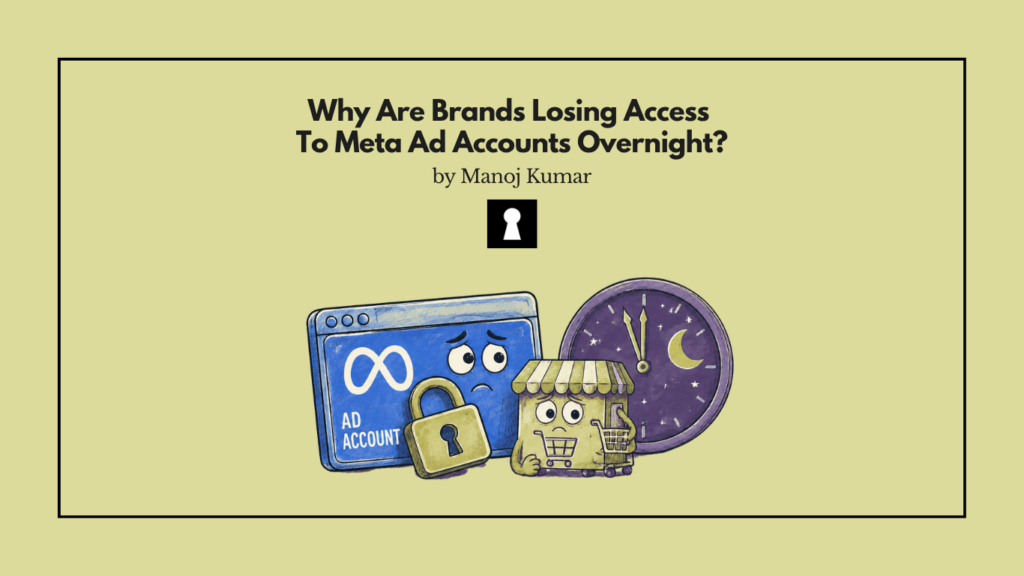
Meta sent a brand owner into panic mode one morning after his ad account was blocked overnight. Seven weeks on, he is still struggling to get his credentials restored. To add to his woes, he lost access to the entire account as he was the sole admin. Though he still has no control over his account, Meta continues to bill him, as the ads are still running without his consent.
Along with his ad account, he has also lost access to his personal Facebook account.
When Automation Sweeps Up the Innocent
Unfortunately, this is not an isolated incident. There are countless examples of founders losing access to their brand ad accounts, where they spent years building brands on Meta’s platforms like Instagram and Facebook. As social platforms and online marketplaces rely heavily on AI and algorithms, such account blackouts have become increasingly common, not only on Meta but also on Amazon and Shopify.
The scale of these actions can be grasped from data shared by Meta itself, where the company claims to have removed over 10.9 million Facebook and Instagram accounts, 600,000 Facebook Pages, and 112,000 ad accounts for various violations in 2025 alone. This was one of the company’s largest exercises to tackle industrialised scamming.
These violations range from fraud, scams, suspicious and deceptive practices, to the blocking of dangerous individuals. Meta’s actions followed media reports criticising the company for profiting from scam advertising.
Celeb-bait and brand impersonation are a big part of this scam industry, where scammers impersonate brands, celebrities, or public figures to commit fraud. Meta says it has deployed AI tools to detect impersonation, deceptive links, and domain impersonation. “We use advanced AI to proactively detect and enforce against content that redirects people to webpages designed to mimic legitimate ones,” Meta said in its March 2025 report.
Now, there is no denying that Meta has been marred by scammers draining billions of dollars from innocent people. Most of the time, these strict actions are genuine, and the tech giant reserves the right to block suspicious activities en masse.
However, there have also been several instances of Meta’s automated control systems causing real trouble for genuine users. Which of these testimonies are genuine and which are not is difficult to determine, but if the issue of suspensions triggered by automated control systems is this widespread, it is worth Meta taking notice. Sometimes, broad ban controls can lead to genuine business owners losing years of effort spent building brand equity, customer relationships, ad history, and, most importantly, access to revenue.
What Exactly Happened And Why It’s Not Rare?
E-commerce operator Jack Oswald runs Cancha Gear, a premium sports and travel bag brand focused mainly on tennis and padel players. According to Oswald, Meta locked him out of his business account, yet it continues to charge his credit card without giving him access to the ad account.
The problem started when he was randomly logged out of his personal Facebook account. Along with it came the loss of credentials required to operate the business account. He tried creating a new ad account, but Meta blocked him when he attempted to link his old Facebook profile with the new Meta account.
Every action, from support calls to Meta Verified DMs, and even friends inside Meta raising employee tickets, has reportedly led to automated loops, with no human intervention to fix the actual issue.
“…No business should be a click away from destruction just because a trillion-dollar company’s algorithm misfired and they couldn’t care less about you,” Oswald rued on X.
This is rarely a random incident, but often what users describe as a “trust flag loop” on Meta’s side. Once the automated systems mark a profile as high-risk, Meta’s platform security measures kick in, and the account is blocked immediately, leaving users with no option but to raise a ticket and hope it is addressed in their favour.
Several brand owners are fed up with automated checks resulting in account disruptions. An Ontario-based new brand owner complained about Meta suspending his account even before he ran a single ad. He was trying to set up Meta ads for his wellness business for the very first time when his account was declared a “fake account.” He confessed that his only mistake was creating a duplicate business portfolio on Meta Business Manager. To his frustration, all his efforts to reach a human customer support representative at Meta failed.
These issues have frustrated brand owners to such an extent that some are resorting to protests outside Meta offices. Entrepreneur magazine Editor-in-Chief Jason Feifer highlighted a similar issue last week, where brand owner Gal Adar said his account, which was hacked two years ago, has still not been reinstated, with no clear explanation from Meta. Left with no option, he has been standing outside Meta’s NYC office with a sign, hoping someone from the company will listen to his complaint.
This raises a question: if so many users are genuine, why do such issues arise? Experts suggest these problems may occur due to login activity from multiple locations, VPN usage, adding too many admins, duplicate profiles, or any unusual activity after account recovery.
On top of that, Meta’s proactive measures are designed to thwart any signs of fraud or scam activity because such threats are a major problem for the company. Meta’s Advertising Standards Enforcement data for 2025-26 suggests it removed over 159 million scam ads in 2025 alone.
This clearly means anyone not following Meta’s guidelines on advertising standards, community standards, business integrity, and data terms faces the risk of prohibition. That is why it is very important to understand how Meta’s ad system works and what brand owners should keep in mind before they even start rolling out ads on Meta.
How Meta’s Ad System Works
Meta’s ad restrictions work in four layers: limits on daily ad spending, loss of access to certain payment and advertising features, and, in severe cases, the complete loss of the ability to advertise on Meta.
These restrictions kick in if and when Meta’s systems believe an advertiser has violated its policies, or if they detect unusual or high-risk activity. Such restrictions are applied when users fail to follow Meta’s guidelines on Community Standards, Ad Standards, and Commercial Policies.
Other instances that may get flagged include a brand’s business portfolio being compromised or the platform failing to meet Meta’s two-factor authentication requirements. This may result in temporary curbs on ad spending and restrictions on which payment features can be accessed. If an account shows high rates of failed or disputed payments, it may count as a risk signal under Meta’s systems.
Meta says its policies are designed to protect people from discriminatory practices, scams, and fraud. As advertisers submit ads, Meta’s automated review systems check everything from content and targeting to ad identity.
But this is not as simple as it sounds. Meta has also frequently been accused of discrepancies in its customer support systems, including random account shutdowns, unresolved payment issues, and endless support loops without any real resolution.
Many times, this may mean adverse action could be taken even if an account followed the guidelines, but certain activities appeared suspicious, such as creating multiple accounts with the same name.
Industry-Wide Problem And Meta’s Solution
The issue of rampant restrictions is far bigger than Meta. Brand owners across platforms — Amazon, YouTube, TikTok, Etsy, and Google Ads — work at the mercy of algorithms that govern the livelihoods of those running ads on these platforms.
These platforms are powerful tools for connecting brands and products with audiences, but their algorithms can sometimes create negative experiences, including automated flagging and suspensions. EcomWatch last month highlighted how Shopify’s automated risk controls were freezing merchant accounts.
Each of these platforms works on different algorithms that decide what kind of content they favour and what they do not. For example, Meta heavily favours organic-style ads over highly produced ones.
Constant updates to these algorithms can hurt brand advertising revenue. Meta’s Andromeda update, which went live in December 2024, reportedly resulted in catastrophic outcomes for certain advertisers, with CPM (cost per mille) spikes of 50% and return on ad spend dropping by over 20%.
Similarly, changes in Google’s algorithms after the introduction of AI summaries caused significant disruptions in search visibility, with Fitch Ratings reporting a 52% decline in monthly referral traffic.
Like Meta, Google also depends heavily on automated sweeps, blocking suspicious accounts from creating new ad campaigns and accessing normal account functions. Every year, the search engine giant suspends around 30 million accounts for policy violations ranging from circumventing systems to identity verification failures.
This is not to say Meta and Google are devilish platforms seeking to punish innocent brands. These platforms operate at an enormous scale — for example, Meta and its family of apps have a combined 3.46 billion users — making automation at this level almost inevitable.
However, the rising incidents of account suspensions clearly suggest that something is broken, while human recovery systems remain inadequate. So what should brands do, and how can they protect themselves from such actions?
Users facing issues can troubleshoot by requesting an Account Overview through the Meta Business Support Home option on Facebook. Navigating to the “What You Can Do” section allows users to confirm identity, complete verification, share account details, and request a review. Once the review is completed, the decision remains final. Experts believe this process alone resolves nearly 90% of ad-related issues.
Meta also says that if an account is disabled for policy violations and remains ineligible for reinstatement for six months, any unused prepaid services may be forfeited, while the account itself cannot be reinstated.
By and large, Meta’s guidelines require advertisers to follow three key principles: avoid prohibited content, direct ads only to authentic landing pages, and learn from rejected ads to ensure similar violations are not repeated.