
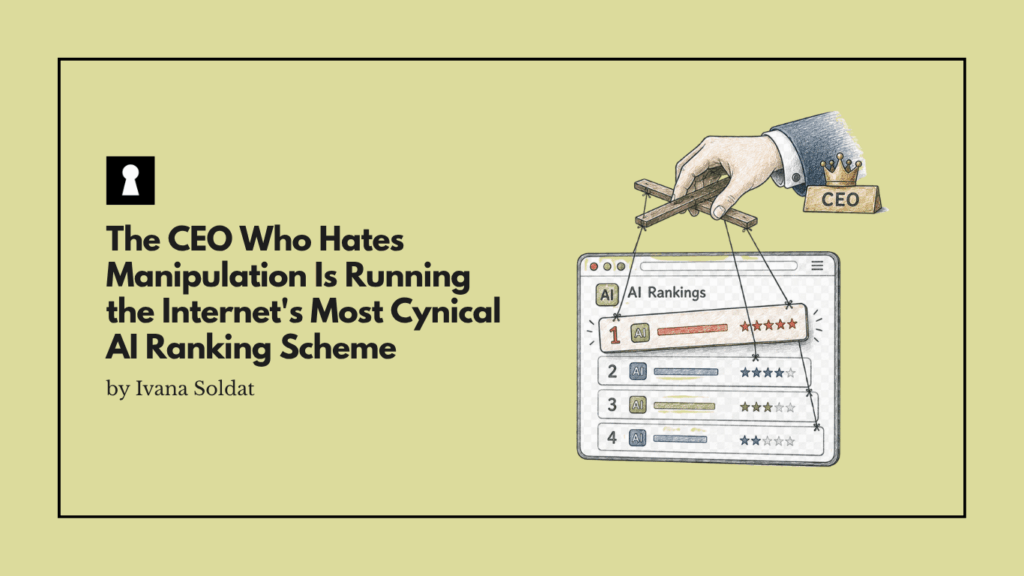
Tobi Lütke has opinions about information quality. Strong ones.
The Shopify CEO has been publicly vocal about the state of online content for years, he’s told people to read vetted nonfiction instead of what he once called “middle management garbage.” He’s pushed back against low-quality, SEO-slop content clogging up the internet. He’s positioned himself as someone who cares about clean information ecosystems, not algorithmic tricks.
So it’s a little awkward that his company just got caught running one of the more brazen AI manipulation plays anyone has documented yet.
What Shopify Actually Did
According to a recent report in The Atlantic, Shopify has published dozens of “best ecommerce platform” lists, written by Shopify, that consistently rank Shopify at number one. Not one or two blog posts. Dozens of them, seeded into the public search index, designed to look like independent third-party assessments.
The goal wasn’t just traditional SEO. It was Generative Engine Optimization, the practice of shaping what AI models say when someone asks them a question.
And it worked. When users ask ChatGPT something like “what’s the best platform to start an online store,” the model pulls from available sources to construct its answer. Several of those sources, it turns out, were lists authored by Shopify’s own marketing team. The model cites them as if they were independent reviews. They are not.
ChatGPT doesn’t know who wrote the list. It just knows it exists, it’s widely indexed, and it says Shopify is number one. So it tells you Shopify is number one.
This Is the New SEO War, and Most Brands Are Already Fighting It
To be clear: Shopify didn’t invent this. GEO is an arms race that’s been quietly escalating for the past 18 months as brands realized that ranking in Google is increasingly irrelevant if ChatGPT, Perplexity, and Gemini are answering questions before users even click anything.
The logic is simple. AI models are trained on and reference publicly available content. If your brand publishes enough authoritative-sounding content that positions you favorably, such as comparison articles, platform roundups, “best of” lists, those models start regurgitating your framing back to users as if it’s objective fact.
Shopify just did it at a scale that got noticed.
What makes this story different from the usual “brand does SEO” cycle isn’t the tactic. It’s the person at the top.
The Tobi Problem
Earlier this year, Shopify quietly open-sourced a tool called QMD, a local retrieval system designed to help AI agents access information without being exposed to web advertising or, specifically, GEO manipulation. The stated purpose was to give AI agents a cleaner, less gamed source of information.
Tobi Lütke has spoken publicly about wanting AI to operate in cleaner information environments. He’s worried, on the record, about AI models being fed manipulated content.
Meanwhile, his marketing team was busy manufacturing exactly the kind of content he says he’s worried about.
This isn’t a minor contradiction. It’s the CEO of a major platform building a tool to protect AI from manipulation while his own company games the same systems. The left hand and the right hand are not just not talking, they appear to be actively working against each other.
What This Means for You
If you’re a DTC merchant using Shopify, none of this changes your day-to-day. Shopify is still a solid platform, and the fact that they’re aggressive about AI visibility doesn’t make the product worse.
But there’s a broader point here worth sitting with.
The recommendations coming out of AI chatbot, which platform to build on, which tools to use, which apps to install, are increasingly shaped by whoever is most aggressively playing the GEO game, not by whoever actually has the best product. The “neutral AI recommendation” most merchants assume they’re getting when they ask ChatGPT for advice is, in many cases, a paid or manufactured outcome that nobody labeled as such.
Shopify can afford to play this game at scale. Most of their competitors can’t. Which means the AI answer to “what ecommerce platform should I use” is going to keep sounding like a Shopify press release, regardless of what the actual competitive landscape looks like.
Our Take
The Uncomfortable Question
The broader issue this surfaces isn’t really about Shopify. It’s about what happens when every major brand does exactly what Shopify did, just with less visibility.
Because they already are.
The difference is that most companies doing GEO manipulation don’t have a CEO who’s publicly on record talking about the importance of clean information ecosystems. Most companies don’t simultaneously release open-source tools to fight the exact thing they’re doing.
That combination is what turned a fairly standard marketing tactic into a story.
If Lütke is serious about the values he’s expressed publicly, the obvious move is to pull the content, acknowledge the tension, and lead by example. The alternative is to quietly let the cycle continue, and hope nobody runs the numbers on how many of those “independent” rankings trace back to shopify.com/blog.
So far, the company hasn’t commented.