
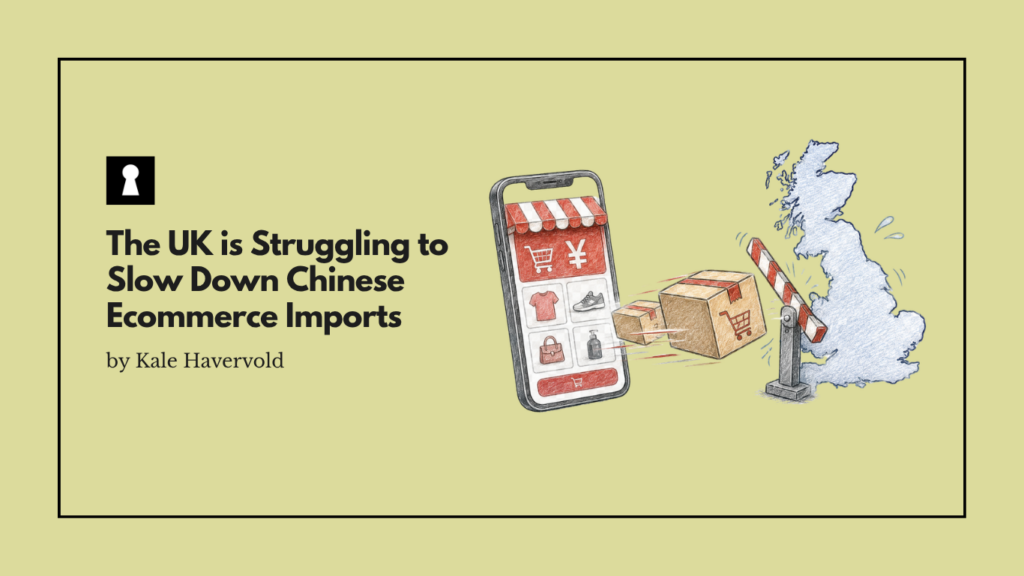
Thanks to the incredibly cheap prices offered on platforms like Temu and Shein, cheap ecommerce products from China find their way into homes in countries across the world. But few countries see as many of these imports as the UK.
British retailers are pleading with the government to crack down on these items, much like many other countries across Europe and around the world have done, to improve competition and back up sellers in the UK.
UK Among the Largest Importers of Cheap Chinese Ecommerce Exports
According to export data from China, the UK is one of the most popular destinations for cheap Chinese exports. In fact, $1.8 billion worth of these exports entered the UK between December 2025 and April 2026, making it the sixth-largest market for them during this period.
Some of the UK’s main European rivals, such as France and Germany, appear much lower down the list at around $880 million and $758 million, respectively. While the data shows that these exports are down 11% in the UK compared to last year, this falls very short of the 34% decrease in France and the 36% drop in Germany.
UK Retailers Are Calling for Changes. Now.
As you could imagine, many retailers in the UK are unhappy with these high import numbers, as it forces them to directly compete with products at prices they simply can’t match. Many of these retailers are calling for the UK government to close tax loopholes that allow Chinese ecommerce giants to operate unfairly in the UK.
In a budget statement back in November, Rachel Reeves, the Chancellor of the Exchequer, said that she promised to do so by 2029. However, retailers argue that this isn’t soon enough.
For example, George Weston, the CEO of Associated British Foods, said that the delay “only supports those operating overseas with no UK footprint and disadvantages UK retailers who employ thousands.” He also added that “Other countries are acting decisively to support their domestic sectors and the government must do the same.”
Similarly, Dan Finley, the CEO of clothing retailer Debenhams Group, said that “Waiting until 2029 risks allowing billions more pounds of imports to enter under a regime that creates a structural disadvantage for UK retailers and reduces potential tax revenues,”.
In addition to pleading their own case, these retailers also point out the potential tax revenue that the UK is leaving on the table by not closing the tax loophole.
For example, Alex Baldock, the outgoing CEO of electronics retailer Currys, said that “Closing the loophole would generate significant tax receipts for the Treasury at a time when the government is looking for every pound of revenue it can find.”
Many Other Regions Have Already Taken Action
Unlike the UK so far, many other nations and regions around the world have already taken action against these cheap and low-value ecommerce imports coming into their countries as frequently as they have in the past few years.
For example, as of July 2026, the EU is removing the duty exemption that allowed parcels valued under €150 to enter the EU customs-free. Not only that, but imports will also face an estimated €3 customs duty per item. Also, starting on November 1st, 2026, a €2 handling fee per order will be applied to cover enhanced screening costs.
Individual countries have also taken measures to address these concerns. For instance, France also has a long history of issues with Shein specifically, which includes numerous fines for deceptive business practices, placing cookies without consent, returns, product information, and more.
However, like the UK, there are some nations where more work is needed, like Germany. In fact, the German economy loses €2.4 billion in economic value annually thanks to Shein and Temu, due to both regulatory non-compliance and incredibly low pricing that local sellers can’t match.
The President of the German Retail Federation, Alexander von Preen, even called the situation a threat to Germany’s position as a viable business location and, he even called for policymakers to take decisive action after too many years of inaction.
Our Take
Local Retailers and Sellers Are Ready for Change, But When Will It Come?
While the UK says it has plans in place to close the tax loopholes that let Chinese ecommerce giants take more and more market share in the region, retailers aren’t happy with the 2029 deadline given.
As the weeks, months, and years go by without any official steps being taken by the UK, there’s a chance the likes of Temu and Shein continue to grow, which is sure to make UK retailers even more unhappy than they already are.
It’ll be interesting to see if the UK Government listens to the wishes of local sellers to speed up the process, or if it waits and sticks to the 2029 deadline. If so, there’s no telling how the ecommerce landscape in the country may look by then if UK sellers continue to be forced to compete with low-cost and potentially non-compliant imports.