We covered the New Jersey Fair Price Protection Act when Governor Mikie Sherrill signed it into law on July 23, making New Jersey the first US state to explicitly ban surveillance pricing for groceries and necessities. We noted at the time that state legislation has a documented pattern of becoming federal legislation, and that the regulatory direction was clear even if the timeline was not.
The timeline just shortened.
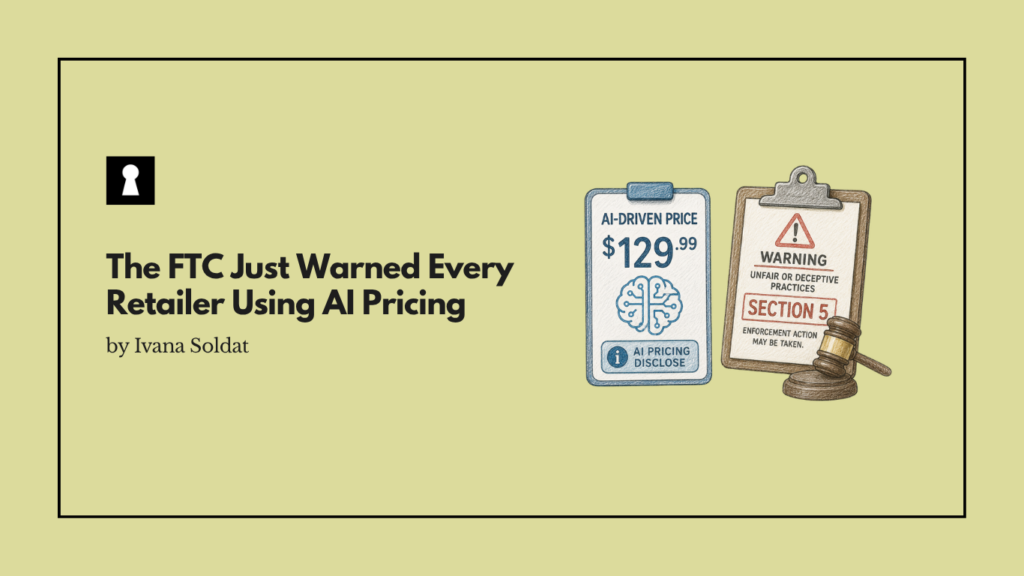
On August 19, the Federal Trade Commission issued for public comment a Proposed Enforcement Policy Statement Regarding Personalized Pricing. The FTC is not banning personalized pricing. What it is doing is telling businesses that existing federal law already covers undisclosed personalized pricing, and that the Commission intends to enforce aggressively against businesses that use consumers’ personal data to set individualized prices without telling them.
What the FTC Is Actually Proposing
The Commission begins by acknowledging what it cannot do:
“Congress has not given the Commission the authority to prohibit personalized pricing in all circumstances.”
What it is proposing is a disclosure requirement with teeth. Where consumers reasonably expect that a price will not vary based on their personal data, businesses using personalized pricing should clearly and conspicuously disclose three things: that the price is personalized, the basis for the personalization, and the types of data used to personalize the price.
Failure to provide those disclosures is likely to constitute a deceptive or unfair practice under Section 5.
The Examples That Explain What the FTC Is Targeting
The Commission’s choice of illustrative examples reveals exactly where its concern is concentrated.
A food-delivery company could raise a price based on information indicating that a consumer is unlikely or unable to leave home to purchase food. A grocery company could charge a customer more for milk because data indicates that several children live in the household.
This example has an AI that identified that the consumer is in a position of reduced ability to walk away from a transaction, and the price reflects that reduced optionality rather than any market condition. The FTC’s deception theory covers the disclosure failure.
The unfairness theory covers the harm itself: consumers cannot reasonably avoid substantial injury when they do not know that their personal circumstances are being used to extract maximum payment.
What Remains Open
The proposed policy statement explicitly does not take a position on whether personalized pricing can be unfair even when it is fully disclosed. That reservation is significant. The FTC is saying disclosure is the minimum.
It is leaving open the possibility that some personalized pricing practices may be unfair regardless of whether disclosure is provided.
The State Law Landscape Surrounding the FTC Proposal
Connecticut, Maryland, and New Jersey have each enacted laws this year restricting the use of personal data to set individualized prices. Eleven other states have introduced similar bills. The state approaches vary significantly in scope, Connecticut’s law is broadest, New Jersey’s targets groceries specifically, Maryland’s focuses on food retail and delivery.
The FTC policy has one further effect that extends its reach beyond direct federal enforcement. Connecticut’s Unfair Trade Practices Act expressly provides that state courts and regulators “shall be guided by” interpretations of Section 5(a)(1) of the FTC Act.
Other states have similar provisions. If the FTC finalises its enforcement policy, state regulators operating under UDAP statutes that look to Section 5 precedent may have a ready-made framework for addressing surveillance pricing without waiting for their own legislatures to act.
The FTC’s proposal could multiply its practical effect across dozens of states that have enacted no surveillance pricing legislation of their own.
The Congressional Dimension
The FTC’s proposal came two weeks after the Senate Judiciary Committee held a hearing entitled “Your Data, Their Profit: The Consumer Cost of AI Surveillance Pricing.”
Chairman Josh Hawley and Ranking Member Richard Durbin both expressed substantial concerns. Senator Blumenthal called for federal law and national safeguards. Hawley indicated he intends to pursue legislation. Blumenthal said he and Hawley already have a legislative framework under discussion.
Bipartisan Senate interest in surveillance pricing legislation, combined with an FTC enforcement policy, combined with state law proliferation across 14 states, is a regulatory environment that any ecommerce business using AI to set individualised prices needs to take seriously before the end of 2026.
What This Means for Ecommerce Brands Right Now
Any ecommerce brand using AI, browsing history, device data, location data, purchase history, or other personal data to show different prices to different customers for the same product should immediately audit its pricing system against the FTC’s disclosure framework.
The three required disclosures, that the price is personalised, the basis for the personalisation, and the types of data used, are not technically difficult to implement. They are likely to be commercially uncomfortable for brands whose personalised pricing has not been disclosed.
The brand that uses a consumer’s zip code, device type, browsing history, and purchase frequency to show them a higher price for the same product than another consumer sees is not running an illegal pricing model under the current FTC proposal. But it is running an undisclosed one, and undisclosed is what the FTC is proposing to treat as deceptive.
Our Take
The FTC Just Told Every Business Using AI Pricing That The Policy Is a Disclosure. The Enforcement Vehicle Already Exists.
The FTC’s proposed enforcement policy on personalized pricing is the most consequential development in AI-driven ecommerce pricing regulation since New Jersey’s Fair Price Protection Act, and it has arrived faster than most ecommerce operators were expecting.
The Commission is not proposing new law. It is proposing to use existing Section 5 authority against undisclosed personalized pricing, which means the enforcement vehicle does not require Congressional approval and does not require a lengthy rulemaking process. The businesses that need to respond to this are not just the large platforms with sophisticated dynamic pricing algorithms.
They are any business that uses personal data to show different prices to different customers. If your pricing system distinguishes between customers based on their personal data without telling them, the FTC’s proposed policy says that distinction should be disclosed. The time to build the disclosure mechanism is before the comment period closes and the policy is finalised, not after the first enforcement action.