
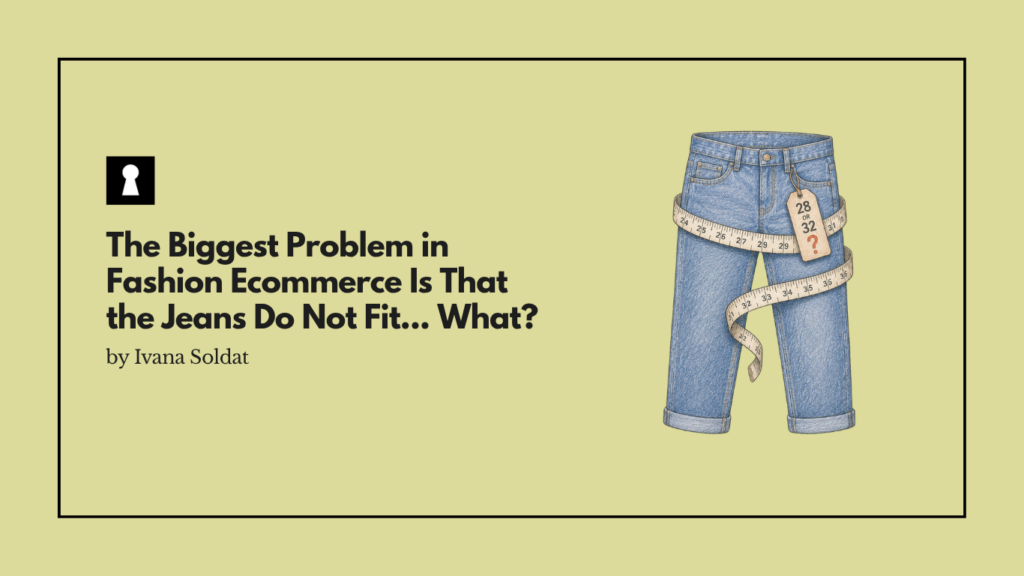
“When was the last time you ordered jeans online and they actually fit?” That is the question Bloomberg’s Sonja Wind posed today in a segment examining whether AI-powered tools can finally solve the sizing problem that has plagued fashion ecommerce since the channel existed. Brands hope that AI-powered tools will help deliver the perfect size, meaning happier customers and fewer returned goods.
The question is fair and the stakes are real. Fashion ecommerce returns run at 30 to 40 percent in most markets, compared to 8 to 10 percent for in-store purchases. The primary driver is sizing.
Why Sizing Is Harder Than It Looks
The sizing problem persists despite decades of effort because it has multiple distinct failure modes, each requiring a different solution.
The first is sizing inconsistency within brands. A size medium from one brand’s spring collection does not mean the same thing as a size medium from the same brand’s autumn collection. Fit models change. Fabric choices affect drape and stretch differently. A brand that has not standardised its own sizing across collections cannot be fixed by any AI tool, because there is no consistent underlying truth for the AI to learn from.
The second is sizing inconsistency across brands. Every consumer knows they wear a different size at Zara than at Uniqlo than at J.Crew. There is no universal standard. An AI recommendation engine learning from purchase history across brands is learning from noise.
The third is body diversity. Standard size charts were developed on a narrow range of body measurements. A consumer whose shoulders, waist, and hips fall in different size ranges for a particular garment will find that no standard size fits well, regardless of how accurate the recommendation engine is.
The fourth is preference variation. Two consumers with identical measurements may want different fits, one wants a relaxed silhouette, the other wants tailored. An AI system that recommends based on measurements without capturing fit preference is solving the wrong problem.
What the Current AI Tools Actually Do
Virtual try-on technology overlays a selected garment on a photo of the consumer or a standardised body form matching their measurements. The technology has improved dramatically: AI-generated images are now photorealistic enough to give a meaningful impression of how a garment will drape and how colour will render. The limitation is that virtual try-on tells the consumer how the garment will look, not how it will feel.
A shirt that fits beautifully in the image may have a collar that sits wrong, a fabric that feels scratchy, or an armhole that restricts movement.
Size recommendation engines use purchase history, stated measurements, and sometimes body scans to recommend the specific size within a specific brand most likely to fit. The better systems learn from returns data. The limitation is the cold start problem: the first recommendation for a new brand has no brand-specific learning to draw on.
Body measurement technology, typically delivered via a smartphone camera, generates a detailed measurement profile from a short video. When the brand’s size chart is accurate and the consumer’s measurements are accurate, this approach can significantly reduce sizing errors. The limitation returns us to the first failure mode: the accuracy of the size chart on the brand side.
The Returns Rate Has Not Moved
Despite several years of significant investment in all three categories of AI sizing technology, the overall fashion ecommerce returns rate has not meaningfully declined.
The reason is that the tools address only part of the problem. A sophisticated size recommendation engine that correctly identifies the right size still cannot help the consumer who wants a different fit aesthetic, who is buying for an occasion where the garment needs to work in a specific way, or whose measurements genuinely do not align with any standard size in the brand’s range.
There is also a behavioural component that technology cannot fix. A meaningful share of fashion ecommerce purchases are made with the intention of returning one or more items, buying multiple sizes or styles to try at home, keeping what works and returning the rest. For these consumers, improved sizing accuracy is beside the point.
The Actual Solution Is Probably Not Technological
The more accurate framing is that AI is a partial solution to some components of the problem, in a context where the problem has structural dimensions that technology cannot address.
Genuine sizing standardisation across the industry, or at least within brands, would do more for returns rates than any AI recommendation engine. Extended sizing that accommodates the full range of human body shapes would reduce the proportion of consumers for whom no standard size fits.
Detailed garment-level measurement information, actual centimetre measurements of the garment, not just a size label, allows consumers to make their own fit judgments without relying on an AI intermediary.
These are not technological innovations. They are category practices that the fashion industry has been slow to adopt because the cost falls on brands and manufacturers rather than on the logistics operators who absorb the returns.
Our Take
AI Can Tell You the Size. It Cannot Tell You How the Denim Feels.
The AI sizing problem in fashion ecommerce is real, the tools are improving, and the investment is substantial.
But the returns rate has not moved because fit is not primarily an information problem. It is a standardisation problem, a body diversity problem, and in many cases a consumer behaviour problem that exists independent of sizing accuracy.
The brands that will make the most meaningful progress on returns are the ones that address the structural issues: consistent size charts, actual garment measurements published at the product level, extended sizing, and honest returns policies that distinguish between the consumer who is disappointed with fit and the consumer who is using the store as a fitting room.