
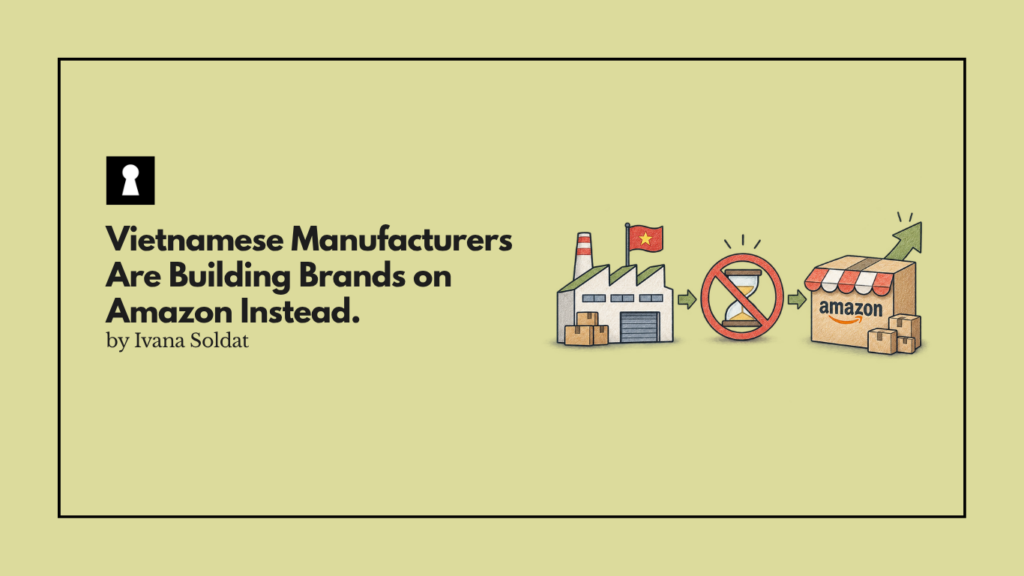
The traditional Vietnamese manufacturing story has been a variation on the same theme for 30 years: competitive labour costs, reliable production, price-competitive against China for certain categories, excellent for OEM orders. International buyers come to Vietnam, find a supplier, place an order, and take the brand to market themselves. The Vietnamese manufacturer gets the production margin. The buyer gets the brand margin. The gap between those two numbers is where the commercial leverage sits.
Vietnamese manufacturers at VIS 2026 are trying to close that gap.
“With e-commerce platforms such as TikTok Shop and Amazon, we can take control of the technology, build our own brands and sell directly to markets with strong purchasing power, which gives us better profit margins,” said Nguyen Dinh Hung, director of Minh Anh International Manufacturing and Trading Co.
Minh Anh exports cooling products, air conditioners, heaters and neck fans to the US, Europe, Dubai and other markets. It shipped an order of 400,000 neck fans to a single US partner. Its heaters perform well through direct B2C sales on Amazon.
The OEM-to-Brand Transition That Ecommerce Is Making Possible
The shift from OEM supplier to branded seller is not new as a strategic ambition. What is new is the infrastructure that makes it achievable for a mid-size Vietnamese manufacturer rather than only for the largest and best-capitalised ones.
Amazon’s marketplace and Alibaba’s global platforms remove the traditional barriers: you do not need a distribution network in the US, you do not need a retail buyer relationship, you do not need a physical presence in your target market. You need inventory in an FBA warehouse, a product listing with good photography and accurate attributes, a review strategy, and the operational capability to handle fulfilment and customer service across time zones.
That is still a meaningful operational undertaking. But it is materially more achievable than the pre-ecommerce version, which required establishing distributor relationships, negotiating shelf space, and absorbing the working capital requirements of building brand awareness in markets where you had no existing presence.
VinaBedding: The Case Study Worth Examining Closely
VinaBedding’s core product is natural rubber mattresses. Vietnam is one of the world’s largest rubber producers. The raw material advantage is structural.
“US consumers once largely preferred spring mattresses but are now increasingly turning to 100 percent natural rubber mattresses,” said a VinaBedding representative. “This presents an opportunity for Vietnamese businesses, given the country’s strong rubber supply and relatively competitive labor costs.”
VinaBedding has registered its brand in 18 countries. It is, by its own account, the first Vietnamese natural rubber mattress brand to enter the US B2C market on Amazon. The positioning decision is the strategically interesting part: “We position our products in the mid-range segment, with prices that reflect the quality.”
Mid-range, not budget. Quality positioning, not price positioning. This is exactly the right strategy for a Vietnamese manufacturer trying to build a sustainable brand. Competing on price against entrenched Chinese sellers on Amazon is a race to zero that most Vietnamese brands cannot win. Competing on authentic provenance, raw material quality, and mid-range positioning is a differentiation strategy that is both defensible and sustainable.
The Certification Reality That Buyers Are Enforcing
The US buyer presence at VIS 2026 told a parallel story about what is actually required to sell into the US market directly.
Jessica, owner of US-based Js5 Global Trade, walked up to a Vietnamese manufacturer’s booth and her opening question was not about price. It was: “What certifications do you currently have for these products?”
That sequencing, certifications before price, reflects the reality of selling consumer goods directly in the US via Amazon or any other channel. CPSC compliance, UL certification for electrical products, FCC certification for electronics, California Prop 65 compliance, Amazon’s own product safety requirements, the certification stack for US consumer goods is substantial and non-negotiable.
The CPSC eFiling requirement that we covered in July, mandatory electronic filing of compliance certificates before imported consumer goods enter US commerce, effective July 8, adds another layer that any Vietnamese brand targeting the US market needs to account for. Minh Anh’s Hung acknowledged his company is positioned to meet these requirements. Not every Vietnamese manufacturer at VIS 2026 is.
Why the Tariff Environment Makes This More Urgent Now
Vietnam is in a comparatively advantageous position relative to China in the current US tariff environment.
The Section 301 tariffs we covered last month imposed 10-12.5% duties on goods from 60 countries. Vietnam’s specific tariff exposure varies by product category, but the tariff gap between Vietnamese-manufactured goods and Chinese-manufactured goods in US customs has been meaningful enough to accelerate sourcing shifts toward Vietnam.
A Vietnamese manufacturer that has spent the last two years building its Amazon seller account, establishing its certification stack, and growing its review base is in a structurally better position now than it was before the tariff escalation. The US buyer who previously sourced from China on price is now comparing Chinese goods with tariff surcharges against Vietnamese goods at potentially lower tariff rates. The landing cost math has changed.
The VIS 2026 Numbers That Show How Far This Has Come
580 international distribution and sourcing groups from 60 countries. 600 Vietnamese businesses. 13,000 direct B2B meetings. An Irish buyer named Colm describing Vietnam as being “in a very good position to embrace the opportunities that are coming.”
This is not a niche trade show. This is a mainstream sourcing event where the Vietnamese side is no longer purely the supplier and the international side is no longer purely the buyer. The Vietnamese manufacturers at VIS 2026 want to be the brand.
Ecommerce platforms have made that possible by removing the geographic and distribution barriers that previously kept the two roles separate.
Our Take
Vietnamese Manufacturers Are Not Waiting for Orders. They Are Placing Them.
The shift from OEM manufacturer to branded DTC seller is one of the most consequential commercial transitions in global ecommerce, and it is happening in Vietnam faster than most Western ecommerce coverage has noticed.
The combination of structural advantages, rubber supply, competitive labour, tariff positioning relative to China, with the accessibility of Amazon and TikTok Shop as direct-to-consumer channels is creating a cohort of Vietnamese brands that did not exist five years ago.
VinaBedding registering its brand in 18 countries and being the first Vietnamese natural rubber mattress brand on Amazon US is not a curiosity. It is a preview of what the next decade of Vietnamese export commerce looks like when manufacturers decide they would rather own the brand than fill the order.