
There’s a pitch deck making its way around ecommerce boardrooms right now. It has a slide that says something like: “AI agents will handle 80% of your operations by 2027.”
Most of it is noise.
That’s not a contrarian take for the sake of it. It’s just what happens when a genuinely transformative technology arrives and every vendor, consultant, and LinkedIn influencer rushes to attach their product to it.
AI agents are changing ecommerce, in specific, measurable ways, in specific parts of the stack. But the gap between what’s being promised and what’s actually shipping is still wide enough to drive a warehouse forklift through.
So let’s be precise about this. What is an AI agent, really? What’s working today, what’s still vaporware, and what do you actually need to do if you run an online store?
“Agentic” Is Being Slapped on Everything, But Here’s What It Actually Means
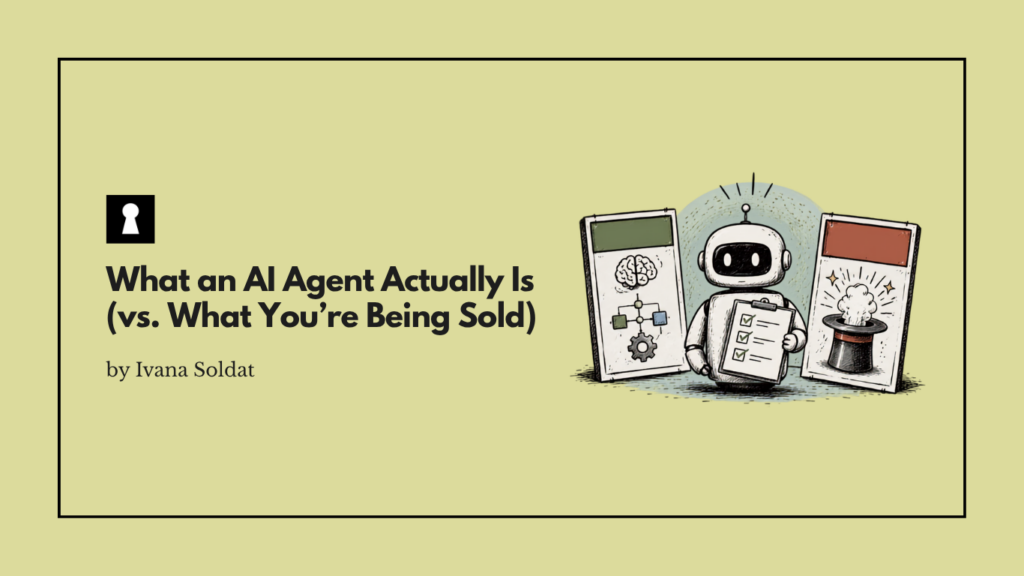
An “AI agent” is not a chatbot with a fresh coat of paint. The distinction matters because right now, in mid-2026, almost everything is being marketed as agentic.
A true AI agent has four things:
- the ability to perceive its environment,
- a goal,
- the autonomy to take multi-step actions toward that goal,
- and the capacity to adapt when things don’t go as planned.
It doesn’t just answer questions, it does things. It browses, decides, executes, checks the outcome, and adjusts.
Most “AI agents” deployed in ecommerce today are closer to sophisticated automation with a language model bolted on. That’s not nothing — it’s often genuinely useful — but it’s not the same as the autonomous, self-correcting systems the marketing decks promise.
The honest benchmark: when Carnegie Mellon researchers staffed a simulated company entirely with AI agents, the best-performing model completed just 24% of its assigned tasks autonomously. Keep that number in your head as you read the vendor case studies.
The Numbers Are Enormous, But Are They Real?
The figures being cited are staggering. McKinsey estimates that agentic commerce could redirect $3–5 trillion in global retail spend by 2030. Gartner predicts AI agents will intermediate $15 trillion in B2B purchases by 2028. Morgan Stanley says nearly half of online shoppers will use AI shopping agents by 2030.
These projections could be right. They could also be wildly off. Analysts projecting commerce behavior five years out have a poor track record, and the history of ecommerce is littered with “this changes everything” moments that took a decade longer than expected.
What’s harder to argue with is the near-term traffic data. Adobe Digital Insights found that AI-driven visits to U.S. retail sites increased 393% year-over-year in Q1 2026. More interesting than the volume: those AI-referred visitors converted 42% better than non-AI traffic, a complete reversal from March 2025, when AI-referred traffic converted 38% worse. That 80-percentage-point swing in twelve months is the most underreported pivot in ecommerce data right now.
The reason makes sense when you think about it. Shoppers arriving via AI have already had a conversation. They’ve described what they want, filtered by budget, compared options. They land on your product page with intent. That’s a different visitor than someone who clicked a broad keyword ad.
That shift alone has real implications for how you think about product discovery, content, and your digital shelf. It also reshapes what ecommerce success actually looks like in competitive markets — speed, relevance, and AI-surface presence are joining price and selection as the factors that decide who wins.
Where is AI Actually Delivering?
AI is delivering in the following areas.
Customer Service: The Least Glamorous Application, and by Far the Most Proven
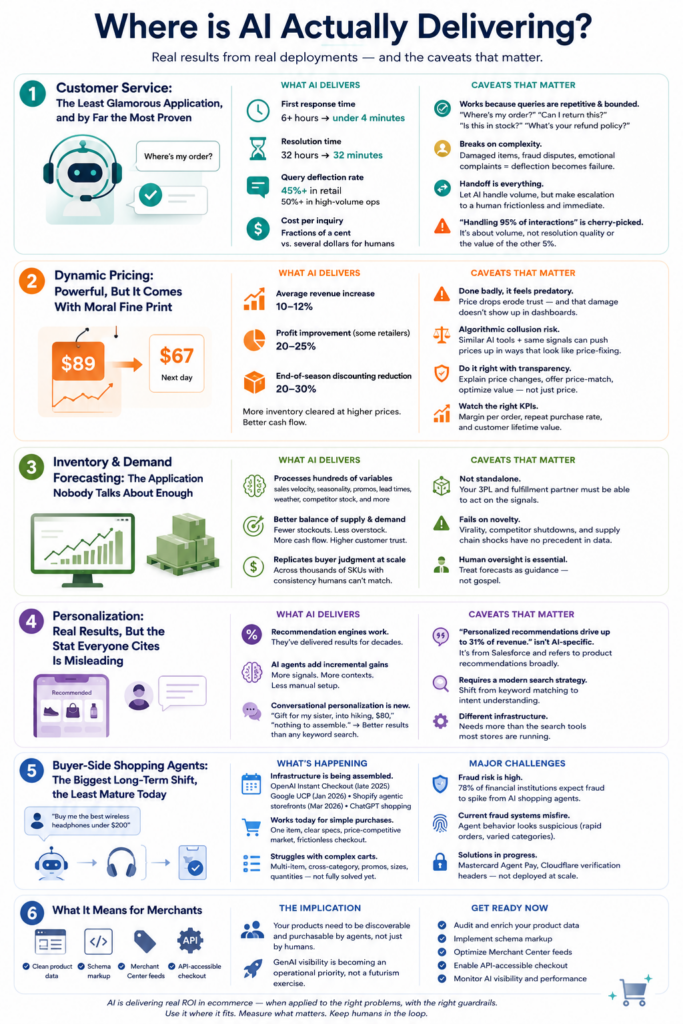
If there’s one area where AI agents have delivered real, measurable ROI in ecommerce, it’s customer support. The numbers here are from actual deployments, not projections. AI-powered support tools have cut first response times from over six hours to under four minutes in documented cases. Resolution times have dropped from 32 hours to 32 minutes. AI agents now deflect over 45% of incoming customer queries in retail — and for high-volume operations, that number climbs above 50%.
The cost math is simple. An AI agent handling a “where’s my order?” inquiry costs fractions of a cent. A human agent costs several dollars per interaction, plus training, plus benefits, plus the fact that they can’t work at 3am on a Sunday when your busiest international market is waking up. Neglecting always-on support is one of the most common and most avoidable mistakes ecommerce operators make.
But here’s the important caveat: this works because customer service queries in ecommerce are highly repetitive and bounded. “Where’s my order?” “Can I return this?” “Is this in stock?” “What’s your refund policy?” These are closed questions with knowable answers. The AI doesn’t need to be creative. It needs to be fast, accurate, and connected to your order management system.
The moment queries get complicated deflection becomes failure. The retailers doing this well have figured out the handoff: let the agent handle volume, but make the escalation to a human frictionless and immediate. The ones doing it poorly have built systems that trap customers in loops while the agent confidently gives wrong answers.
One more thing worth saying: “handling 95% of interactions”, a statistic that gets thrown around frequently, is a cherry-picked metric. It tells you about volume, not about the quality of resolution or what happened to the other 5% that probably contained your most valuable customers with your most complex problems.
Dynamic Pricing: Powerful, But It Comes With Moral Fine Print
Amazon updates its prices roughly every 10 minutes. They’ve been doing this for years. AI-driven dynamic pricing is not new, but the agents running it have gotten significantly more capable, and the results at scale are meaningful.
Companies implementing AI pricing strategies are reporting average revenue increases in the 10–12% range, with some retailers claiming profit improvements of 20–25%. The mechanism is straightforward: the system monitors competitor pricing, demand signals, inventory levels, and conversion data in real time, then adjusts prices to maximize margin or sell-through depending on your objective.
Brands using demand-based models are reporting 20–30% reductions in end-of-season discounting, which means more inventory cleared at higher prices, which means better cash flow.
This is genuinely useful. But it comes with a catch that most vendors conveniently skip.
Dynamic pricing done badly feels predatory. Customers who pay $89 for a product and then see it at $67 the next day don’t forget that. The trust erosion is real and it doesn’t show up in the pricing agent’s dashboard. There’s also the algorithmic collusion problem: when multiple retailers use similar AI pricing tools that all respond to the same signals, prices can converge upward in ways that look a lot like price-fixing even if no human ever made that decision. Regulators are starting to notice.
The retailers getting this right are pairing pricing agents with transparency, letting customers see why a price changed, offering price-match commitments, using the AI to optimize value delivery alongside price.
That’s a harder problem than just running the optimization. And it’s why the ecommerce KPIs worth watching in a dynamic pricing rollout aren’t just revenue and conversion, margin per order, repeat purchase rate, and customer lifetime value tell you whether you’re actually building something or just extracting it.
Inventory and Demand Forecasting: The Application Nobody Talks About Enough
This is the area that gets the least press and probably delivers the most consistent value.
AI agents managing inventory are doing something that was genuinely impossible for human teams at scale: processing hundreds of variables simultaneously — historical sales velocity, seasonality, promotional calendars, supplier lead times, weather patterns, competitor stock levels — and producing demand forecasts accurate enough to actually change purchasing behavior.
The business impact is real. Overstocking is one of the largest hidden costs in ecommerce; capital tied up in slow-moving inventory is capital not being used for growth. Understocking during demand spikes costs revenue and, worse, costs customer trust. Getting the balance right used to require experienced buyers with years of category knowledge. AI systems can now replicate a significant portion of that judgment at scale, across thousands of SKUs.
None of this works in isolation from your 3PL and fulfillment partner. The best demand forecast in the world is worthless if your fulfillment operation can’t respond to the signals the AI is generating.
The caveat: these tools fail badly on novelty. An AI trained on historical data has no idea how to respond to a product that goes viral, a competitor that shuts down overnight, or a supply chain disruption with no precedent. Human oversight of the outputs is still the right operating model.
Personalization: Real Results, But the Stat Everyone Cites Is Misleading
“Personalized recommendations drive up to 31% of revenue.” You’ll see that statistic cited in approximately every AI ecommerce article published in the last two years. It comes from Salesforce research and it refers to product recommendations broadly — not specifically AI agents.
Here’s the honest picture: recommendation engines work. They have worked since Amazon deployed one in the early 2000s. What AI agents add is the ability to personalize across more signals, in more contexts, with less manual configuration. That’s incremental improvement, not transformation.
What genuinely is new is conversational personalization, the ability to have a customer describe what they want in natural language and get a curated response that accounts for their history, preferences, and context. “I need a gift for my sister, she’s into hiking, budget around $80, nothing she’d have to assemble.” That query, handled well by an AI agent with access to your catalog and the customer’s purchase history, produces a genuinely better result than any keyword search.
This matters enormously for ecommerce search strategy, the shift from keyword matching to intent understanding is one of the most concrete changes AI is driving right now, and it requires different infrastructure than the search tools most stores are running.
Buyer-Side Shopping Agents: The Biggest Long-Term Shift, the Least Mature Today
This is where the hype is most concentrated and the actual deployment is thinnest.
OpenAI’s Instant Checkout went live via its Agent Commerce Protocol in late 2025. Google launched the Universal Commerce Protocol at NRF in January 2026, co-developed with Shopify, Target, and Wayfair. Shopify made agentic storefronts available to millions of merchants in March 2026. ChatGPT hit 900 million weekly active users and introduced shopping features. The infrastructure is being assembled.
The promise: a customer tells their AI assistant “buy me the best wireless headphones under $200” and the agent researches, compares, negotiates if possible, applies loyalty points, selects the fastest shipping, and confirms the purchase. The customer never visits your website.
The reality today: this works for simple, commodity purchases with well-structured product data. One item, clear specifications, price-competitive market, frictionless checkout. When a user asks an agent to “order everything I need for a dinner party,” the agent needs to build a multi-item cart across categories, apply promo codes, select the right sizes and quantities, and current protocols handle this poorly. Multi-item cart support is described as a 2026 priority, which means it’s not fully there yet.
The fraud problem is also unsolved. 78% of financial institutions expect fraud to spike from AI shopping agents. Traditional fraud detection flags agent behavior as suspicious, rapid sequential orders, purchases across unrelated categories, because it looks like a compromised account. Mastercard’s Agent Pay and Cloudflare’s cryptographic verification headers are working on this, but it’s not deployed at scale.
For merchants, the implication is clear even if the timeline is uncertain: your products need to be discoverable and purchasable by agents, not just by humans. That means clean product data, schema markup, Merchant Center feeds, and API-accessible checkout. Your brand’s GenAI visibility is becoming an operational priority, not a futurism exercise.
What Gets Sold That Doesn’t Actually Work
Tools claiming to “autonomously run your campaigns” are mostly automating the reporting layer while a human still makes the actual creative and strategic decisions. The ones that do operate autonomously tend to optimize toward easily measurable proxies, such as click rate and immediate ROAS, at the expense of brand and long-term customer value.
A content strategy that actually drives traffic and sales still requires human judgment about what you’re building and who you’re building it for. No agent knows whether your brand should be funny or serious, whether your customer is a first-time buyer or a ten-year loyalist. Those calls still need people.
A related failure mode: merchants using AI coding agents to rapidly spin up or overhaul their ecommerce stack without understanding what they’re building. There’s a reason vibe coding in ecommerce can replace workflows but not infrastructure, the distinction matters enormously when something breaks at 2am on a peak sales day and nobody on the team actually understands the system beneath it.
The agent-buys-for-you model also breaks down fast when the purchase involves tradeoffs that require taste, judgment, or incomplete information. Buying a laptop, a mattress, a piece of furniture for a specific room, these involve considerations an agent can’t fully capture from a text prompt. The more considered the purchase, the worse autonomous agents perform, because the customer doesn’t fully know what they want until they’re in the process of deciding.
Perhaps the most insidious sales pitch is AI agents as a substitute for getting your site right. No agent compensates for a slow site, confusing navigation, or a broken checkout flow. Plenty of merchants have bought AI personalization tools while their conversion rate fundamentals were still broken. The AI optimizes the experience the customer has after they arrive. If that experience is bad, the AI just gets them to the bad part faster.
Then there’s the SEO angle. Some merchants took the agentic content promise literally and published thousands of AI-generated pages in 2024 and 2025. Many saw short-term ranking gains, then manual penalties, then sustained traffic declines that took months to recover from.
AI can assist content creation, but it cannot replace editorial judgment about what your audience actually needs. An ecommerce SEO checklist built on real topical authority still outperforms bulk AI output, and Google has made clear it intends to keep it that way.
The Physical Problem That No Protocol Can Solve
Here’s the gap that’s going to determine which retailers actually benefit from agentic commerce and which ones get left behind.
An AI agent can browse your catalog and decide to buy something. It can navigate to checkout. It can complete a payment using agent-compatible protocols. But it cannot make your warehouse pack and ship the order in the timeframe a customer expects. The physical layer doesn’t care about protocols.
Most retailers are racing to appear in AI-powered discovery surfaces while their fulfillment operations are completely unprepared for the transaction volume and speed that agentic commerce implies. The “agentic readiness gap”, the distance between digital discoverability and physical delivery capability — is where most commerce AI initiatives are going to stall.
Retailers on legacy infrastructure who want to participate in agentic commerce aren’t just adding a feature, they’re staring at foundational changes they deferred for years. The ecommerce replatforming conversation is showing up in more AI strategy meetings than anyone expected, because agent-readiness requirements are simply exposing technical debt that existed long before AI arrived.
Is Organic Traffic Dead, or Just Changing? What AI Agents Do to Search
This deserves its own section because it’s the thing keeping the most ecommerce marketers up at night.
If a significant portion of product discovery moves to AI interfaces such as ChatGPT, Gemini, Perplexity, and those interfaces either synthesize answers or send traffic directly to purchase without a traditional search visit, what happens to organic traffic?
The early data is unsettling. AI traffic to retail sites grew 805% year-over-year on Black Friday 2025, according to Adobe. Traffic from AI sources surged 1,200% across the year while traditional search traffic declined 10%. These are not small shifts.
The implication is not that SEO is dead,it’s that the goal of SEO is changing. You’re no longer optimizing purely for a position on a results page. You’re optimizing to be the source an AI cites, recommends, or transacts with. That requires different things: structured data, authoritative content, clean product feeds, and a brand reputation that AI models have seen enough of to trust.
Off-page SEO for ecommerce, the signals that tell AI models your brand is credible, matters more now than it did two years ago, when backlinks were mostly about PageRank. And local SEO for ecommerce is evolving similarly: location-based agent queries are routing purchases to local inventory in ways that didn’t exist in 2024.
Why AI Agents Are Further Along in B2B Than in Consumer Commerce
One pattern worth noting: AI agents are further along in B2B ecommerce than in consumer retail, and the reason is structural.
B2B purchases are more rule-bound. A procurement agent buying office supplies operates within defined parameters, approved vendors, budget limits, preferred specifications, existing contracts. That’s a much more tractable problem for an AI agent than “help me find something my sister would like.” Gartner projects AI agents will intermediate $15 trillion in B2B purchases by 2028. That number is aggressive, but the direction is right.
What’s changing is what buyers expect from the platforms they use. The B2B ecommerce buyer experience now increasingly means procurement software that integrates with AI assistants, suggests reorder timing, flags price anomalies, and surfaces contract compliance issues autonomously — tasks that were done manually by procurement staff for decades.
So What Should Merchants Actually Do Right Now?
Start with customer service. The ROI is clearest, the risk is lowest, and it frees your human team for the work that genuinely needs them. Implement it, measure deflection rate alongside CSAT, not one without the other, and iterate. Don’t declare victory because volume is down. Ask whether the problems are actually being solved.
Get your product data clean. This is boring and unglamorous and it is the single most important thing you can do to be AI-ready. Clean titles, complete attributes, accurate inventory, schema markup, updated Merchant Center feeds, AI agents and AI search surfaces can only work with what you give them. Everything downstream, from discovery to recommendation to agentic purchase, depends on this foundation. The strategies that actually boost ecommerce sales haven’t fundamentally changed; AI just changes how and where you execute them.
On dynamic pricing, pilot it on a category you understand well. Don’t automate what you don’t understand. Pick one category where you know the demand patterns, run the AI alongside your existing pricing for a quarter, and compare the outcomes honestly before expanding. The failure mode is applying it everywhere at once and finding out six months later that you’ve been quietly training your customers to wait for price drops.
On SEO, don’t abandon it, restructure it. Search in ecommerce is not dying; it’s bifurcating. You need to rank in traditional search and be visible in AI surfaces simultaneously. The underlying tactics overlap more than the framing suggests, authoritative content, genuine expertise, clean structure, but the measurement and the content format need to evolve.
Watch the protocols, but don’t bet your roadmap on them yet. Google’s UCP, OpenAI’s ACP, Shopify’s agentic storefronts, get familiar with what they require, make sure your infrastructure could accommodate them, but don’t treat a standard that’s still being written as a foundation. Be ready to move fast once the interoperability actually solidifies.
If you’re in high-ticket ecommerce, the agent-buys-for-you model is furthest from maturity in your category. Considered purchase behavior — trust, specificity, the back-and-forth of evaluating something expensive, is exactly what autonomous agents handle worst right now. Your near-term AI investment belongs in post-purchase experience, customer service, and operational efficiency. Not in trying to make your $3,000 product purchasable by a bot.
And if you’re planning for Black Friday and Cyber Monday, factor in that AI-referred traffic on peak days is growing fast enough to change your channel mix. Deals that aren’t structured in machine-readable formats are increasingly invisible to shopping agents, which means a slice of potential buyers simply never sees them.
Build for What Works Now, Watch What’s Coming
AI agents in ecommerce are real, and a few of them are delivering genuine, measurable value right now. Customer service automation is proven. Demand forecasting is working. Dynamic pricing is producing results where it’s implemented thoughtfully. Conversational search is changing how shoppers find products.
The fully autonomous agentic shopping ecosystem, where AI agents browse, buy, and manage entire purchase relationships on behalf of consumers without human intervention, is real in prototype and in protocol, but not yet real in the day-to-day experience of most shoppers or most merchants.
The companies that will benefit most from what’s coming aren’t the ones chasing every new announcement. They’re the ones doing the unsexy work: cleaning their data, fixing their fundamentals, building post-purchase experiences that create the repeat customers AI agents will eventually be buying for, and quietly deploying the tools that are already working.
Build for what’s working now. Stay close to what’s coming. Don’t let the vendors pick your pocket while you wait for the revolution.