
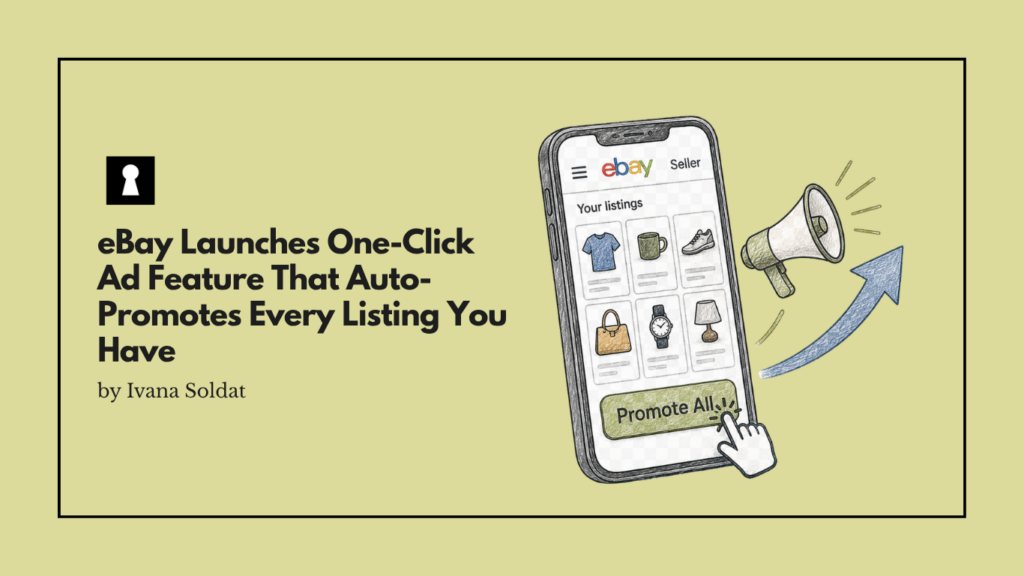
eBay this week launched a feature called Easy Boost, available through its mobile app. The premise is simple: pick one ad rate, and eBay applies it automatically to every listing in your store, bumping items higher in search results without any additional campaign management on your end.
Sellers pay ad fees only when an item actually sells based on whatever percentage rate they set when enabling the feature. eBay is billing it as the “fastest and easiest way to promote all of your items at once.”
One Rate, Everything Enrolled – Including Future Listings
Unlike standard Promoted Listings, which require sellers to either set rates per listing or configure campaigns by category, Easy Boost operates as a single blanket campaign. Turn it on, set your rate, and every active listing gets pulled in immediately.
The part that deserves attention: new listings you create after enabling Easy Boost are enrolled automatically at the same rate. You don’t have to think about it, and that’s exactly the point. Whether that’s a convenience or a liability depends on how carefully you’re tracking margins per SKU.
It Overwrites Your Existing Promoted Listings Campaigns
Sellers who are already running Promoted Listings with general strategies need to know this before touching Easy Boost: the feature doesn’t run alongside existing campaigns. It absorbs them. Whatever ad rates those campaigns were running at get replaced with the new single rate you set in Easy Boost.
This isn’t buried in fine print, but it’s the kind of detail that’s easy to miss when a feature is being marketed around convenience. If you’ve spent time calibrating rates across different categories, enabling Easy Boost resets that work.
Who Benefits From This?
The obvious target is high-volume sellers with a relatively uniform catalog, think resellers moving hundreds of similar items in the same category, where individual rate management is genuinely tedious and the margin profile is consistent across SKUs.
It’s also clearly designed for mobile-first sellers: casual resellers, side hustlers, and smaller operators who manage their eBay store from their phone and have no interest in navigating campaign dashboards. For that audience, one-tap advertising is a meaningful improvement over what existed before.
Sellers with mixed inventory, with multiple categories, wide price ranges, and varying margins, are a worse fit. A blanket rate that works for your $150 items will likely hurt you on your $20 items, and Easy Boost has no mechanism to account for that.
The Margin Math Nobody is Talking About
Promoted Listings fees are calculated as a percentage of the final sale price. A 5% ad rate on a $200 item costs $10 in ad fees. On a $15 item, that’s $0.75, which sounds fine until you account for eBay’s selling fee, shipping, the cost of goods, and whatever else eats into that transaction. For low-margin items, the difference between a 3% and a 7% ad rate can mean the difference between a profitable sale and a breakeven one.
Easy Boost doesn’t do that math for you. It sets one number and applies it everywhere. Sellers who haven’t already mapped their margin floor per category before enabling this feature are flying blind.
eBay’s Glitch History Makes This Worth Monitoring
eBay has a documented track record of settings that toggle themselves on without sellers intending them to — sometimes through glitches, sometimes through confusing UI flows during unrelated updates. Easy Boost, designed to be as frictionless as possible, is exactly the kind of feature that could end up active without the seller remembering enabling it.
It’s worth building in a periodic check: confirm the feature is on or off, confirm the rate matches what you intended, and confirm it’s not quietly running on inventory you’ve added since you last looked at it.
How It Fits Into eBay’s Broader Ad Strategy
eBay has been steadily expanding its advertising products for several years, and Promoted Listings has become a significant revenue line. Easy Boost is the latest step in a pattern: lower the barrier to advertising, grow the number of sellers running ads, grow ad revenue. It’s the same playbook Amazon ran with Sponsored Products, and it works.
That’s not a criticism of the feature itself — more visibility for sellers who want it is a reasonable offering. But context matters. Features designed to make advertising easier to start are rarely designed to make it easier to evaluate whether it’s worth continuing.
Our take
Easy Boost is eBay Charging Sellers for the Privilege of Doing Less Thinking
“Pay only when it sells” is a framing choice, it makes the fee feel like a success tax rather than an expense, and it encourages sellers to set a rate and stop thinking about it. That’s good for eBay’s ad revenue. Whether it’s good for your margins is a different question.
The feature will work well for a specific type of seller: high volume, consistent inventory, already profitable enough that a fixed ad rate across the board is a rounding error. For everyone else, the calculus is murkier. A single rate applied to a mixed catalog is a blunt instrument, and blunt instruments have a way of costing more than expected once you actually run the numbers.
If you’re going to use Easy Boost, treat the rate you set as a real business decision, not a default you picked because the app suggested it. Know your margin floor before you commit to a percentage. And check back on it in 30 days because “set it and forget it” is exactly what eBay is counting on you to do.