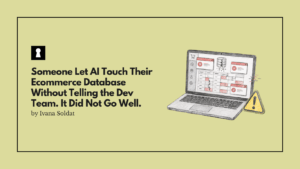

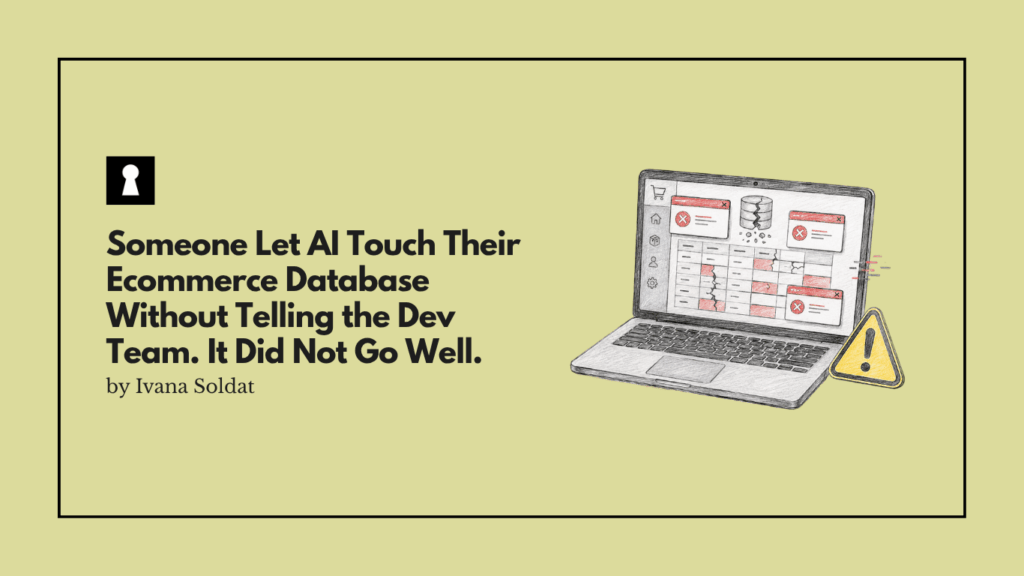
It started with a client who wanted to move quickly. They used AI to write code, skipped the dev team to save time, and watched their database drop completely.
That story, shared in a recent online thread by an ecommerce consultant, became the starting point for one of the more honest conversations about AI in online retail you will find anywhere right now.
The original poster’s framing was that automation does not automatically improve a business. It scales the system that already exists. If the catalog is messy, AI makes the mess faster. If workflows are fragmented, AI adds more moving parts. If nobody owns review, permissions, rollback, or data quality, moving faster just means breaking things faster.
The Database Story Is Not the Scary One
The database incident at least had an obvious cause and a clear lesson. The comment that should make more ecommerce operators uncomfortable came from someone who described building a custom AI tool with an outside agency, spending $15,000, seeing zero return on the investment, and then being offered a $1,000 per month maintenance contract to keep the broken thing running.
The AI part of the project got all the attention. The basic delivery risk, no clear problem definition, no success metrics, no QA process, no ownership, quietly became the actual cost.
Another commenter described switching customer service platforms, fully aware the new one included an AI agent, only to discover after signing that the AI agent could not be turned off. It gave customers wrong answers. Everyone hated it. They waited out the contract and left the moment it ended. The lesson they drew: the question is no longer whether a platform has AI. It is whether you can control it, limit it, audit it, and turn it off.
The Rule That Kept Coming Up
Several commenters independently landed on the same practical boundary. One put it plainly: only let AI do what someone with knowledge can evaluate as good or bad. Do not use it for back-end systems. Do not use it for financial analysis. Do not let it touch anything where a mistake has real-world financial consequences.
The original poster refined this into a permission model that most ecommerce operators have probably never thought to apply: read access by default, write access only by exception. AI reading your catalog, summarizing your support tickets, identifying patterns in your customer data, all fine. AI editing products, changing pricing, touching inventory, or executing store actions in production without human review, completely different risk category.
One commenter reported using Claude with Shopify’s MCP connection to rewrite product descriptions at scale, describing it as “store management on steroids.” The original poster’s response was telling: MCP is genuinely powerful precisely because it gives AI actual store context instead of just guessing from prompts, and that is also exactly why the permission model matters more, not less.
What AI Is Actually Good at in Ecommerce
The thread was not anti-AI. It was anti-careless.
The use cases that came up as genuinely working: repetitive low-risk content tasks like product descriptions, meta titles, and translations. Pattern recognition across large data sets like customer reviews, support tickets, and social comments. Surfacing anomalies in reporting that a human would catch eventually but AI catches faster. Search and catalog enrichment where the output is reviewed before going live.
The use cases that kept coming up as risky or broken: any direct connection to back-end logic without a human in the review loop. Pricing changes executed automatically. Inventory decisions made without oversight. Customer-facing responses published without quality control. Financial reporting where a non-deterministic output is treated as authoritative.
One commenter made the most technically precise observation in the thread. Generative AI is non-deterministic, meaning it does not always produce the same output from the same input. Ecommerce is fundamentally transactional, meaning it requires consistent, reliable, auditable operations.
Inserting a non-deterministic layer into a transactional system without understanding where the uncertainty is acceptable is how you get a database that drops, a pricing engine that goes sideways, or a customer service bot that cannot be turned off and keeps getting things wrong.
Our Take
The Boring Cleanup Is Still the Work
The ecommerce industry has spent two years watching platforms, agencies, and vendors compete to announce AI features, and the result is that a meaningful number of operators have adopted AI tools without first asking what problem they are solving or what breaks if the AI gets it wrong. The Reddit thread is a useful corrective because it comes from people who found out the hard way.
The pattern in the failures is consistent, someone skipped the operational cleanup, went straight to the tool, and discovered that AI is very good at doing the thing you point it at, including the wrong thing, at scale, faster than you can stop it. The businesses getting real value out of AI in ecommerce are almost uniformly the ones who did the boring work first: documented workflows, clean data, clear permissions, and a human in the loop anywhere the downside is real.