
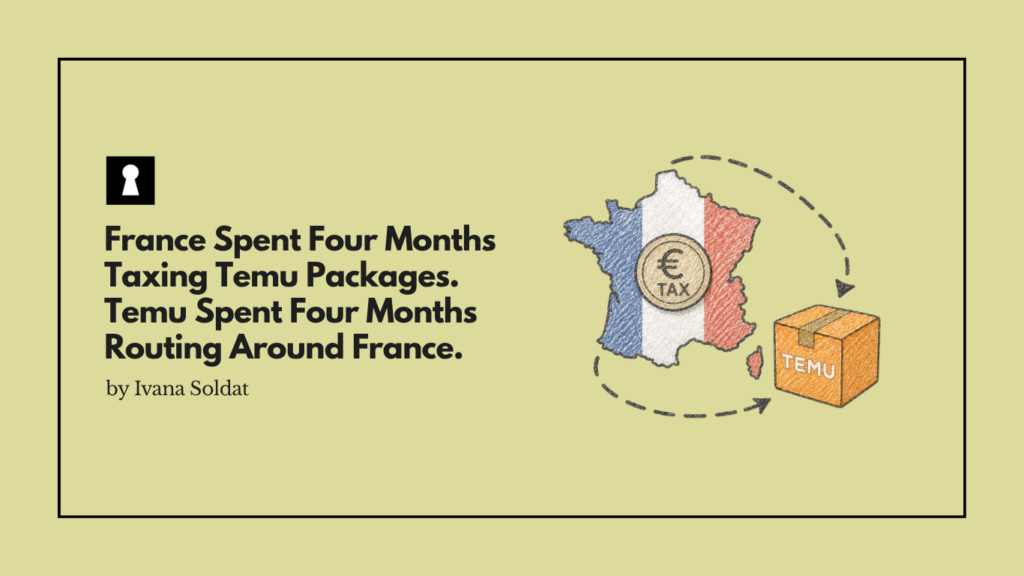
On March 1, 2026, France added a €2 flat surcharge per product category to all small parcels arriving from outside the EU and valued under €150.
The stated goals were straightforward: slow the flood of packages from platforms like Shein, Temu, and AliExpress; raise money to fund customs inspections; and level the playing field for French retailers who had been watching cheap Chinese goods arrive duty-free for years. The government estimated the tax would raise around €400 million over the year.
It raised €2.3 million per month. That is a 97% shortfall.
The reason is that by the time the tax came into effect, the platforms and logistics operators it targeted had already started rerouting. Packages that previously flew direct into French customs started landing in Germany, the Netherlands, Belgium, and other European entry points first, then moving into France by truck.
The General Directorate of Customs estimated that roughly 90% of the volume subject to the new tax shifted to other entry points within weeks of the measure coming into force. France had taxed its own customs agency out of the transaction.
Why July 1 Is the End Date
The French government announced the suspension of its national parcel tax on June 30, with effect from today, July 1.
The timing is not coincidental. Today is also the date the EU-wide abolition of the de minimis customs exemption takes effect across all member states, replacing the old system with a flat €3 duty per product category on sub-€150 parcels from outside the EU. With a European charge now in place, Paris concluded that running both a national and a European tax simultaneously made no sense, particularly when the national one had already demonstrated it could not actually collect what it promised.
Left unspoken in the official framing: the national surcharge had also comprehensively failed on its own terms.
How the New €3 EU Duty Actually Works
The EU system that replaces France’s national tax is more nuanced than it might appear, and the details matter for anyone ordering from Shein or Temu going forward.
The €3 duty is assessed by product category, not by parcel. A package containing a T-shirt and a pair of shoes counts as two categories and is charged twice, for a total of €6. A package containing fifteen T-shirts counts as one category and is still charged only €3. Only parcels valued under €150 are affected. The cost is legally on the seller, who can pass it on to the consumer as long as buyers are clearly informed at the point of purchase.
The European consumer group BEUC has warned that platforms, postal services, and carriers must not add unexpected surcharges to customers who were not told about additional costs when they ordered.
The current €3 charge is also explicitly temporary. From November 1, a processing fee of roughly €2 per parcel will be added on top, bringing the total to around €5. A full overhaul of the EU customs system is planned for 2028.
The Rerouting Problem Has Not Gone Away
The uncomfortable question hanging over the new EU system is the same one that killed France’s national tax: can platforms route around it?
Brussels says it is monitoring avoidance schemes, particularly the use of third-country routing through places like Switzerland to obscure the country of origin. These practices are already illegal under EU law, with duties charged based on origin rather than the shipping country. But “already illegal” and “effectively prevented” are different things, as France’s four-month experiment demonstrated.
There is also a warehouse play emerging. Some platforms have reportedly been exploring building large European distribution hubs to import in bulk above the €150 threshold, then sell to consumers at retail, sidestepping the small-parcel duty entirely. The EU processed 4.6 billion small parcels in 2024. That volume did not build itself in four months and will not be deterred by a €3 charge on its own.
Our Take
France Tried. Temu Rerouted. Europe Is Next.
France’s national parcel tax experiment is the most useful piece of evidence available for anyone trying to predict how the EU-wide duty will perform. The lesson is not that taxing Asian ecommerce platforms is impossible. It is that a fixed per-parcel charge is only as effective as the ability to actually capture the volume it targets.
When 90% of French parcel traffic rerouted within weeks of a €2 charge coming into effect, it demonstrated that the logistics networks these platforms operate are more adaptable than any regulatory framework that moves at the speed of a government consultation. The €3 EU duty is better designed and harder to route around because it covers the whole single market rather than a single entry point.
Whether that is enough to prevent the same disappearing act at European scale is the question nobody has answered yet, and the answer will arrive whether anyone is ready for it or not.