
Here is a question that ecommerce advertisers running Performance Max campaigns could not answer twelve months ago: which specific products in your ads are getting direct clicks, and which products are showing up in ads but driving brand engagement rather than direct product traffic?
They could not answer it because the data did not exist in the reporting interface. Performance Max, Google’s automated campaign type that serves across Search, Shopping, Display, YouTube, Gmail, and Discover simultaneously, was designed to let Google’s algorithm handle most of the decision-making.
The tradeoff was visibility. Advertisers handed over control and received aggregate results. The individual mechanics behind those results, which channels, which products, which creative elements, were largely hidden.
Google has spent the past eighteen months systematically fixing that. The new product clicks and non-product clicks metrics, spotted this week by advertiser Yash Mandlesha, are the latest addition to a reporting infrastructure that looks fundamentally different from what Performance Max launched with.
What the New Metrics Show You
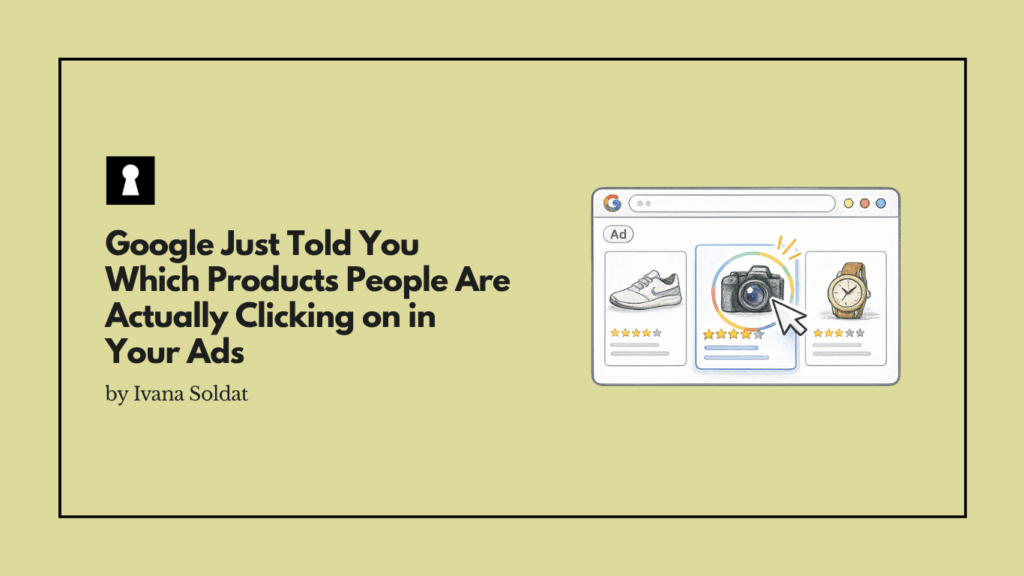
The distinction Google is drawing is specific and useful. Product clicks are when someone clicked directly on a product in your ad and landed on that product page. Non-product clicks are when someone clicked another part of the ad, like your store name, headline, or “Visit site” CTA, instead of a specific product.
In a Shopping ad or a Performance Max ad showing multiple products, a user might click the specific product image that caught their attention, going directly to that product page. Or they might click the store name or a broader call to action, landing on the homepage or a category page rather than a specific product. Both are clicks. They represent meaningfully different user behaviors and different stages of purchase intent.
Product clicks indicate a user who saw a specific item, wanted it, and went directly to it. Non-product clicks indicate a user who was interested in the brand or the general category but was not yet ready to commit to a specific product. The conversion paths, the retargeting strategies, and the bid optimization logic that makes sense for each group are different, and until this week, advertisers had no way to separate them in their reporting.
As Mandlesha put it, the new metrics allow advertisers to understand “whether specific products are attracting direct clicks, or simply helping users engage with the brand.”
The Context: Performance Max Is Not a Black Box Anymore
The most significant shift in 2026 has been transparency. For years, the chief complaint about Performance Max was that it operated as a black box. Advertisers poured money in and got results out, with minimal visibility into where that money went or why it worked. Google has systematically addressed this.
The list of additions to Performance Max reporting over the past year is substantial. Channel-level reporting now shows performance across all inventory sources separately. Full search term reporting for Search and Shopping placements has been restored. Campaign-level negative keywords, up to 10,000, are now available. Asset-level reporting now includes impressions, clicks, and cost for individual creative assets.
Starting June 2026, product reporting expanded further. Previously, product performance metrics such as cost and conversions were only available for products in Performance Max ads serving on Search networks and Standard Shopping campaigns. Google now provides a comprehensive set of metrics for products across all campaign types that use Google Merchant Center, including data for all networks in Performance Max campaigns, as well as metrics for Video, App, and Demand Gen campaigns.
The product clicks and non-product clicks metrics released this week build on that foundation by adding a behavioral dimension to the click data. It is not just how many times your products were clicked. It is what kind of click each one received.
Why This Matters for Ecommerce Advertisers Specifically
The practical applications are several, and most ecommerce advertisers running Performance Max campaigns will recognize immediately which questions these metrics help answer.
If a product has high impressions and low product clicks but meaningful non-product clicks, it is functioning as a brand awareness driver rather than a direct response driver. It is getting attention but not converting that attention into direct product interest. That information should influence whether you continue to include that product in the same campaign or segment it into a different campaign with different bidding and creative objectives.
If a product has high product clicks and strong conversion rates, it is functioning as a direct response driver. The bidding optimization, the creative emphasis, and the budget allocation should reflect that.
If a product has high product clicks and poor conversion rates after the click, the problem may be on the landing page rather than in the ad. The user wanted the specific product enough to click it directly, which means ad-level interest was not the issue. The product page, the price, the delivery options, or the trust signals are where the drop-off is happening.
None of these diagnoses were possible before this metric existed. All of them are actionable once you can see the data.
Google Gave Back Something It Took Away
A useful framing from a Google Ads audit guide published earlier this year: a control that reinstates baseline visibility is not the same as a control that expands advertiser leverage. The ability to separate brand from non-brand inside Performance Max is not new functionality, it restores a distinction that previously existed by default. Network-level reporting within a bundled campaign is not an expansion of transparency, it restores reporting that was removed when bundling was introduced.
The same framing applies to the product clicks metric. The distinction between a click on a specific product and a click on a broader ad element is basic information about user behavior. It existed before Performance Max. It was obscured by Performance Max’s original black-box architecture. Its return is useful, and it reflects real advertiser pressure that has pushed Google toward transparency throughout this product cycle.
Our Take
Performance Max in 2026 Is a Different Product Than Performance Max in 2023
The product clicks and non-product clicks metrics are a small addition to what has become a genuinely substantial improvement in Performance Max transparency over the past eighteen months.
The campaign type that launched as a take-it-or-leave-it black box, where Google’s algorithm made decisions that advertisers could not see or meaningfully influence, has been rebuilt into something with channel-level reporting, full search term visibility, asset-level performance data, product-level metrics across all networks, and now behavioral click segmentation at the product level.
Each individual update is incremental. The cumulative change is significant. Ecommerce advertisers who dismissed Performance Max in 2023 because of its opacity and wrote it off for Standard Shopping should reassess whether the reporting infrastructure now gives them enough visibility to actually use it effectively.
For most catalog sizes and budget levels, the answer is probably yes in a way it was not two years ago.