
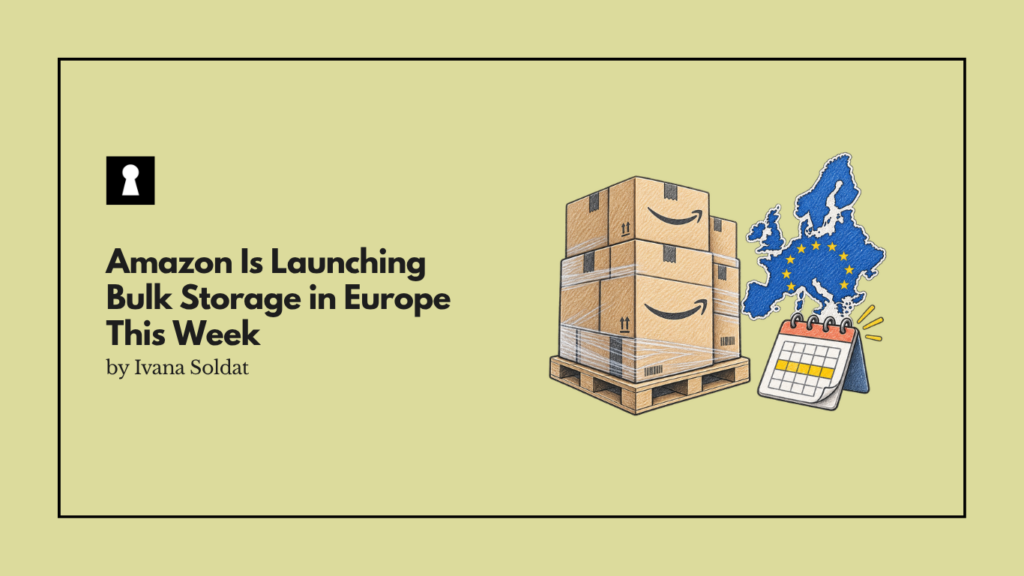
Amazon Warehousing and Distribution was a relatively quiet US product launch in 2022. (Ecommerce News EU) It solved a specific problem: sellers who wanted to hold more inventory in the Amazon ecosystem than FBA capacity limits allowed, without managing their own external storage. AWD functions as a buffer: bulk inventory sits in Amazon distribution centres at flat-rate long-term storage fees, and Amazon’s automated replenishment system moves stock into FBA fulfilment centres as needed based on demand signals.
In the US, AWD has since expanded to supply external sales channels as well, meaning sellers can use Amazon’s distribution network to fulfil orders from Shopify stores, Walmart, and other platforms. That cross-channel capability is not part of the European launch for now.
What is launching on August 20, across Europe’s five largest ecommerce markets simultaneously, is the core AWD proposition: flat-rate bulk storage, automated FBA replenishment, and the ability to hold inventory inside Amazon’s logistics network without FBA capacity constraints.
Why This Week Specifically
Amazon has been operating in Europe for decades. AWD has been live in the US for four years. The choice to launch it in Europe on August 20, 2026, in the middle of August, is a logistics and commercial strategy decision that deserves the context EcomWatch has been building all month.
The EU’s July 1 parcel duty change eliminated the €150 duty-free threshold and imposed a €3 per-category fee on small parcels arriving from outside the bloc. Chinese parcel volumes have dropped 20% in the six weeks since. Every major Chinese platform, Temu, Shein, AliExpress, and JD.com, is accelerating European warehouse construction to route around the duty by holding inventory within the EU before last-mile distribution.
Amazon is simultaneously launching a European bulk storage and distribution service that offers European sellers the ability to hold inventory inside Amazon’s existing distribution network. The two trends are directly connected. The race to build European logistics infrastructure is underway. Amazon’s AWD launch is its entry into that race on behalf of the sellers who use its marketplace.
The Dependency Dynamic
The Ecommerce News article correctly identifies the central tension of the AWD launch: it makes sellers’ operations easier while increasing their dependence on Amazon’s infrastructure.
Automated replenishment means sellers do not have to manually monitor FBA stock levels and send in new shipments. Bulk storage means sellers do not have to manage external 3PL relationships or negotiate their own warehouse space. Amazon handles it. The seller focuses on selling.
This is also the framing we applied to TikTok Shop’s managed services pilot, which we covered earlier this month: the platform that runs your store has leverage over your operation that the platform that merely hosts it does not.
Amazon has been building this leverage for years through FBA, FBA Small and Light, Prime, and various fulfilment programmes. AWD extends that leverage further upstream into the supply chain, embedding Amazon into the inventory management and distribution decisions that sellers make months before a product reaches a consumer.
We covered this same dynamic from a different angle in the Indian FDI investigation piece: distributors and retailers arguing that Amazon and Flipkart’s quick commerce operations, which require pre-positioned inventory managed by the platform, constitute inventory-based retail rather than marketplace operations under Indian FDI law. The closer a platform’s involvement with seller inventory management, the harder the line between marketplace and retailer becomes.
What Sellers Should Know
AWD pricing in Europe has not been publicly detailed in the launch announcement. In the US, AWD charges a flat monthly storage fee per cubic foot plus processing fees when inventory is moved from the distribution centre to FBA. The fee structure is typically lower than standard FBA storage fees, which is by design: AWD is cheaper storage in exchange for less proximity to the customer and a longer replenishment lead time.
The automated replenishment is the feature that requires the most careful evaluation. It means Amazon’s algorithm decides when and how much inventory to move from the AWD buffer into FBA fulfilment centres. Sellers who want manual control over that decision will need to evaluate whether AWD’s automation aligns with their inventory strategy, particularly for seasonal products or items with irregular demand patterns.
The European launch does not include cross-channel supply, which means sellers cannot use AWD to fulfil orders from their own Shopify stores or from other European marketplaces like Bol or Zalando. That limitation may change over time, as it did in the US, but it means AWD’s initial European value proposition is specifically for Amazon sellers who want Amazon inventory management for their Amazon business.
Peak Season Context
The August 20 launch date puts AWD in European markets approximately 10 weeks before the peak of the festive season. For sellers who are currently managing their own bulk storage or using 3PLs to buffer inventory before FBA replenishment, AWD offers an immediate alternative.
Given the freight market conditions we covered in the peak season fulfilment cost piece, where warehouse vacancy is at its lowest point since 2022 and storage costs are elevated, an Amazon-managed bulk storage option at flat-rate pricing is a commercially attractive alternative to finding and negotiating external warehouse space in a tight market.
Our Take
Amazon Just Gave European Sellers Another Reason to Stay Inside Its Ecosystem
Amazon Warehousing and Distribution launching in Europe on August 20 is a straightforward product expansion that has been expected for some time. It is also, in context, one piece of a much larger story about who controls European ecommerce logistics infrastructure as the post-parcel-duty landscape settles into a new shape.
The race to build European warehouse and distribution capability is being run simultaneously by Amazon, JD.com, Temu, AliExpress, TikTok, and every major 3PL in the market. Amazon’s entry with AWD is from the seller side rather than the consumer side: it is not trying to win consumers away from other platforms with faster delivery, it is trying to make Amazon’s own marketplace sellers more operationally dependent on Amazon’s infrastructure.
That dependency is commercially rational for sellers in the short term. It is strategically worth thinking about carefully in the medium term, particularly for sellers who have been thinking about diversifying their channel mix or building logistics independence from the platforms they sell through.