
The question for anyone building a commerce business in 2026 is no longer whether TikTok livestream selling works. TikTok’s own data shows 76% of consumers who engaged with TikTok Shop had bought something from a livestream in the previous year. US brands and creators hosted more than 8 million hours of LIVE shopping in 2024. 89% of SMBs surveyed by TikTok in May 2026 reported sales increases after promoting on the platform.
The question is how to do it at the level where a single session generates five figures before expenses.
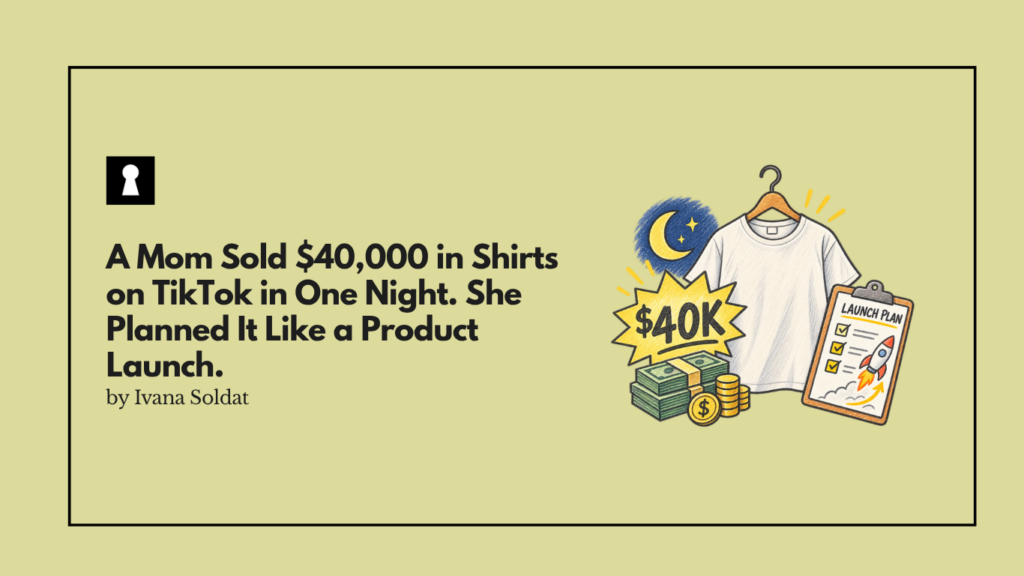
Duplantis’s answer is that the $40,000 night was the product of preparation, not performance. “That Live worked because it was planned,” she said. She promoted the event ahead of time, opened pre-registration through her profile, spent hours arranging products, building the cart and staging flash sales and buy-more-save-more offers before going live. More than 500 people registered before she started.
The Mechanics That Made It Work
Pre-registration turns a broadcast into an event. A viewer who registered for a TikTok LIVE is a different prospect from one who stumbled into it via the algorithm. They have an appointment. They came with purchase intent. Duplantis’s 500 pre-registered viewers gave the stream a built-in audience before it started, which in turn gave the algorithm a signal that drove organic reach.
Pre-loading the cart eliminates purchase friction at the moment of highest intent. A viewer who wants to buy something in a live stream has a very short attention window. A pre-loaded cart that a viewer can add to with one tap during the live session compresses that window to near zero.
A discount ladder creates urgency. Buy-more-save-more offers and timed flash sales are the mechanics that turn browsers into buyers during live commerce. A viewer who is watching but not yet convinced to buy will act when a flash sale counter appears.
Consistent timing builds habit. Duplantis favors 5 to 8 p.m. for live sessions, when viewers may be finished with work and scrolling before bed. A seller who goes live in the same window every week builds a viewer habit in the same way a podcast builds a listener habit.
The Energy Dimension That Cannot Be Faked
The preparation creates the conditions. The live session itself requires something preparation cannot fully provide.
“The biggest thing is that it didn’t feel like a hard sell. It felt fun. People were hanging out, shopping, commenting, getting excited, and feeling like they were part of something,” Duplantis said.
She focused on “energy, urgency, and connection” during the $40,000 stream, standing, moving around, thanking customers by name, tying giveaways to engagement goals like reaching 100,000 likes. The difference between a $40,000 live and a $400 live is often not the product or the discount structure. It is the seller’s ability to make viewers feel like participants rather than an audience.
How Poppy Rose Got Here
Poppy Rose Print Company started on Etsy. The shift to TikTok Shop and print-on-demand was a deliberate channel decision: from roughly $30,000 in monthly sales to hundreds of thousands of dollars.
The print-on-demand model is worth noting because it is the logistics foundation that makes live commerce viable for a small operation. A seller who holds inventory risks going out of stock during a viral moment. A seller using print-on-demand produces each item only after it is ordered, which means a $40,000 night does not require $40,000 of pre-positioned inventory.
The Platform Context
We’ve covered TikTok Shop extensively this month. The US managed services pilot, the AI voice ban in live streams, the FBT incentives, the Japan market hitting 49.5 million monthly active users, and Ulta Beauty’s TikTok Shop driving 100 million impressions.
The Poppy Rose story sits at the other end of the TikTok Shop ecosystem from the Ulta Beauty story. Both are winning. The platform’s mechanics are working across that entire range simultaneously, which is what makes TikTok Shop genuinely different from most ecommerce channels where brand size and ad budget are strongly correlated with outcomes.
The Professionalisation Phase That Changes the Competition
Casual streams that rely on flipping the camera on are not going to compete with sellers who pre-register 500 viewers, pre-load a discount cart, and maintain genuine energy for hours. As more sellers adopt the Duplantis playbook, the baseline for what a competitive TikTok LIVE looks like will rise.
The same professionalisation is happening at the brand level. Crocs, Liquid I.V., and Glossier have joined TikTok Shop. Pacsun’s Casey jean generated $20 million in TikTok sales in 2024 after a micro-creator with roughly 5,000 followers helped it go viral, leading the brand to sell 11,000 pairs in 48 hours. As established brands build affiliate programmes and LIVE partnerships, the small seller’s competitive advantage shifts toward personal storytelling and tight community relationships that larger brands cannot easily replicate.
Our Take
The $40,000 Night Was Not an Accident.
The Poppy Rose Print Company story is useful not because a $40,000 night is replicable by every TikTok seller, it is not, but because the mechanics that produced it are.
Pre-registration, pre-loaded carts, discount ladders, consistent timing, and authentic energy are learnable and deployable by any seller who is willing to treat a TikTok LIVE as an event rather than a broadcast.
The sellers who are figuring this out right now are building audience habits and platform relationships that will be meaningfully harder to replicate in 12 months when more sellers have adopted the same playbook. The window for being the professional in a sea of casual streamers is open. It will not be open indefinitely.