
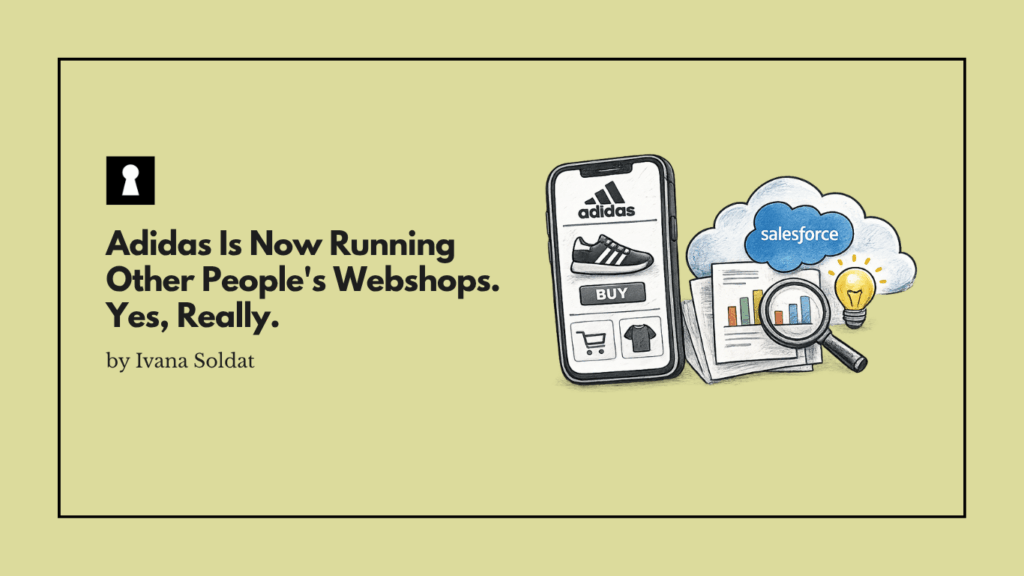
Adidas has decided that selling sneakers isn’t enough. The three-stripe giant is now in the business of running entire ecommerce operations for other brands, and its first victim client is Audi’s Formula 1 team.
The model is called ecommerce-as-a-service, or EAAS if you like acronyms that sound like a sneeze. Adidas senior project manager Dominik Seeberger laid out the whole thing at Salesforce Connections 2026 in Chicago, and the pitch is genuinely bold: Adidas handles your webshop, your global fulfillment, your customer service, your merchandising, your checkout in 100 currencies, shipping to 200+ countries, and you, the partner brand, “sit back and enjoy the show.” Seeberger’s words, not ours.
The Audi F1 store went live in February 2026, built in eight weeks. The consumer visiting it has no idea Adidas is behind the curtain. Which is either impressive infrastructure or a slightly unsettling amount of white-labeling, depending on your mood.
Why Adidas Is Doing This
The honest answer: Fanatics scared them. Seeberger basically admitted it. Fanatics has been quietly eating everyone’s lunch with its licensed partner business and end-to-end ecommerce services across 200+ partners, many of whom are also Adidas partners. Adidas looked at that, looked at its own logistics and tech capabilities, and decided it could play the same game.
It’s a smart pivot, actually. Adidas already has the global supply chain, the Salesforce infrastructure, and the brand relationships. Turning that into a revenue line by running other people’s digital commerce operations is a $100 million opportunity according to Seeberger, and they’re already in conversations with more partners to expand.
The AI Part (There’s Always an AI Part)
Here’s where it gets interesting for the lean-team crowd. Adidas is currently running the Audi F1 store with one merchandiser, one computer scientist, and one site operations person. Three people. For a global ecommerce operation.
The reason that’s possible is Salesforce’s Agentforce. Adidas is building AI agents that handle merchandising, adjusting search rankings, boosting or burying products, adapting to demand signals, without a human touching it every time. The logic is straightforward: if Adidas wants to operate 20 or 30 partner sites, hiring an army of merchandisers isn’t viable. So you build agents instead.
The shopping assistant demo shown at the conference is what you’d expect: user asks for a gray short-sleeve shirt, agent recommends three options with size suggestions based on purchase history, offers to drop it in the cart. The returns flow was arguably more useful, user provides just an email, agent surfaces the relevant orders and walks them through eligibility.
Our Take
Adidas Just Quietly Became a Tech Company That Also Sells Shoes
The EAAS play is genuinely underreported as a strategic move. Everyone is focused on Adidas’s DTC numbers or its Amazon partnership or whatever Ye-adjacent drama resurfaces every six months. But this is different. This is Adidas deciding its real competitive moat isn’t the Samba silhouette, it’s logistics infrastructure and global checkout at scale.
The Fanatics comparison matters here. Fanatics built a business worth billions not by making better jerseys but by controlling the ecommerce layer between sports IP and fans. Adidas is trying to do the same thing for its partner ecosystem before Fanatics (or someone like it) does it to them.
The three-person team running a global operation is the stat worth circling. That’s not a flex about AI, it’s a preview of what lean ecommerce operations will look like as agent technology matures. The brands that figure out how to scale service without scaling headcount are going to have a structural cost advantage that compounds quietly until suddenly it doesn’t look quiet at all.
Whether EAAS becomes Adidas’s second business or a conference slide that gets quietly shelved in 18 months depends entirely on whether the partner pipeline is real. The Audi proof of concept is live. Now we wait for client number two.