
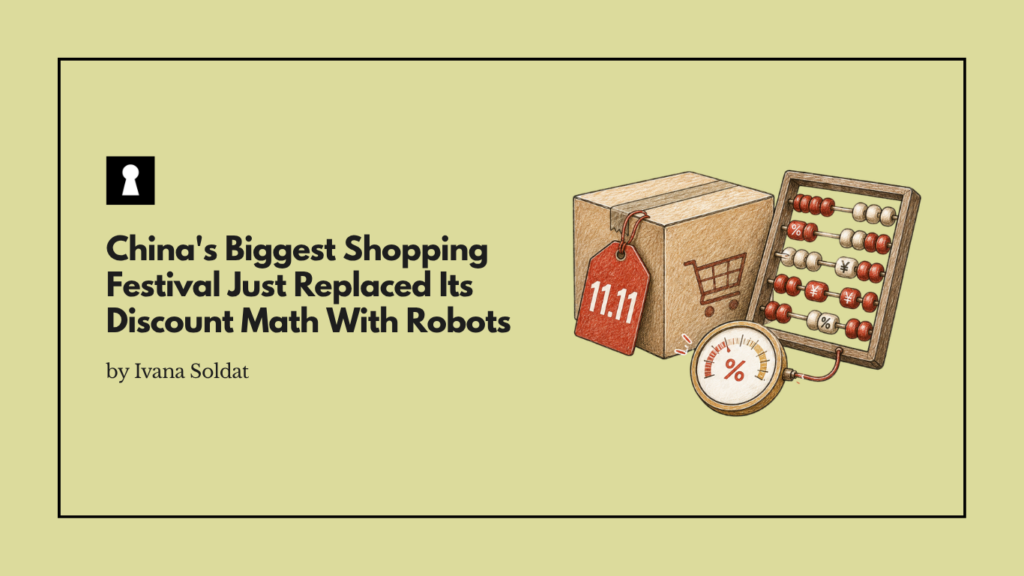
For years, surviving China’s 618 sale meant doing math homework. Cross-store discount stacking, deposit inflation schemes, the dreaded “spend 300 across three stores to save 50” formula, it turned millions of shoppers into amateur Olympiad contestants every June, spawning entire genres of social posts dedicated to cracking the discount code.
This year, the math homework got quietly swapped out for something else entirely: an AI standing between the shopper and the cart, doing the thinking for them. Whether that’s actually progress is where things get interesting.
The shopping festival still runs on its usual sprawling, multi-week timeline across Douyin, Pinduoduo, Tmall, and JD.com, and the old discount mechanics haven’t disappeared. But platforms have stopped bothering to advertise them.
The thing they’re putting front and center now is AI, in basically every form it can take: conversational shopping assistants that replace the search bar, digital human anchors livestreaming product pitches at 3 a.m. with nobody actually awake to run them, AI customer service bots fielding the surge of promo-season questions, and AI-driven warehouse and logistics systems quietly deciding which regional warehouse your order ships from before you’ve even finished checking out.
The Shopping Assistant Era Has Quietly Arrived
The most visible shift is at the entry point of the shopping journey itself. Instead of typing keywords into a search box and wading through results, shoppers on Alibaba’s ecosystem can now talk to Qianwen, the AI assistant fully integrated with Taobao, describing what they want in plain language and letting it handle product selection, price comparison, and even checkout.
Douyin built something similar by wiring its AI assistant Doubao directly into its in-app mall, letting users go from a conversation straight to a completed order without ever leaving the chat.
It’s a genuinely different shape of shopping than the keyword-and-filter model that’s defined e-commerce for two decades. The catch, according to the reporting, is that it’s mostly early adopters using it so far, not yet the default way most people shop, which raises the obvious question of whether platforms are betting big on a habit that hasn’t actually formed yet.
The Robots Doing the Selling Never Sleep
The merchant-facing side of this AI push is where the numbers actually look dramatic. JD.com’s digital-human livestreaming tool reportedly saw session volume jump sixfold year over year, with tens of thousands of merchants now running AI anchors that pitch products, hand out coupons, and never need a lunch break. New livestreaming regulation that took effect earlier this year requires every AI-hosted stream to clearly disclose that it’s AI-generated, with real penalties, reduced visibility or outright bans, for platforms or merchants that try to fudge that label.
The pricing pitch for merchants is blunt: one provider quoted digital-human livestreaming for as little as 12 yuan per hour, meaning a full day of round-the-clock streaming can cost less than what a single shift of a human livestreamer would. AI customer service tools follow a similar logic, cheap or free at the basic tier, with real cost only kicking in at scale, and still dramatically below the price of staffing a 24/7 human support team.
But the cost savings come with real friction. Not every platform supports the same tools, Douyin, Kuaishou, and Xiaohongshu reportedly don’t allow the external digital-human livestreaming tools that work fine on JD.com, Taobao, or Pinduoduo. And AI customer service tends to handle simple pre-sale questions reasonably well while falling apart on the messier post-sale stuff, such as refunds, complaints, price-protection disputes, which is exactly the category that spikes hardest during a major sale.
Merchants are also stuck holding the liability bag, if an AI bot gives a customer the wrong answer, the merchant, not the AI vendor, is the one who answers for it.
Shoppers Are Less Impressed Than the Platforms Want You to Think
The consumer-facing version of this AI push is landing rougher than the merchant-side pitch decks suggest. Social media chatter around this year’s 618 leans heavily toward complaints about AI customer service specifically, bots that handle basic logistics questions fine but loop into useless, repetitive non-answers the moment a question touches promotions, price protection, or an actual complaint, leaving frustrated shoppers typing “transfer to human” over and over with no success.
Survey data on consumer expectations backs up the skepticism: people are broadly fine with AI as a tool, comparing prices, tracking discounts, organizing information gets a 65 to 70 percent comfort rate, but trust drops sharply, down to somewhere between 37 and 48 percent, the moment AI starts making purchase decisions or placing orders on its own.
Our Take
Everyone Got Cheaper Except the Customer
Strip away the press-release numbers and what 618 actually reveals is a pretty unflattering org chart: platforms get the data, the ecosystem lock-in, and a fresh growth narrative now that discount fatigue has made the old promo calendar boring; merchants get marginally lower costs and zero reduction in who’s actually liable when things break; and consumers get a chatbot that’s great at telling you the delivery date and useless at literally everything that matters during a dispute.
Calling this an “AI revolution” in retail is generous, what’s actually happening is platforms quietly using AI to extract more leverage over merchants and more behavioral data from shoppers, dressed up as a customer-experience upgrade nobody asked for and most people are already learning to route around.