
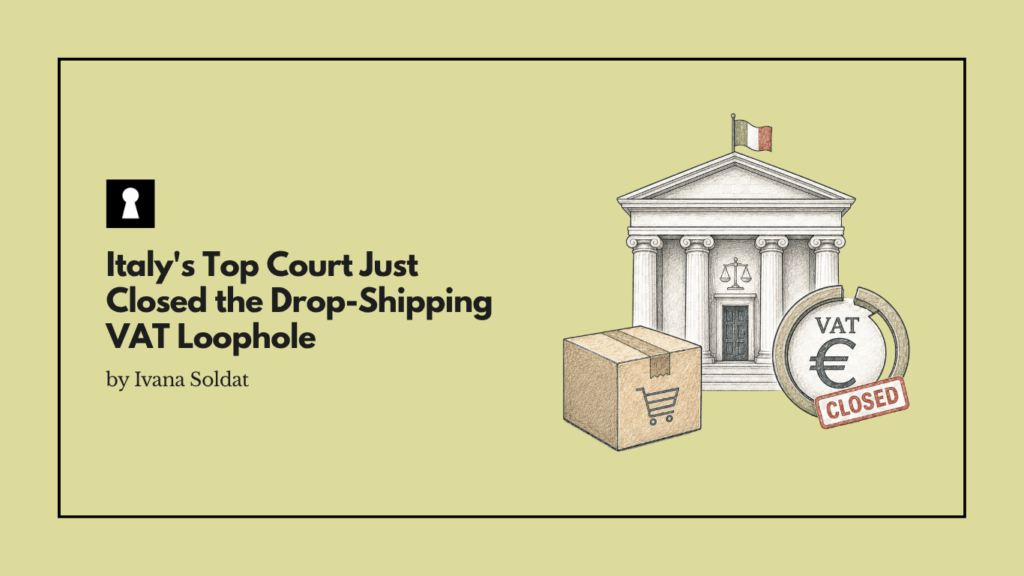
There’s a version of drop-shipping that’s just smart logistics, and there’s a version that’s basically a tax magic trick. Italy’s Corte di Cassazione just made it very clear which one regulators think it usually is.
The ruling centers on an Italian company selling tires online. A customer in Italy places an order, the Italian seller forwards it to a German supplier, and the German supplier ships the tires straight to the customer’s door without ever routing through the seller’s own warehouse, or through Italy at all. It’s the exact structure thousands of dropshippers run every day, often deliberately, because it’s lean and fast and doesn’t tie up capital in inventory.
The seller’s argument, and one that lower courts initially bought, was straightforward: at the moment the sale was finalized, the tires were sitting in Germany. Italian VAT law (specifically Article 7-bis of Presidential Decree 633/1972) ties taxability to where the goods physically are when the deal closes. No Italian soil, no Italian VAT, or so the logic went.
Why the Court Said “Not So Fast”
The Cassazione tore that reasoning apart by refusing to look at the transaction as one single sale. Instead, the judges split it into two separate, sequential operations that happen to be bundled inside a single customer order: first, an intra-EU acquisition where the Italian seller buys the goods from the German supplier (this leg is taxable in Italy under Article 38 of Decree-Law 331/1993); and second, a domestic resale where that same Italian seller sells the goods on to the Italian end customer, which triggers ordinary Italian VAT all over again.
In plain terms: the German supplier isn’t selling to the Italian consumer. The German supplier is selling to the Italian business, which is then selling to the Italian consumer. There are two transactions, two tax triggers, even though only one box ever got shipped.
The Court’s logic for why this matters isn’t subtle. If you accept the seller’s version, the sale to the Italian consumer ends up taxed nowhere, not in Germany, since that leg isn’t territorially relevant there, and not in Italy, since the seller claimed the goods were never “in” Italy when the deal closed. That’s a VAT-free zone created out of shipping logistics, and the Court explicitly flagged it as the kind of non-taxation outcome the rules are designed to prevent.
The Two Triggers That Actually Matter
The ruling boils the whole test down to two facts that determine taxability going forward: whether the goods are shipped from another EU member state into Italian territory, and whether the intermediary buyer, the dropshipper, is a VAT-registered entity established or identified in Italy. If both are true, the intra-EU acquisition leg is taxable in Italy, full stop, regardless of where the goods were sitting at the exact second the consumer clicked “buy.”
The Court also went out of its way to say Article 7-bis simply doesn’t apply to this fact pattern at all, it’s the wrong rule for the job, because this isn’t a single cross-border sale, it’s an acquisition followed by a domestic sale.
Our Take
Turns Out ‘No Inventory’ Also Meant ‘No Tax Liability,’ Until Now
This is the kind of ruling that sounds like a narrow tires-and-paperwork dispute but is actually a direct hit on a structure that a meaningful slice of the dropshipping industry has been running on for years, sometimes without realizing it was ever legally shaky. If you’re an Italian seller sourcing from EU suppliers and routing goods straight to customers, the “the product was never technically here” defense is now dead, and tax authorities have a tidy two-transaction roadmap for assessing exactly what you owe.
A lot of “lean, asset-light” dropshipping businesses were really just VAT-light businesses, and that distinction was never going to survive contact with a court that actually bothered to read the invoices.