
Meta has never been shy about automating things advertisers used to do themselves. First it took targeting. Then budgets. Now it wants your video shoots too.
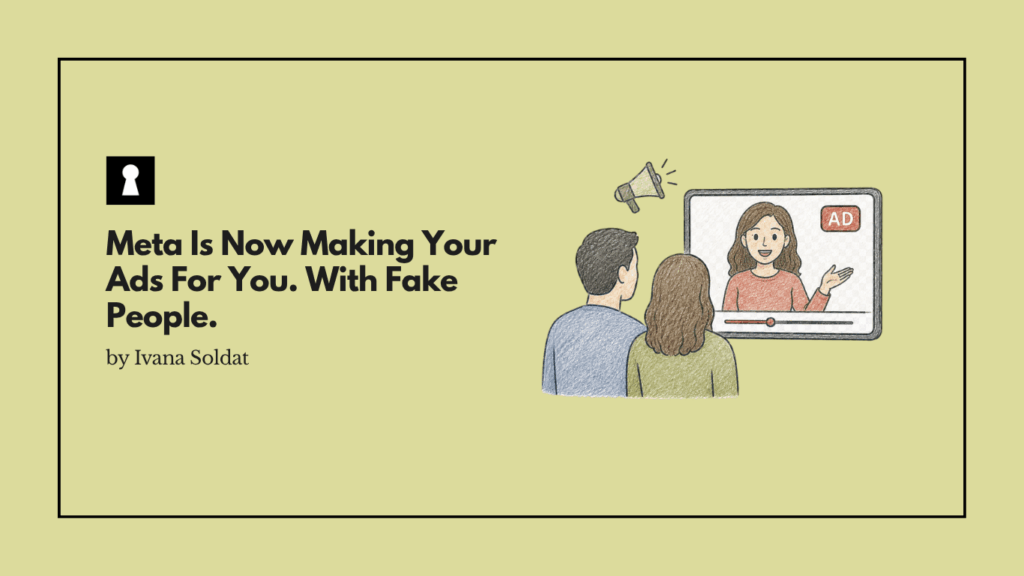
The company is currently testing a new open-ended creative mode inside Advantage+, its AI-driven ad system, that lets sellers upload a product catalog and five headlines. The platform then generates an unlimited stream of UGC-style video ads, complete with AI actors delivering what looks, sounds, and feels like an enthusiastic customer review.
What Advantage+ Creative Actually Does
The mechanic is straightforward on paper. You hand Meta your catalog and a handful of copy prompts. It handles the rest, pulling together synthetic presenters, scripted delivery, and product visuals into videos that mimic the lo-fi, bedroom-filmed aesthetic that has driven performance advertising for the past half-decade.
Early results are hard to ignore. Some advertisers inside the test are reporting cost-per-acquisition figures down roughly 25%, a number that tends to make CFOs sit up straight regardless of how they feel about AI ethics.
25% CPA drop reported by early testers
14 Days before creative fatigue sets in
45 Days fatigue used to take
The catch, and there is always a catch, is buried in the fatigue data. Where a well-made UGC video used to stay fresh for around 45 days, AI-generated creative is burning out in roughly 14. Audiences figure it out faster, or they simply see more of it. Either way, the creative hamster wheel just got a lot smaller.
The Speed Problem No One Is Talking About
This is the part of the story that tends to get skipped in the excitement over lower CPAs. The whole premise of AI-generated creative is that you get more, faster and cheaper. But “more” only helps if your offer and your hook are still sharp. If those are dull, the machine just makes dull content at scale.
The 14-day fatigue window also means that ecommerce brands running Meta ads now need a creative refresh cycle, not a creative campaign. That is a structural shift in how teams operate, not just a new feature to click on.
“The algorithm can cast the actor. It still cannot tell you what that actor should say to actually make someone buy.”
High-ticket sellers, such as furniture, fitness equipment, outdoor gear, actually have a slight edge here. When your average order value sits above a thousand euros, a 25% CPA improvement is a meaningful margin win, and producing a new batch of AI creative every two weeks is a manageable overhead. For sellers moving cheap impulse products at thin margins, the math gets thornier fast.
This Fits a Pattern Meta Has Been Building Quietly
Advantage+ Creative did not appear overnight. Meta has been systematically expanding its AI ad tools since 2023, and this latest move connects to something else the company has been doing that drew far less applause.
In late 2025, a coalition of 36 privacy and consumer rights groups wrote to the FTC, urging it to investigate Meta’s plan to use conversations from its AI chatbots on Facebook, Instagram, and WhatsApp to inform ad targeting. Those conversations, the groups argued, often contain sensitive disclosures including health and mental health information, and Meta offered no opt-in mechanism before rolling the feature out in December 2025.
The same company now generating synthetic human actors for your ads is also, separately, feeding conversational data into its targeting layer without asking users explicitly. These are not unrelated decisions. They are two branches of the same strategy: automate more, personalise deeper, and move faster than regulators can keep up.
The Compliance Layer Sellers Cannot Ignore
New York became the first US state to require explicit disclosure when advertisements include AI-generated synthetic performers. The law, signed in December 2025 and effective mid-2026, carries fines starting at $1,000 per first violation and $5,000 for each subsequent one.
The EU AI Act, now fully operational, takes a harder line. Deployers of AI systems that generate advertising content must ensure output is marked as AI-generated in a machine-readable format, with penalties reaching up to 15 million euros or 3% of global annual turnover. The FTC, meanwhile, set its per-violation fine for undisclosed AI content at over $53,000 in 2026, and each individual non-compliant piece of content counts as a separate violation.
Meta says it labels AI-generated ad content automatically when photorealistic AI humans are used, a policy that has been active since February 2025. Whether that label is prominent enough to satisfy state-level synthetic performer laws is a question currently working its way through legal interpretation rather than settled case law.
AI Actors in Ads Are Not the Problem. The Silence Around Them Is.
The backlash to AI-generated advertising tends to focus on authenticity, specifically the idea that consumers are being deceived by fake people endorsing real products. That is a legitimate concern. But the more uncomfortable conversation is about what it reveals about UGC advertising itself.
User-generated content was always sold to brands as authentic because it came from real customers. In practice, most of it was scripted, paid, gifted, or produced by influencer agencies that coached creators on exactly what to say. The “real person” in the bedroom with the ring light was often performing authenticity as much as a trained actor would. AI simply removes the middleman and makes the performance visible.
If audiences are burning through AI creative in 14 days instead of 45, it is worth asking how much of that is because the creative is synthetic, and how much is because audiences have finally grown tired of the format entirely, regardless of who is in the video.
Our Take
The “Authentic” UGC You’ve Been Trusting Was Always a Performance
The 25% CPA improvement is real and the tooling is only going to get better. Sellers who ignore Advantage+ Creative over the next 12 months will hand their competitors a meaningful cost advantage, and that is not a philosophical position worth defending.
The practical move is to treat AI-generated creative the way you would any other performance lever: test it, measure it, and build a refresh cadence that accounts for the shorter fatigue window. That means a two-week creative cycle, not a quarterly one. It also means keeping your brand voice and product positioning sharp, because the AI can execute a hook but it cannot invent one that actually converts for your specific audience.
On the compliance side, do not wait for the label standards to settle. Disclose proactively, especially if you are selling into the EU or New York. The fine structure is designed to be punishing enough to grab attention, and it will.
What we would push back on is the idea that this is a creative shortcut. It is a creative multiplier. The difference matters. A multiplier scales whatever you put into it. If your offer is weak, your messaging is generic, or your product is not genuinely differentiated, Meta’s AI actors will just broadcast that weakness at a higher volume.