
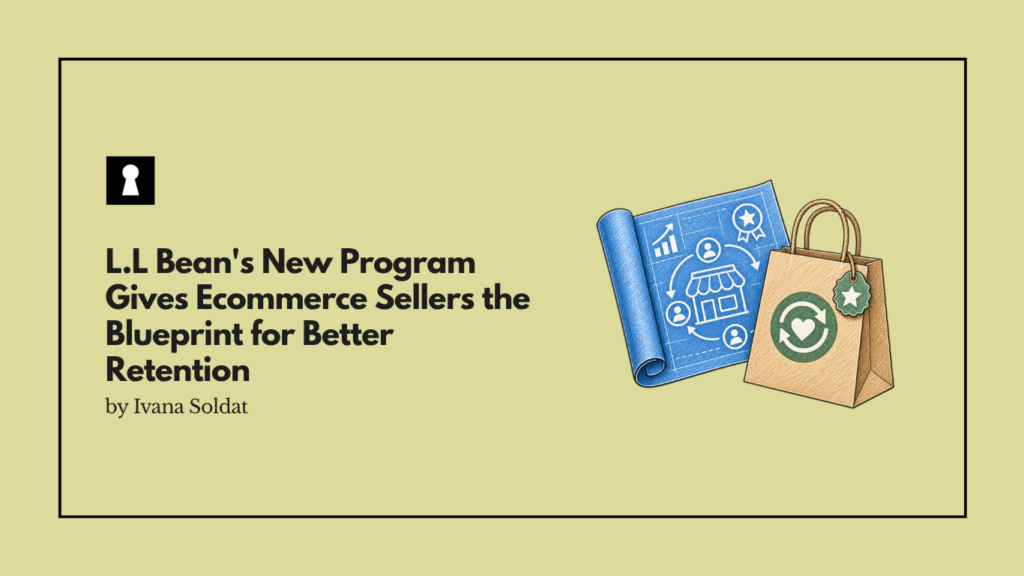
L.L. Bean has had loyal customers for more than a hundred years. It has had a branded credit card for decades. What it has not had, until this week, is a free standalone loyalty programme that any customer can join without a credit application. L.L. Bean Rewards launched on August 11 and brings the outdoor retailer into a loyalty landscape that virtually every other major outdoor brand has been playing in for years.
The standard mechanics are straightforward. Members earn one point for every dollar spent on qualifying purchases. One hundred and fifty points converts to five dollars in Bean Bucks. Free shipping is available on orders over fifty dollars. Members get ten percent off the retailer’s outdoor discovery programmes. None of that is distinctive.
The Part That Is Actually Interesting
What is different about L.L. Bean Rewards is the charitable voting mechanic. Members receive one vote per purchase on how the company directs $250,000 of its charitable investments across four partner organisations: the National Park Foundation, YMCA, Mental Health America, and the Appalachian Mountain Club.
This is not a donation matching programme. L.L. Bean is not inviting members to donate their points to charity. It is inviting members to direct the company’s own charitable spending through the act of purchasing. Every qualifying transaction generates both points and a vote. The more you buy, the more influence you have over where $250,000 goes.
“Shared values are inherent to loyalty,” an L.L. Bean spokesperson said. “Our customers share our longstanding commitment to the outdoors and to the communities we’re part of, so it felt natural to give them a voice in where our support goes. It reflects something we know about our customers: their connection to the outdoors is a lifestyle and extends beyond the products they buy.”
That statement is the loyalty programme strategy in one sentence. L.L. Bean is not trying to keep customers coming back with cash rewards alone. It is trying to create a loyalty relationship built on shared identity and shared values. The programme makes the act of shopping feel like an extension of a value system rather than a transactional exchange.
The Timing Is Not Accidental
This week, Shopify’s CEO lost customers over his publicly expressed political values. Consumers demonstrated that they pay attention to the values expressed by the brands and platforms they use, and that misalignment between those values and their own is a reason to reconsider the commercial relationship.
L.L. Bean is doing something adjacent but opposite. Rather than waiting for a controversy that forces customers to evaluate brand values, it is building values into the loyalty programme itself, making them visible and participatory from the moment of sign-up. The four charitable partners are not random: the National Park Foundation and the Appalachian Mountain Club connect directly to the outdoor identity that L.L. Bean’s customer base shares.
Mental Health America and the YMCA connect to community wellbeing in ways that resonate with customers who see outdoor activity as part of a broader healthy lifestyle philosophy.
The Outdoor Retail Loyalty Landscape and Where L.L. Bean Sits
L.L. Bean entering the loyalty market in 2026 is genuinely late relative to competitors. REI has run its Co-op membership model since its founding. Patagonia’s repair and resale programmes have become loyalty mechanics in their own right. Columbia and The North Face both run tiered points systems with meaningful earn rates.
What L.L. Bean has that some competitors lack is a century-old brand with genuine emotional resonance. The loyalty programme is an attempt to formalise that emotional relationship into a commercial structure without making it feel merely commercial.
The charitable vote is the differentiator. How much it matters commercially depends on how much L.L. Bean’s specific customer base cares about participating in that kind of decision. The Bean Bucks earn rate at 3.3 percent return is competitive but not exceptional. The free shipping threshold at $50 is lower than most competitors, which is a genuine convenience for customers who make regular smaller purchases.
Our Take
L.L. Bean Took a Hundred Years to Launch a Loyalty Programme. The Part Worth Waiting For Is the $250,000.
L.L. Bean Rewards is a well-constructed loyalty programme that is notably late to a competitive market and notable primarily for the charitable voting mechanic that distinguishes it from every standard points accumulation programme in the category.
The mechanic is a bet that L.L. Bean’s customers are motivated by values participation as much as financial reward. In a week when the consequences of visible CEO politics have been playing out at Shopify, L.L. Bean’s approach of embedding values into the programme structure rather than expressing them through executive social media posts looks like a more durable and more commercially sensible way to build a values-aligned customer relationship.
Whether it is compelling enough to change purchase behaviour is the question the next twelve months will answer.