
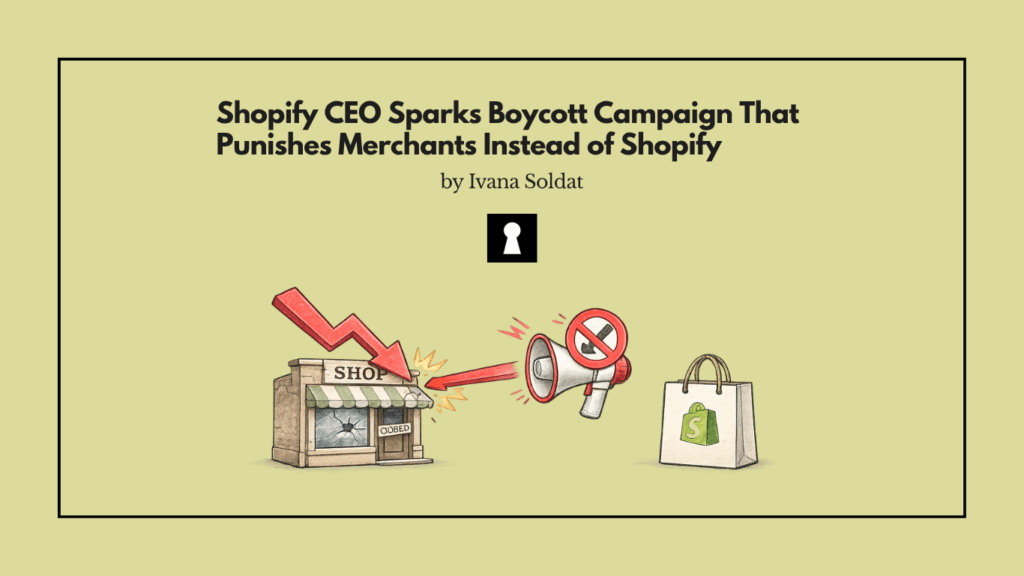
Tobi Lütke’s comments are now someone else’s problem. Specifically, the hundreds of thousands of small and independent businesses that run their stores on Shopify and have nothing to do with their CEO’s political views on voting rights.
A post circulating in the Twin Cities Geeks Facebook group, which has spread to other communities, instructs people to open the Shop app, pull up their entire purchase history, and contact every business they have ever ordered from with a specific message: “Please contact Shopify and demand that they immediately fire their fascist CEO and also share your demand publicly. I will not be patronizing your business while you support this anti-democratic monster. I will make sure everyone I know does not shop at your business either.”
The campaign is not asking consumers to stop buying from Shopify. But it is asking them to threaten independent businesses with a boycott unless those businesses publicly take a political position on behalf of someone they have never met, have no control over, and cannot fire.
What Lütke Actually Said
The comments that triggered the campaign came from X posts Lütke made on the weekend of July 25. He endorsed a proposal for voting power to be proportional to income tax payments, ranging from zero votes for non-taxpayers to five votes for those paying $500,000 or more annually.
He also argued that retirees receiving pensions should lose their voting rights entirely, comparing them to legal dependents. In a separate post, he referred to politically engaged Toronto residents as “retired, unemployed, unemployable, and useful idiots.”
The posts spread rapidly. By Monday they had been covered by CBC, Fortune, CTV, Gizmodo, and dozens of other outlets. Lütke has not apologised and has not deleted the posts. Shopify board member David Heinemeier Hansson publicly defended him, and Elon Musk called Lütke a “national treasure.”
The Small Business Problem Nobody Is Talking About
The campaign’s targeting logic is the part that deserves scrutiny. The Shop app is Shopify’s consumer-facing shopping tool, and the businesses that appear in a customer’s order history there are predominantly small and independent operators. Many of them chose Shopify years ago because it was the best available platform for their size and budget. They are not in a position to fire Tobi Lütke. They are barely in a position to switch platforms.
One comment thread from the original Facebook post captures the tension clearly: “If you are going to boycott them for being on Shopify, that is still a problem. Moving a small company would take months. And they would still have to pay Shopify their fees.”
Another commenter noted that small business owners “are locked in a system where they have to be dependent on these platforms.” The switching cost argument is real: migrating a Shopify store to a different platform involves rebuilding product listings, reconnecting payment processors, redirecting domain settings, retaining customer email lists, rebuilding SEO, and potentially losing the transaction history and integrations that a store has built over years of operation.
One commenter in the thread said they had already moved away from Shopify. Another said they were a developer who had spent the better part of a year building a tool for Shopify stores and was now reconsidering. The thread has 23 comments and counting.
This Is Not the First Time Shopify Has Been Here
In 2017, Lütke faced backlash over Shopify hosting a store for Breitbart News. His defence at the time: “Products are speech, and we are pro-free speech.” The company eventually removed the store after sustained pressure.
The Breitbart precedent is relevant for two reasons. First, Shopify’s platform survived it without measurable merchant migration. Second, that controversy was about what Shopify chose to host. This one is about what its CEO chose to say. The company has less control over the second category and less obvious recourse for responding to it.
The Numbers Behind the Anger
The weighted voting proposal Lütke endorsed would affect the 40% of American households that pay no federal income tax, roughly 76 million people in 2025. Under the proposed system, they would receive zero votes. The proposal would invert the founding American principle of “no taxation without representation” into something closer to “no representation without taxation”, and specifically, high taxation.
The irony not lost on commenters: Shopify’s own corporate structure already operates on a tiered voting principle. Lütke controls 40% of Shopify’s voting power through a Founder Share structure approved by shareholders in 2022, which guarantees his voting power regardless of how much equity he actually owns.
Our Take
The CEO Said Something, and The Merchants Are Paying for It
The boycott campaign targeting Shopify merchants is a misdirected expression of a legitimate grievance. Lütke’s comments were genuinely alarming to a large number of people, and the frustration driving the campaign is real.
But a small business owner who sells handmade goods on Shopify is not responsible for their platform CEO’s views on plutocratic voting systems, and threatening to ruin their business unless they publicly demand someone else’s firing is not a proportionate or fair response.
The people who have actual power to hold Lütke accountable are Shopify’s board, its institutional shareholders, and its largest enterprise clients, none of whom appear in anyone’s Shop app order history. The small businesses do. That is not a coincidence of the campaign’s design. It is a flaw in it.