Alexa for Shopping launched on May 13, 2026, replacing Rufus as the primary AI interface inside the Amazon.com search bar and mobile app. The new assistant is free to all US Amazon customers. It lives in the main search bar, the Amazon Shopping app, amazon.com, and Echo Show displays.
Rufus lived in a separate side panel. Alexa for Shopping occupies the main search bar, the highest-traffic surface on one of the world’s highest-traffic retail sites. Every product search is now an invitation to have a conversation with the AI rather than filter through a results list.
The Full Feature Stack
The “Update Me When” feature launched today is the proactive discovery layer. The rest of the Alexa for Shopping stack handles what happens after discovery:
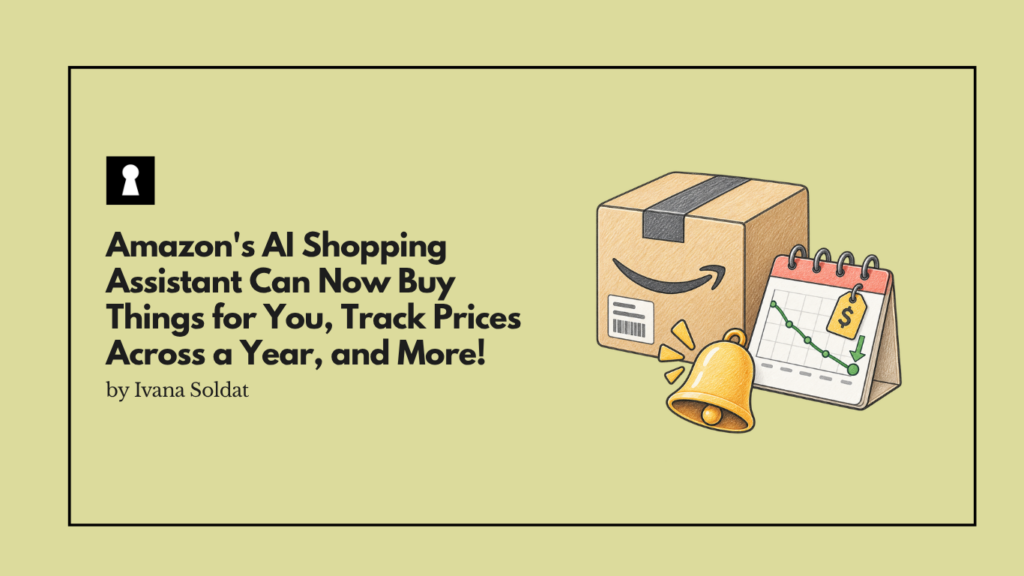
Price tracking and alerts. More than 50 million customers have checked price history since the feature launched in 2024. Amazon stretched its price tracker out to a full 365 days of history on June 30, 2026. A shopper can see exactly what a product has cost over the past year, ask Alexa to set an alert when it reaches a target price, and subscribe to deal alerts on specific categories: “Alert me to deals on noise-canceling headphones.”
Auto-Buy. Tell Alexa for Shopping “Buy these headphones when they’re $75 or less” and it will automatically complete the purchase using your default payment method when the price drops, no need to keep checking back. Users can also set multi-condition rules: “Add this sunscreen to my cart if the price drops to $10 and I haven’t purchased it in the last 2 months.”
Scheduled Actions. Recurring purchases for household staples — pet food, paper towels, vitamins — can be scheduled so the AI orders them before they run out, using purchase history to estimate the timing.
Buy for Me. The agentic Buy for Me feature completes purchases on third-party sites on the user’s behalf. Amazon’s AI can browse to a product on a site that is not Amazon, navigate the checkout flow, and complete the purchase.
Personalized deals guides. Alexa for Shopping builds personalised deals guides based on shopping history and preferences, delivering curated promotions rather than a generic deals page.
Product comparison. The assistant compares items side-by-side, summarises reviews, and answers specific product questions by pulling from listings, reviews, Q&A, and external sources.
Update Me When. Today’s new feature: proactive notifications when events occur that might trigger a purchase.
What “Update Me When” Actually Represents
Each feature in the Alexa for Shopping stack represents a different point in the purchase funnel where Amazon is inserting AI.
Price tracking and Auto-Buy are bottom-of-funnel: the consumer has decided what they want and is waiting for the right price. Deals guides and category alerts are mid-funnel: the consumer knows their interest category and is looking for specific opportunities. “Update Me When” is top-of-funnel: the consumer has not yet decided to buy anything. They have expressed a preference and the AI monitors for events in that domain that could create a purchase occasion.
Historically, Alexa answered product questions when shoppers asked directly. Now it can help anticipate when something might prompt a user to make a purchase, before the shopper even thinks to ask.
The trajectory is clear. Amazon is building a system that operates across the entire purchase lifecycle, generating awareness of purchase occasions, monitoring for optimal purchase timing, and executing purchases when conditions are met. The consumer’s active role in each of those steps is being progressively reduced.
The FTC Context That Makes Today Significant
Yesterday, the FTC and 22 states filed suit against Amazon alleging that for more than seven years, it secretly inflated prices in its advertising auctions using a hidden surcharge and an “invented auction participant” to extract tens of billions of dollars from more than a million advertisers.
Today, Amazon launched a feature designed to proactively notify consumers of events that might tempt them to make a purchase on Amazon.
Both stories are about the same underlying ambition: extracting maximum commercial value from the customer relationship. The advertising lawsuit alleges Amazon extracted that value from sellers deceptively. The Alexa for Shopping suite is extracting it from consumers transparently — by making it genuinely convenient and useful to let Amazon’s AI manage an increasing share of the purchase decision process.
The consumer who enables “Update Me When” for their favourite brand is inviting Amazon to become the intermediary between that brand and their own attention. When the brand launches a new product line, Amazon’s notification arrives before the brand’s own email, before their own social post, before their own advertising. Amazon is inserting itself into the discovery moment.
What This Means for Brands and Sellers
The opportunity: a brand whose products are well-listed in Amazon’s catalog, with complete attributes, strong reviews, and accurate pricing history, is positioned to surface in Alexa for Shopping’s recommendations, price alerts, deals guides, and “Update Me When” notifications.
The AI Commerce Rankings data we covered this month from ReFiBuy showed that clean, structured, AI-readable product data is the primary driver of AI-driven discovery. Amazon’s own AI shopping assistant follows the same logic.
The structural dependency, a consumer who has configured Alexa for Shopping to manage their purchase decisions across price tracking, auto-buy, and proactive notifications is a consumer whose purchasing behaviour is being channelled through Amazon’s systems. The brand’s own direct marketing, email newsletters, social media, DTC website traffic, is competing with an AI system that lives in the consumer’s primary shopping interface and that has a year of their purchase history.
The Auto-Buy Feature Is the Most Important One Nobody Is Discussing
The feature that receives the least coverage relative to its commercial significance is Auto-Buy. A consumer who has set an Auto-Buy rule for a product has made a purchase decision in advance. They have effectively pre-committed to the purchase at the stated price point. The conversion rate on a condition that has been met is, by definition, 100%.
For ecommerce brands outside Amazon’s marketplace, Buy for Me is the equivalent threat: Amazon’s AI can navigate to a competitor’s site, complete a checkout flow, and make a purchase on the consumer’s behalf. The consumer does not have to engage with the brand’s own UX, their own promotional messaging, or their own checkout optimisation. The AI handles it. Amazon is positioning itself as the consumer’s default commerce interface regardless of which retailer is actually selling the product.
Our Take
Amazon Is Building the Infrastructure to Be the Default Intermediary in Every Consumer Purchase Decision
Amazon launched Alexa for Shopping in May 2026, and today’s “Update Me When” feature is the latest addition to what is becoming one of the most commercially significant AI systems in retail. The full feature stack describes a system that is progressively inserting Amazon into every stage of the purchase decision lifecycle.
The optimisation priority is the same as for AI search more broadly: complete, accurate, AI-readable product data is the asset that makes a product discoverable and purchasable through this system. For brands selling outside Amazon, Buy for Me is the feature to watch most carefully as it gives Amazon’s AI the ability to execute purchases on any ecommerce site, which means Amazon is positioning itself as the consumer’s default commerce interface regardless of which retailer is selling the product.
The consumer who hands Amazon’s AI the keys to their entire purchase decision process is not just an Amazon shopper. They are an Amazon shopper who no longer needs to go anywhere else.