
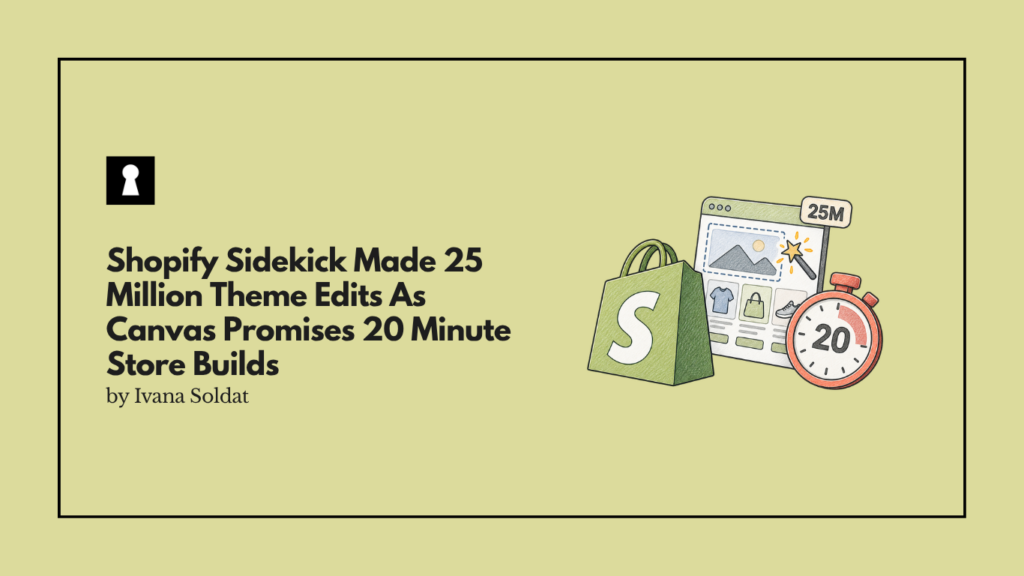
Shopify announced the rollout of Canvas, a new design surface that integrates deeply with Sidekick, the company’s artificial intelligence agent.
The Promise Of 20 Minute Bespoke Stores Is A Double Edged Sword
Ben Sehl, Director of Product at Shopify and co-founder of Kotn, stated that building a rough store used to take two weeks even with coding knowledge. He claims that today, an entrepreneur on Shopify can build a fully custom store in twenty minutes that surpasses those early efforts.
This dramatic reduction in development time is undeniably appealing to resource constrained founders.
However, compressing a two week development cycle into twenty minutes suggests a heavy reliance on pre existing patterns rather than genuine architectural innovation. True bespoke design requires iterative refinement that an AI agent rushing to completion may simply bypass.
Visual Workspaces Mask The Reality Of Algorithmic Homogenization
Canvas transforms the entire online store into a collaborative workspace where merchants can pan across pages and zoom into details. Merchants can preview each page with full interactivity and animation while Sidekick makes real time code changes.
Austin Knight, design director at Shopify, noted that guiding the AI to make good design decisions required significant time and attention to curated patterns and opinionated evaluation data.
While this ensures tasteful outputs, it also means every custom store is ultimately assembled from the same finite pool of algorithmic preferences. The visual workspace gives merchants the illusion of total control while the underlying logic remains strictly bounded by proprietary design contracts.
Sidekick Is A Coding Agent Designed To Lock Merchants Into The Ecosystem
Sidekick has been writing code for some time, but Canvas elevates it from a simple assistant to a comprehensive store builder. The agent navigates all templates and files that make up a theme, making coordinated changes across them to produce high quality custom theme code.
This deep integration means the resulting store is inextricably tied to the platform’s proprietary theme architecture. Merchants who rely on this AI to build their foundational code will find it exceptionally difficult to migrate to competing platforms in the future. The convenience of AI generated code comes at the cost of long term vendor lock in.
The Democratization Of Design Threatens True Brand Differentiation
For most of the platform’s history, a bespoke store required writing code, hiring a developer, or navigating unwieldy settings panels. Canvas aims to unlock latent creativity by removing these barriers to entry.
Yet, when every merchant has access to the same AI design partner, the definition of a unique brand identity becomes blurred. If an algorithm can generate a distinct vision for thousands of stores simultaneously, distinctiveness ceases to be a competitive advantage.
Brands must now compete on factors beyond their storefront aesthetics, such as supply chain efficiency or community building, to stand out in an increasingly uniform digital landscape.
Our Take
Algorithmic Convenience is Rapidly Replacing Authentic Brand Expression as the Default Standard for Online Retail
Shopify Canvas is a brilliant engineering feat that fundamentally misunderstands what makes a brand valuable. By reducing store creation to a twenty minute AI prompt, the platform is not democratizing design. It is commoditizing it.
Merchants who celebrate this frictionless experience are unknowingly surrendering their visual identity to a centralized algorithm trained on aggregate data.
If your store can be built in twenty minutes by an AI, your competitors can clone it in twenty seconds.