
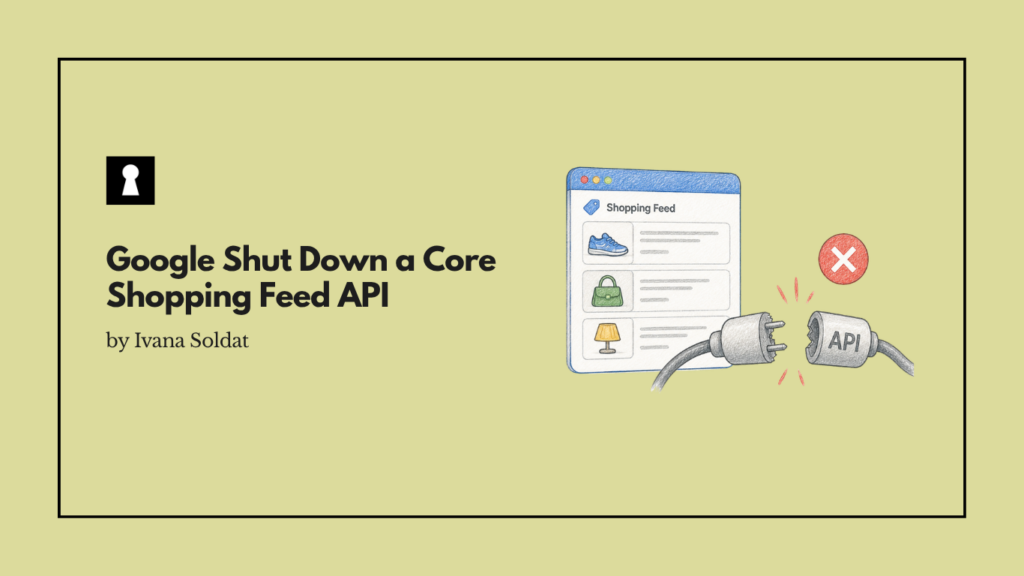
Google announced this shutdown a year in advance. The Merchant Center documentation stated it plainly: access to the Content API for Shopping would be provided until August 18, 2026, after which it would be shut down. Merchant API version 1 is the replacement, generally available and documented. This is not a surprise to anyone who was paying attention.
The problem is that “paying attention” in this context means actively monitoring Google developer communications and Merchant Center release notes, which most ecommerce operators, agency clients, and small retailers do not do.
The Content API for Shopping was the underlying infrastructure that many product feed integrations, third-party apps, and custom Google Shopping connections were built on. Yesterday, it stopped working for any integration that had not migrated.
The 30-Day Silent Fuse
This is the detail that changes what you need to do today. Google’s Merchant Center rules state that products expire 30 days after their last successful refresh. A broken feed does not immediately remove your Shopping listings. It stops refreshing them. The listings keep serving until the expiry clock runs out.
A store whose integration stopped working on August 18 will show live Shopping and Performance Max inventory throughout the rest of August and into mid-September. The listings will begin dropping out somewhere around September 17. During that entire window, Merchant Center will show active products and everything will appear to be working normally.
That means if you log into Merchant Center today, see active products, and conclude that your migration was handled correctly, you have confirmed nothing. The correct thing to check is the last updated timestamp on your data source, not the product status. If that timestamp shows August 18 or earlier, your integration is dead and you are inside a 30-day fuse with your Shopping traffic.
Who Is Actually Affected
The exposure is counterintuitive. The integrations that are broken are the more sophisticated ones, not the simplest ones.
Manual file uploads are unaffected. Scheduled URL fetches are unaffected. Google Sheets data sources are unaffected. The Content API shutdown applies specifically to API-based integrations, custom connections, older third-party apps, and mid-market setups that were programmatically pushing product data to Merchant Center.
In practical terms: the small store on a basic Shopify plan using a Google Sheets feed is probably fine. The mid-market operation that had a developer build a custom feed integration two years ago is probably broken. The agency client whose integration uses a third-party feed management tool that has not pushed a Merchant API update is probably broken.
Google opened an extended access request form for integrations that could not finish migration in time, with selectable extension deadlines of October 15, 2026 and December 31, 2026. If your integration is broken and you need time to migrate properly, that form is worth investigating immediately.
The Shopify-Specific Risk
For stores using the official Shopify Google and YouTube channel app, Google handled the migration at the platform level, provided the app is on a recent version. The risk worth knowing: practitioners reported earlier in 2026 that migrating the app by uninstalling and reinstalling rewrote product IDs in a way that detaches historical performance data.
If you are on the Shopify channel and planning to update or reinstall the app, take a Shopping performance snapshot before touching it on any store where historical data matters.
Product Schema as a Buffer
A store with clean, complete product schema markup degrades more slowly when its feed dies, because Google can re-validate some items from the page itself. A store without product schema falls off completely at the 30-day mark.
Two stores with the identical broken integration will produce very different mid-September revenue results based on whether their product pages have structured data or not.
What to Check Right Now
Open every Merchant Center account you manage.
Do not look at the product count or the product status.
Look at the last updated timestamp on each data source. If any data source shows a timestamp of August 18 or earlier, that integration is broken and you have approximately 30 days before listings start disappearing.
Our Take
Your Shopping Ads Look Fine. They Will Not in 30 Days.
The Google Content API shutdown is a well-documented, year-in-advance migration with a clear replacement. The operators who followed Google’s developer communications and migrated on time are fine.
The operators who did not are currently in a 30-day window where nothing looks wrong and everything is broken. The specific danger is the false confidence the current Merchant Center dashboard creates, active product counts and healthy status indicators that reflect 30-day-old data, not yesterday’s feed failure.
September 17 is when the first wave of Shopping listing disappearances will start for stores whose integrations broke on August 18. The brands that catch this in the next two weeks can fix it before it affects revenue. The brands that catch it in mid-September will be troubleshooting a revenue drop while simultaneously trying to understand why their Shopping campaigns suddenly stopped working.